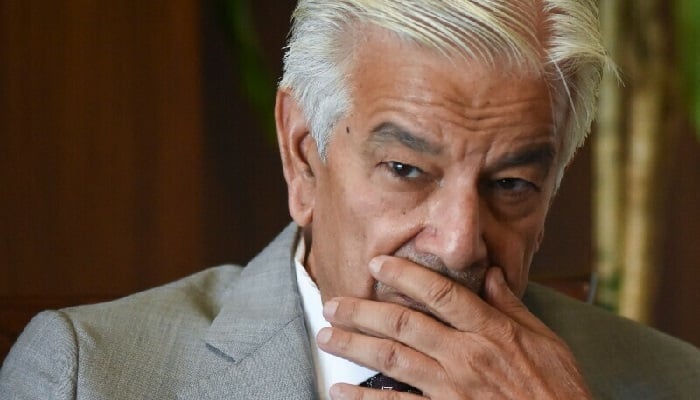
Pakistan’s Defence Minister Khawaja Asif on Sunday issued a sharp warning to India in response to recent statements from New Delhi’s top military and political leadership, declaring that any aggression would result in India being “buried under the wreckage of its warplanes, Inshallah.”
In a post on X (formerly Twitter), Asif described the latest remarks from Indian officials as “desperate attempts” to reclaim lost credibility following their “decisive 6–0 defeat” earlier this year, a reference to Pakistan’s aerial dominance during May’s conflict.
بھارتی فوجی اور سیاسی قیادت کے بیانات اپنی خاک میں ملی ساکھ کو بحال کرنے کی ناکام کوشش ھے۔ اتنی فیصلہ کن شکست کے بعد جس کا سکور 0-6 رہا ھو اگر دوبارہ کوشش کی تو سکور انشاءاللہ پہلے سے کہیں بہتر ھوگا۔ جسطرح بھارت میں عوامی رائے تاریخ کی بد ترین شکست کے بعد حکومت کے خلاف ھوئ اور…
— Khawaja M. Asif (@KhawajaMAsif) October 4, 2025
“After such a decisive 6–0 defeat, if they try again, the score will only get better,” Asif said, adding that the Indian leadership was speaking under domestic pressure as “public opinion has turned sharply against the ruling party.” Reaffirming Pakistan’s resolve, the minister said, “Pakistan is a state built in the name of Allah; our defenders are soldiers of Allah. This time, India will be buried under the wreckage of its planes. Allahu Akbar.”
Military Responds to India’s ‘War Hysteria’
Earlier, the military’s media wing — the Inter-Services Public Relations (ISPR) — had also condemned what it called “provocative and jingoistic” statements by Indian officials, warning that such rhetoric could lead to “cataclysmic devastation” in South Asia. “These remarks appear to be a renewed attempt to manufacture arbitrary pretexts for aggression, which would have serious consequences for regional peace and stability,” the ISPR said in a statement.
The military added that Pakistan “shall not hold back” and would respond “swiftly, decisively, and destructively” to any act of hostility, warning that those seeking to establish a “new normal” should remember that Pakistan has “set its own new normal of response.” On Indian rhetoric about “erasing Pakistan from the map,” the ISPR remarked, “India must know that if the situation comes, the erasure will be mutual.”
Read More: Pakistan Engages Diplomatically for Safe Repatriation of Citizens Detained by Israeli Forces
Indian Claims Dismissed as Baseless
The remarks from Islamabad came after Indian Air Force Chief Amar Preet Singh claimed that India had shot down five Pakistani fighter jets — F-16s and JF-17s — during the May clashes. “As far as the air defence part is concerned, we have evidence of one long-range strike… along with that five fighters between F-16 and JF-17 class,” Singh said during the Indian Air Force’s annual day press conference, though he provided no evidence to support his claims.
Pakistan’s military dismissed the statement as “fabricated propaganda,” saying India’s attempts to distort the facts only revealed its “frustration and internal political compulsions.” “India has long portrayed itself as a victim while stoking violence and perpetrating terrorism in South Asia and beyond,” the ISPR added, noting that the global community now recognises India as “the true face of cross-border terrorism and the epicentre of regional instability.”
Background: The May Confrontation
The latest exchange of words follows the May conflict, the most intense fighting between the two nuclear-armed neighbours in decades. The skirmish was triggered by an attack on tourists in Indian Illegally Occupied Jammu and Kashmir’s (IIOJK) Pahalgam area, which New Delhi blamed on Pakistan. Islamabad strongly denied any involvement in the attack, which killed 26 people — the deadliest assault on Indian civilians since the 2008 Mumbai attacks.
Following the incident, Indian forces launched a series of unprovoked air and artillery strikes on Pakistani territory, to which Pakistan responded with Operation Bunyan-um-Marsoos, downing six Indian Air Force (IAF) jets, including three Rafales, and dozens of drones. The fighting lasted for more than 87 hours before a U.S.-brokered ceasefire took effect on May 10, halting hostilities and bringing the region back from the brink of a wider war.
Analysts Urge Caution
Security analysts in Islamabad said the latest Indian rhetoric reflected “internal political desperation” rather than actual military intent, as New Delhi’s leadership faces criticism over its handling of both the economy and border tensions. “India’s bluster is largely for domestic optics,” one senior defence official said. “But Pakistan’s response is clear — we will not be the first to escalate, but any misadventure will be met with absolute force.”