• Skip to primary navigation
  • Skip to main content
  • Skip to primary sidebar
  • Skip to footer
Trending:
  • Kashmir
  • Elections
Saturday, June 6, 2026

Daily Times

Your right to know

  • HOME
  • Latest
  • Iran-Israel war
  • Gilgit Baltistan Election
  • Pakistan
    • Balochistan
    • Gilgit Baltistan
    • Khyber Pakhtunkhwa
    • Punjab
    • Sindh
  • World
  • Editorials & Opinions
    • Editorials
    • Op-Eds
    • Commentary / Insight
    • Perspectives
    • Cartoons
    • Letters to the Editor
    • Featured
    • Blogs
      • Pakistan
      • World
      • Lifestyle
      • Culture
      • Sports
  • Business
  • Sports
  • E-PAPER
    • Lahore
    • Islamabad
    • Karachi

Pakistan’s Solar Revolution Deepens Punjab’s Thirst

Published on: October 5, 2025 11:58 AM

Solar-powered farming is digging Pakistan into a water catastrophe

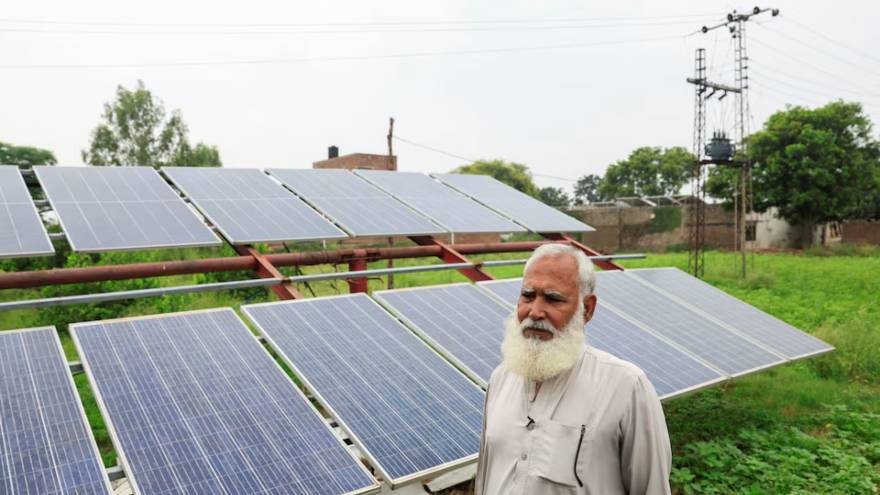
MURIDKE, Punjab — Under the blinding sun of central Punjab, rice farmer Karamat Ali stands beside a gleaming row of solar panels that have replaced the dozen cows he once relied on for milk and livelihood.

“I sold my animals for this,” he says, pointing toward the panels that now power his tube well. “Water supply to my paddy field is smoother than before.”

Ali is one of thousands of farmers across Pakistan turning to solar-powered tube wells to escape erratic electricity and costly diesel. But as the solar boom spreads, so too does a silent crisis beneath the soil: Punjab’s groundwater is vanishing at alarming rates.

A Bright Revolution with a Dark Underside

The shift toward solar irrigation marks one of the most dramatic transformations in Pakistan’s agriculture in decades. Encouraged by rising power tariffs and falling solar prices, farmers have rapidly adopted photovoltaic systems to fuel their water pumps.

According to estimates by energy economist Ammar Habib, roughly 650,000 solar tube wells are now operating across Pakistan — 400,000 converted from grid electricity and another 250,000 newly installed since 2023.

Yet, as farmers gain the freedom to pump water anytime, groundwater levels are plummeting. Confidential Punjab water authority documents viewed by Reuters show that the water table has sunk below 60 feet in 6.6% of the province’s area — a 25% increase since 2020. In some regions, wells now run deeper than 80 feet.

Read More:  Poland Scrambles Jets as Russia Launches Airstrikes Near Ukrainian Border; Lviv Hit, Power Outages Reported

Water Without Limits

For many growers, solar energy means liberation from dependency on unreliable grid supply. But it also means pumping without restraint.

Farmers interviewed across Punjab say they now irrigate their rice paddies several times a day through a method called pulse irrigation — a luxury they couldn’t afford under diesel costs. U.S. Department of Agriculture data show that rice cultivation expanded 30% between 2023 and 2025, while less water-intensive maize acreage fell by 10%.

“Solar panels should be installed at all costs,” says 38-year-old farmer Rai Abdul Ghafoor, who is saving up for his own system. “They save time, money, and worry.”

The affordability of solar power has even led rural communities to pool resources. “Farmers share, rent, and move panels like tractors,” says solar merchant Shahab Qureshi. “Within months, the panels pay for themselves.”

Officials Divided Over the Water Fallout

Federal power minister Awais Leghari rejects the notion that solar irrigation is draining Punjab’s aquifers, arguing that farmers are “replacing expensive diesel with solar” and not expanding farmland.

But Punjab’s irrigation minister Muhammad Kazim Pirzada admits the tradeoff is real: “Solarization is good for the environment because it’s clean energy,” he says. “But at the same time, it is also impacting our water table.”

The province has launched aquifer-recharge projects at 40 sites to slow depletion and revive traditional water infrastructure, including the colonial-era Ravi Siphon. Still, experts warn that these efforts are piecemeal compared to the pace of extraction.

An Unregulated Rush

Pakistan’s solar transition mirrors a global trend driven by the 80% drop in solar panel prices since 2017, largely due to Chinese production. Yet the country lacks regulation for groundwater use or real-time monitoring of tube wells.

Independent environmental scientist Imran Saqib Khalid cautions that “the solar push lacks any method to the madness.” Without governance reforms, he says, Pakistan risks an agricultural imbalance: “In the long run, this will affect the kinds of crops we can grow — and our food security.”

The Rising Cost of Free Energy

Back in Muridke, farmer Mohammad Naseem proudly guards his solar panels, dismantling them each night to prevent theft. The panels have saved him 2 million rupees in energy costs since 2021 and improved his rice yields.

Yet, as Punjab’s aquifers retreat deeper underground, the benefits of solarization may prove temporary. The sun may be free — but the water it draws is not infinite.

Filed Under: Pakistan Tagged With: agriculture energy shift Pakistan, clean energy farming, groundwater depletion, Pakistan agriculture, Pakistan solar energy boom, Pakistan solar irrigation, Pakistani farmers solar panels, Pakistan’s Solar Revolution Deepens Punjab’s Thirst, Punjab groundwater levels, Punjab irrigation system, Punjab water crisis, renewable energy Pakistan, rice farming Pakistan, solar farming Pakistan, solar panels Pakistan, solar power for irrigation, solar revolution Pakistan, solar tube wells, sustainable agriculture Pakistan, water scarcity Pakistan, water table decline Punjab

Submit a Comment


Primary Sidebar


Latest News

Alexander Zverev eases past Jakub Mensik in French Open semifinals

Taylor to face Pili in Croke Park farewell

FIFA bans vuvuzelas from World Cup stadiums

France brush off Ivory Coast loss, call it timely World Cup reminder

Legendary boxer Muhammad Ali’s 10th death anniversary observed

Pakistan

JAAC declared proscribed party ahead of AJK polls on July 27

Fixed tax scheme for small retailers launched to raise Rs 50bn annually

Govt cuts petrol price by Rs 4 per litre, keeps diesel’s unchanged

Bilawal promises GB voters with land and job rights

Iran declares support for Hezbollah with wider peace deal in doubt

More Posts from this Category

Business

SBP’s ‘Go Cashless’ campaign saw Rs 34bn in digital transactions on Eid

Short-term inflation down by 0.56%

Saudi-Pak Business Council shows interest in infrastructure investment

‘Govt, allies united in efforts to craft people-centric budget’

Rupee records gain against US dollar

More Posts from this Category

World

CENTCOM space post signals wider US military footprint

US official delivers Trump’s “good hello” to Putin

NASA lifts ISS evacuation alert after leak

More Posts from this Category


Footer

Home
Lead Stories
Latest News
Editor’s Picks

Culture
Life & Style
Featured
Videos

Editorials
OP-EDS
Commentary
Advertise

Cartoons
Letters
Blogs
Privacy Policy

Contact
Company’s Financials
Investor Information
Terms & Conditions

Facebook
Twitter
Instagram
Youtube

© 2026 Daily Times. All rights reserved.

Manage Consent
To provide the best experiences, we use technologies like cookies to store and/or access device information. Consenting to these technologies will allow us to process data such as browsing behavior or unique IDs on this site. Not consenting or withdrawing consent, may adversely affect certain features and functions.
Functional Always active
The technical storage or access is strictly necessary for the legitimate purpose of enabling the use of a specific service explicitly requested by the subscriber or user, or for the sole purpose of carrying out the transmission of a communication over an electronic communications network.
Preferences
The technical storage or access is necessary for the legitimate purpose of storing preferences that are not requested by the subscriber or user.
Statistics
The technical storage or access that is used exclusively for statistical purposes. The technical storage or access that is used exclusively for anonymous statistical purposes. Without a subpoena, voluntary compliance on the part of your Internet Service Provider, or additional records from a third party, information stored or retrieved for this purpose alone cannot usually be used to identify you.
Marketing
The technical storage or access is required to create user profiles to send advertising, or to track the user on a website or across several websites for similar marketing purposes.
  • Manage options
  • Manage services
  • Manage {vendor_count} vendors
  • Read more about these purposes
View preferences
  • {title}
  • {title}
  • {title}
We use cookies to ensure that we give you the best experience on our website. If you continue to use this site we will assume that you are happy with it.