
• Skip to primary navigation
  • Skip to main content
  • Skip to primary sidebar
  • Skip to footer
Trending:
  • Kashmir
  • Elections
Sunday, June 7, 2026

Daily Times

Your right to know

  • HOME
  • Latest
  • Iran-Israel war
  • Gilgit Baltistan Election
  • Pakistan
    • Balochistan
    • Gilgit Baltistan
    • Khyber Pakhtunkhwa
    • Punjab
    • Sindh
  • World
  • Editorials & Opinions
    • Editorials
    • Op-Eds
    • Commentary / Insight
    • Perspectives
    • Cartoons
    • Letters to the Editor
    • Featured
    • Blogs
      • Pakistan
      • World
      • Lifestyle
      • Culture
      • Sports
  • Business
  • Sports
  • E-PAPER
    • Lahore
    • Islamabad
    • Karachi
Yumna Ali

Yumna Ali

The writer is an International Knowledge Management and Communications Analyst at the UNDP HQ in New York. Previously, Yumna worked for UNDP China, UNDP Bureau of External Relations and Advocacy, UNDP Human Development Report Office and Innovations for Poverty Action. She has a Master’s in Public Administration from the University of Pittsburgh and a Bachelor’s in Economics and International Relations from Knox College. Any views or opinions expressed in the blog are the author’s and do not represent the views of any organization.

Where are ‘Pakistan’s 100 Most Powerful Women’ – Fighting for Gender Equality

Published on: May 24, 2021 3:40 PM

In 1998, Fortune magazine added another dimension to their much-anticipated yearly lists – a list of the world’s 100 most powerful women. This month, the US’s Fortune 500 announced yet another milestone – listing two black women as CEOs. All this in a country where many years after the women’s suffrage movement led to securing women’s right to vote in 1920. Fast forward to 2021 and the United States announces its first female Vice President. 


But what is the reality for half of Pakistan’s population today? In the most recent Global Gender Gap Report by the World Economic Forum, Pakistan is ranked among the four worst countries in the world (153rd out of 156), after Iraq, Yemen and Afghanistan, in terms of gender parity – a measure of true equality in society. 


However, as an empowered, Pakistani working woman based in my elitist household, I can dream of being that ‘powerful woman’ of the 21st century. I work where I want, I wear what I want, I say what I want, I go where I want, I decide what I want. I can argue with those that I disagree with, I can speak up when faced with harassment, I can say no – I have a voice therefore I can dream. 


But I do not represent 98 percent of the women in my country because the poor trends in economic participation and opportunity, educational attainment, health and survival, and political empowerment does not allow them to do so. 


Despite a wide array of national policies against harassment of women at the workplace, honor killings and rapes, and towards education, health, employment, and empowerment packages, enforcement of these laws and policies remain extremely weak and in most cases absent.


COVID has further exacerbated a situation that was already alarming. Pakistan is part of a host of countries that has gender gaps in managerial positions as large as 80% or more. Women make up only 5 percent of all managerial positions in Pakistan – a 95 percent gap in gender parity, leading also to stark differences in income between men and women with women earning 16 percent less than the average man. During COVID, ILO suggests 5 percent of already very few women employed have lost their jobs. With school closures and limited care facilities, women have also had extreme challenges in maintaining a work-life balance with a ‘double-shift of paid and unpaid work in a country where most of the burden of child-rearing is unfairly put on the woman.


To develop more inclusive policies to resolve the issues above, women must be represented on the drawing board, occupying key seats in the political arena – but they are not.  The gender gap in political empowerment remains the largest across all 156 countries covered by the index, with women representing only 26.1 percent of some 35,500 parliament seats and just 22.6 percent of over 3,400 ministers worldwide. Even in Pakistan where we can proudly claim we had a female Prime Minister before many other countries, there is a decline in the share of women ministers from 12 percent to 10.7 percent.


Let us learn from New Zealand – a country that leads in gender parity in politics with one of the highest women’s representations in parliament (almost 50 percent). It is also one of the first countries in the world where women won the right to vote and is now home to the youngest, female Prime Minister. From passing an Equal Pay Amendment Bill to ensuring paid leave after miscarriage to increasing the length of paid parental leave, fairer policies are made when you have a more representational government body.


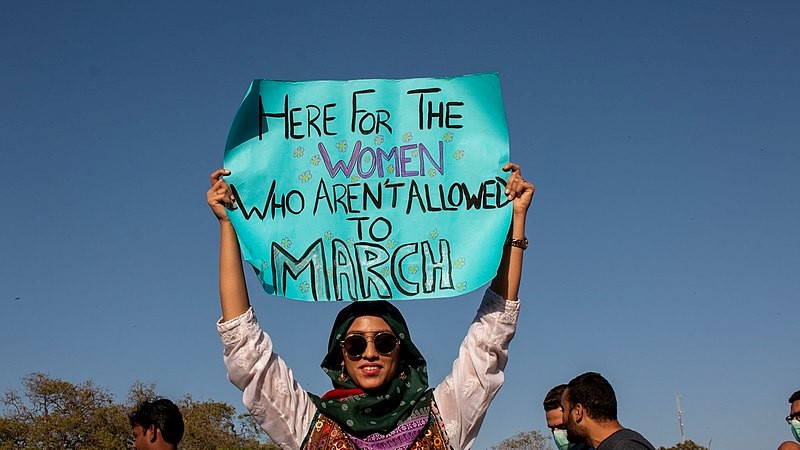
Beyond gaps in economic and political participation, Pakistani women score low in education, health, survival, and many more measures. It is no surprise then that these global rankings have led many women and men to march on the streets, raise their voices and ask for a detailed ‘Charter of Demands’ around exactly those rights that we staunchly need that is economic justice, education, healthcare, civil liberties, and political participation.


All of the following begs these questions – why were many so staunchly against the Aurat Azadi March but so quick to post on Instagram for Kashmir? We all raced to march for the recent Israel-Palestinian clashes but claimed marching doesn’t do anything when it’s for the rights of our women? Why are we quick to demand rights when it comes to speaking up against the ‘enemy’ but avoid fighting for mass gender rights at home? Have you ever looked at an all-man company board room and asked your CEO why that’s the case? 


Our progress as a country depends on the state of women’s rights and our collective effort to continue fighting the right fight, elevating attention on these issues and demanding concrete policies, many already there, to be enforced. All this to fulfill a dream where one day we wake up to frontpage news of our rankings: ‘Pakistan’s 100 most powerful women’.

Filed Under: Commentary / Insight Tagged With: Fortune magazine, Gender equality, Pakistan, Pakistan’s 100 Most Powerful Women

Submit a Comment


Primary Sidebar


Latest News

PFF president hails national men’s team for ending 64-year wait

Maryam Nawaz unveils major Lahore urban renewal project

UoR earns NTC thumbs-up, sets new benchmarks in technology education

US weighs Iranian assets plan as Gulf tensions rise

Punjab shifts to digital land ownership system from July

Pakistan

Maryam Nawaz unveils major Lahore urban renewal project

UoR earns NTC thumbs-up, sets new benchmarks in technology education

Punjab shifts to digital land ownership system from July

Bilawal calls urgent PPP meeting over AJK tensions

Punjab launches QR panic button system for transport safety upgrade

More Posts from this Category

Business

Pakistan savings rate hits 30-year low raising economic concerns

PSX new IPOs deliver 47% average return, boosting investor confidence

Pakistan signs MoU with Saudi, local firms to develop Karachi maritime business district

Gold prices witness sharp decline

Gul Ahmed venture QGDC announces $230m investment to set up Pakistan’s largest data centre

More Posts from this Category

World

US weighs Iranian assets plan as Gulf tensions rise

King Charles signals unity as royals gather at wedding

Pakistan tells un Kashmir dispute remains unresolved integral issue

More Posts from this Category


Footer

Home
Lead Stories
Latest News
Editor’s Picks

Culture
Life & Style
Featured
Videos

Editorials
OP-EDS
Commentary
Advertise

Cartoons
Letters
Blogs
Privacy Policy

Contact
Company’s Financials
Investor Information
Terms & Conditions

Facebook
Twitter
Instagram
Youtube

© 2026 Daily Times. All rights reserved.

Manage Consent
To provide the best experiences, we use technologies like cookies to store and/or access device information. Consenting to these technologies will allow us to process data such as browsing behavior or unique IDs on this site. Not consenting or withdrawing consent, may adversely affect certain features and functions.
Functional Always active
The technical storage or access is strictly necessary for the legitimate purpose of enabling the use of a specific service explicitly requested by the subscriber or user, or for the sole purpose of carrying out the transmission of a communication over an electronic communications network.
Preferences
The technical storage or access is necessary for the legitimate purpose of storing preferences that are not requested by the subscriber or user.
Statistics
The technical storage or access that is used exclusively for statistical purposes. The technical storage or access that is used exclusively for anonymous statistical purposes. Without a subpoena, voluntary compliance on the part of your Internet Service Provider, or additional records from a third party, information stored or retrieved for this purpose alone cannot usually be used to identify you.
Marketing
The technical storage or access is required to create user profiles to send advertising, or to track the user on a website or across several websites for similar marketing purposes.
  • Manage options
  • Manage services
  • Manage {vendor_count} vendors
  • Read more about these purposes
View preferences
  • {title}
  • {title}
  • {title}
We use cookies to ensure that we give you the best experience on our website. If you continue to use this site we will assume that you are happy with it.