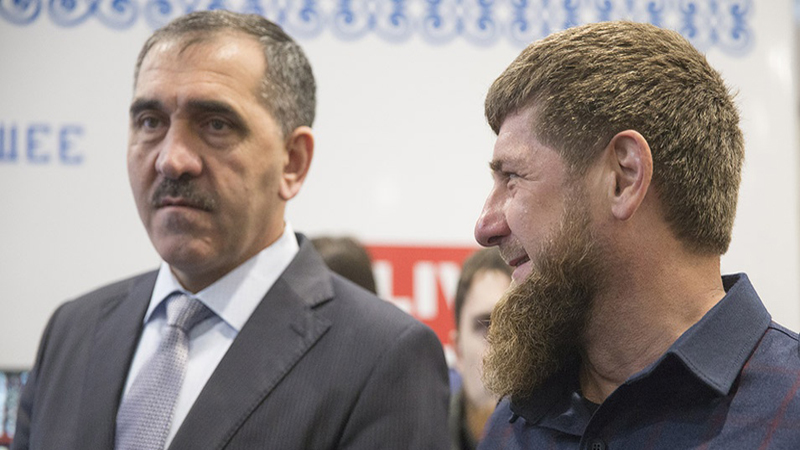
The past two months have seen a tumultuous set of developments in the North Caucasus. The region is well known for instability due to its long-running Islamist insurgency. But now it faces a fresh form of destabilization. Namely, the expansionist instincts of Chechnya’s Ramzan Kadyrov, by far in a way the region’s most powerful leader.
News broke on Sept. 26 that Kadyrov and Yunus-Bek Yevkurov, the leader of Ingushetia, Chechnya’s western neighbor, had signed a deal. The terms involved a transfer of up to 10% of Ingushetian territory to Chechnya. Unprecedented protests ensued in Magas, the Ingush capital. Tens of thousands took to the streets to denounce the deal and call for its overturn.
This is not where the story ends. Ingushetia is but one part of the saga in Kadyrov’s latest quest to expand his influence beyond the borders of the Chechen Republic. His next target likely lies to the east, and with it a much more dangerous opponent.
Chechnya’s national symbol, the wolf emblem, provides clues for Kadyrov’s expansionist ambitions. The nine stars under the wolf represents the nine Chechen tukkhums, the loose traditional tribal groupings that encompass most Chechens and their many teips, or clans. (It is also said that there were once ten stars, with the last standing for the Ingush, who form part of the broader Vainakh people).
Eight of these nine tukkhums are within the borders of the modern-day Chechen Republic. The last is the Akkintsy, also known as the Aukhovtsy after the region they inhabit, Aukh. Aukh was also part of Chechnya, or rather the Checheno-Ingush ASSR, until 1944, when Joseph Stalin deported the entirety of the Chechens to Central Asia. Upon their 1957 return, their republic was reinstated in its previous boundaries, with two exceptions: the Prigordnyi district of western Ingushetia, and Aukh. It, and its Akkin Chechen inhabitants, stayed within the Republic of Dagestan, where they remain today. Several abortive agreements to reattach the region to Chechnya and resettle its ethnic Lak and Avar inhabitants, whom Stalin moved there in 1944, have occurred, most recently in 2016. None have yet been successful.
In the past, the indigenous Chechens of Aukh likely gravitated more towards Chechnya’s capital, Grozny. Yet today another city dominates their society. Khasavyurt, the second-largest city of Dagestan, lies astride the main east-west North Caucasus highway. It is ten kilometers from the present border with Chechnya. Another figure dominates there: Saigidpasha Umakhanov, who served as mayor of the city from 1997 to 2015. A former wrestler, Umakhanov became the head of an informal union of Avar elites in northern Dagestan in the 1990s. Their backing secured his election as mayor in 1997. Two years later, he organized thousands of Avar militiamen to defend the city and its environs from the August 1999 invasion of Dagestan by Chechen rebel warlord Shamil Basayev and his Saudi accomplice Ibn Khattab.
The successful resistance secured Umakhanov the gratitude of Moscow. The Russian government’s forces launched the Second Chechen War against Basayev and other Chechen separatists shortly thereafter. Moscow helped bolster Umakhanov’s political position in the years that followed. Umakhanov soon rose to become the head of the Northern Alliance, a broad Avar political movement across Dagestan. In turn, the Northern Alliance repeatedly challenged the Kremlin-appointed leadership in Makhachkala, the republic’s capital. While Umakhanov was forced to resign in November 2015, exchanging his title for that of Dagestani minister of transport, he has continued to rule Khasavyurt from the shadows via his handpicked successor and a commanding patronage network.
Rival strongmen and a war of words
makhanov’s ran Khasavyurt as his personal fiefdom for almost two decades. But his city’s location and ethnic breakdown (a third of its population are Chechens) has brought him into conflict with Kadyrov. The two had a tense start, with a brief rapprochement in 2009 proving short-lived. A series of public spats with the Chechen leader, who called Umakhanov a ‘bandit’ and ‘criminal’ in 2014, have seen ethnic and regional tensions grow. Kadyrov has been seeking influence in the city via coopting local Chechen elites. This includes Buvaysar Saitiyev, a Khasavyurt native and one of the greatest freestyle wrestlers of all time. But Kadyrov has so far met with little success.
The potential for this high-stakes rivalry to turn violent became clear last year. A July 2017 standoff between local Avar and Akkin Chechen residents in the villages of Leninaul and Kalininaul, just south of Khasavyurt, nearly escalated into large-scale ethnic clashes. Relatives from Chechnya proper streamed into the area to aid their kin. The personal intervention of Kadyrov’s close ally Magomed Daudov prevented violence. But the specter of further conflict was again inflamed by Kadyrov’s critical remarks towards Umakhanov. He called him “provocative” and claimed the Avar leader had remarked on the Chechen delegation’s arrival in Leninaul with the words “our enemies have arrived.”
Khasavyurt and its adjacent disputed lands constitute the potential spark for wider Chechen-Avar tensions that extend even into Chechnya proper. In April 2016, Ramazan Dzhalaldinov, a Chechen citizen of Avar descent in the remote southern village of Kenkhi, was forced to flee Chechnya. He saw his house torched by security forces after criticisms he made of Kadyrov online were discovered by the Chechen leader. Some consider this incident linked to greater Avar-Chechen tensions. Maxim Shevchenko, editor of the analytical portal KavPolit, believes that it was an intentional provocation by Avar elites against Kadyrov, aimed at creating backlash and limiting the Chechen leader’s influence in Khasavyurt.
A map of a greater Chechnya
Fast-forward to the present day. Following the seeming success of his land grab in Ingushetia, Chechnya’s leader is now hinting he wants to turn eastwards. On November 10, the website of Chechnya’s parliament updated its map of the republic. The new version included not only its gains in the West, but also something unexpected: an additional slice of territory inside Dagestan, near the high-altitude Lake Kezenoy. This addition was thus not even in Khasavyurt or Aukh region, but a seemingly entirely new claim, in Dagestan’s Botlikh district (also inhabited by Avars).
In an ominous coincidence, Botlikh is best known in recent decades for having been the epicenter of Basayev and Khattab’s 1999 invasion of Dagestan, the same one that Umakhanov in Khasavyurt opposed. Chechen authorities are thus expanding their claims in Dagestan to include the entirety of the area that saw full-scale Chechen-Avar clashes less than two decades ago.
The present situation in the northeast Caucasus, then, sees two powerful warlords. Each stand at the head of one of the region’s largest ethnic groups, moving ever closer towards potential conflict. The Kremlin’s failure to make any remark on Kadyrov’s moves in Ingushetia appears to have emboldened him to extend his irredentist policy to Dagestan as well. This is a region with a not-so-distant history of open warfare between Chechens and Avars, who are currently under the sway of a powerful local elite with a long history of opposing Grozny’s designs. That means Ramzan Kadyrov’s next move could prove dangerous.
Neil Hauer is an independent security analyst based in Tbilisi, Georgia. His work focuses on Russian activity in Syria and conflict and politics in the Caucasus. This article was originally published by The Riddle. The views expressed in opinion pieces do not necessarily reflect the editorial position of The Moscow Times.
Published in Daily Times, December 11th 2018.