
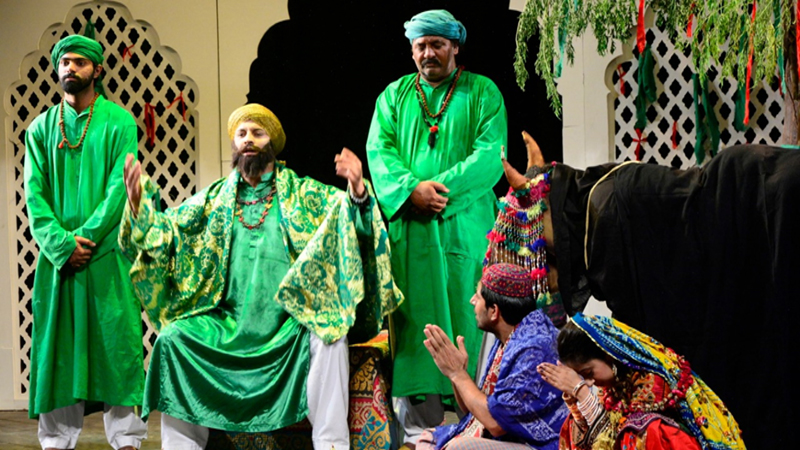
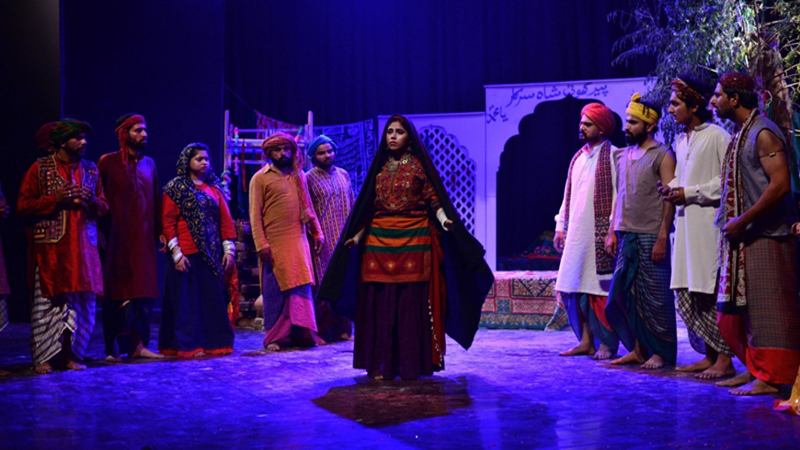
A large green shrine covered with shawls and lights, a tree well decorated with lamplights and an ox standing under– ‘Kala Meda Bhes’ has to be the most vibrant of Ajoka’s plays. This splash of colour was accompanied with the multi-hued glittering skirts and headgear to break the monochrome of the arid desert. The play is based in a village in the Cholistan. The town is short of water, and the only functional well is “owned” by the village saint or pir. The main protagonist is called Sundri, and she is childless. Her husband is Allah Wasaya, and he has taken a second wife for the sake of an offspring. The two women are naturally at odds with each other. Allah Wasaya loses his precious ox to poisoning and exchanges his first wife with a widower in the village for an ox. Hence, Sundri, the main protagonist is remarried against her wishes. The infertile Sundri here is an analogy to the rest of the barren village. Her new husband is called Ditta.
Although Allah Wasaya was a tragic hero, Usman Raaj added humour and colour to the performance. He played the downtrodden, vulnerable and uneducated husband torn between two wives with panache
He is a father of three and obsessed with finding a fresh aquifer for the town. The most interesting character in the play is Opra. He is depicted as a middle-aged, mysterious man in black, who is a loner and stays at a distance from the villagers. He opens the play with lucid Punjabi verses and continues to recite different, heart-touching poems each time he reappears. He consoles Sundri when she is in remorse and encourages Ditta to continue his search for water. The play is based on a real-life story and was first written in 1996. The event took place in Sindh, where a woman was exchanged for an ox. The play is a microcosm of the desert. The main themes of the play are the main issues in the Cholistan desert- water scarcity, discrimination against women, poor, illiterate and dogmatic people as well as a weak law and order. Ajoka Theater focuses on the women of Pakistan and their issues in our still quite conservative and patriarchal society. But the take is always sensitive and progressive.
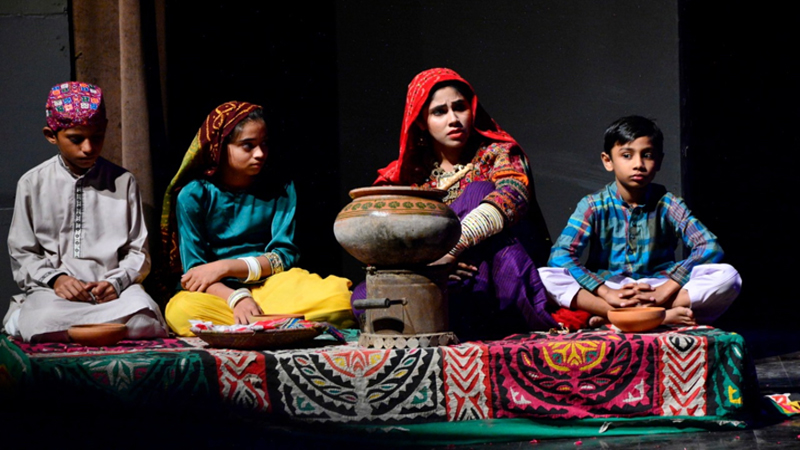
The audience does not see the story through the male gaze but always from the perspective of women. They are made to empathise with the female characters. There is an immense focus on livestock and cattle because the rural economy depends on it. Allah Wasaya is obsessed with his ox and fawns over it whenever he can. The main villain is the pir. He exploits poor people, hires them to serve at the shrine, sells them expensive water and takes advantage of the women who come to pray. The village population depends on him. In one intense scene, the saint takes advantage of the second wife of Allah Wasaya who goes to the shrine in hopes of finally becoming a mother. The play highlights the plight of the main character, Sundri, who is hurt by her husband’s second marriage. The apparent fact is that the husband might be infertile, but the woman pays the price. The unfairness of easily taking up a second wife is highlighted. And so is the injustice of watta satta. The woman in this equation is dehumanised and less worthy than the ox.
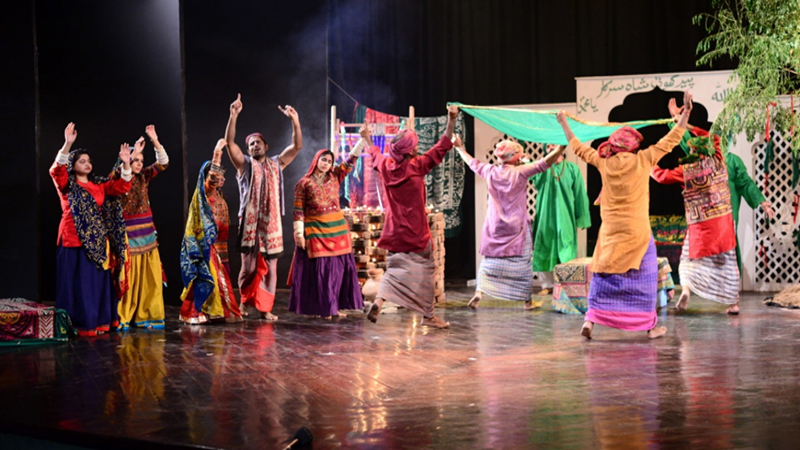
This play was written by Shahid Nadeem and is one of Ajoka’s best-known productions. The script is not just dramatic but also gives the audience ample comic relief. It has traditionally been directed by Madeeha Gauhar and performed several times before. However, this is the first time it was shown after Gauhar’s death. Most of the actors in the play were trained by her and therefore managed to capture the spirit of the original drama effectively. Despite the play being in Punjabi, the actors were expressive and quite at ease with the accent. They also refrained from the urge to yell too much or indulge in melodrama, despite the play being sad and tragic. Usman Chaudhry played the exploitative pir and gave a convincing performance. His body language and tone exuded power and grace. Naseem Abbas, who played the role of Opra, was also the Assistant Director of the play. He sang the Punjabi verses very well. Although Allah Wasaya was a tragic hero, Usman Raaj added humour and colour to the performance.
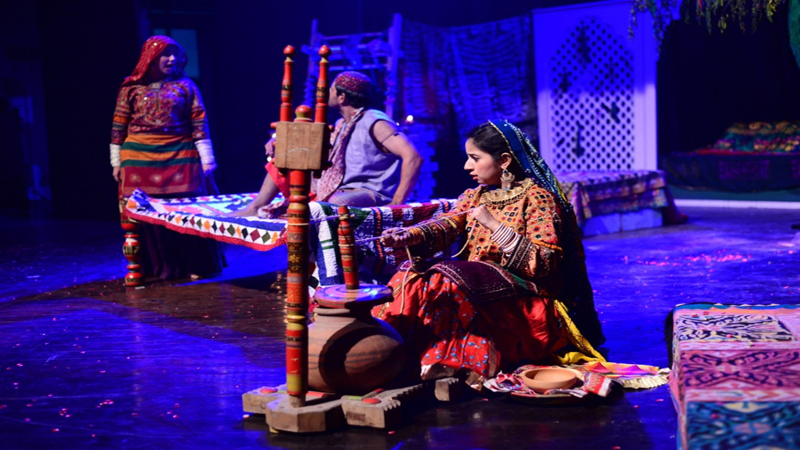
He played the downtrodden, vulnerable and uneducated husband torn between two wives with panache. The audience probably affiliated with him the most. Hina Tariq, the second wife of Allah Wasaya, gave a persuasive performance. Her character was grey, but it also included a lot of victimization in the end. Also, Tariq sang and danced very elegantly. However, the role that won the most accolades was Sundri played by Nayyab Faiza. Though the character had a few scenes, they were often sad and powerful. Her confrontation with her husband and his “other” wife, her painful confessions after not being able to conceive, resistance to remarriage and her eventual settlement in the second home – all left an impact on the audience. The music, particularly the dholak and the dhol, added to the ambiance of the play. The play had a happy end, and this left the audience even more gratified. They gave the team a standing ovation that lasted for a long time.
The writer is based in Lahore and tweets as @ammarawrites. Her work is available on www.ammaraahmad.com
Published in Daily Times, October 2nd, 2018.