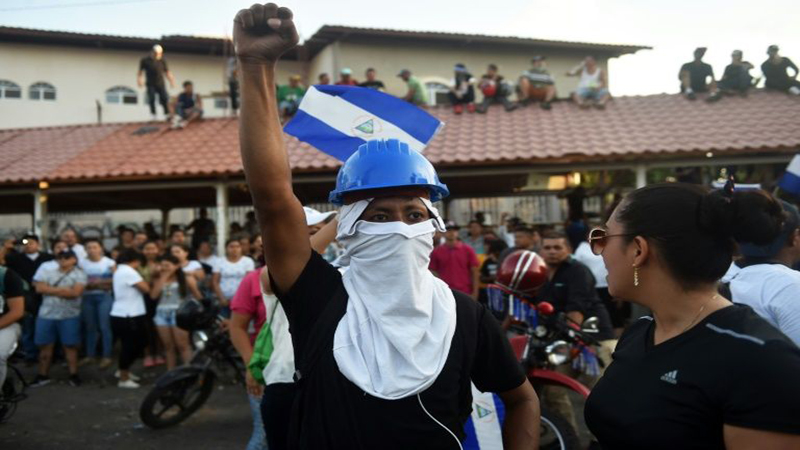
A week of deadly anti-government protests in Nicaragua appeared to be subsiding on Wednesday after concessions by President Daniel Ortega set the scene for talks with powerful business leaders.
A prominent rights group, the Nicaraguan Center for Human Rights, said 34 people had died in the demonstrations that had been brutally put down by security forces.
Ortega’s government has not put out an official death toll since last Friday, when it counted 10 deaths.
The protests were triggered by pension reforms that Ortega ended up withdrawing amid mounting condemnation of the harsh police tactics against the demonstrators.
Other grievances also surfaced, notably resentment at the authoritarian style of Ortega and his wife Rosario Murillo, who is his vice president.
The unrest was the worst Ortega has faced in the past 11 years of his current stretch in power.
A mass march in Managua on Monday brought together tens of thousands of ordinary Nicaraguans, many of them calling for him to step down.
Another, smaller march of hundreds of students and residents took place on Wednesday to demand justice for those killed or hurt in the police repression.
Passing motorists honked their horns in support of the procession, which passed off peacefully.
The violence and intensity of the protests faded after Ortega made a series of concessions, including freeing dozens of arrested protesters, lifting curbs on independent media and calling for dialogue.
But some Nicaraguans adopted a wait-and-see attitude over whether tensions were dissipating or merely in a lull.
“We are going to see how long this calm lasts,” said Managua taxi driver Alan Saavedra.
Though schools reopened on Wednesday, “I’m not sending my daughter to class because I still don’t see it as stable,” he said.
Some of the released protesters, many of them youths and university students, said they were maltreated in custody.
“They hit all of us in the stomach with kicks, punches and the sticks they use. They hit us in the head,” one of them, Marvin Guevara, 26, told AFP.
Another man released, Carlos Sandoval, said they were told they were “political prisoners” for opposing the government.
Jose Castaneda, another freed protester, said: “They put us in a cell where they continued to hit us. They dragged us along the ground.”
At his side, Gilbert Altamirano said “we were tortured — beaten like I have never been in my life. The more we cried, the more they beat us.”
More than 200 people were detained in the protests, but no charges have been laid.
Fifteen of the released protesters on Wednesday lodged a complaint with the government’s human rights office over the treatment they endured.
The Nicaraguan Center for Human Rights said 16 protesters were still missing.