
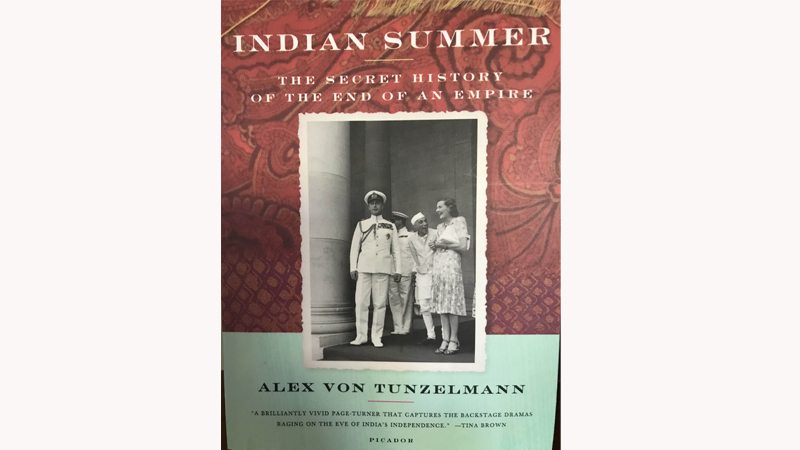
 Indian Summer by Alex Von Tunzelman is part of the growing literature on the unceremonial end of the British Raj. The scholarly work is also a page turner.
The book adds nuance and texture to a well-known story. It does so by revealing the dramatis personae one at a time to the reader. No one escapes censure. All heroes are found to have feet of clay.
The story begins in the year 1577 when Akbar ruled India. He was “the world’s most powerful man” and one “of the most successful military commanders of all time.” The 100 million people who lived under the aegis of the Mughal Empire were cosmopolitan and affluent.
In contrast, England with a population of around two and a half million was a backwater. The vast majority lived “in a state of misery and impoverishment,” with nine of out ten living in rural areas. “Politically and religiously, the country had spent much of the 16th century at war with itself.”
It was only a matter of time before history reversed itself. In 1577, the average Indian peasant had “enjoyed a relatively higher income and lower taxation than his descendants ever would again.”
After the end of the Second World War, Britain was broke and ‘there was a practical urgency to dump the empire.’ A Cabinet Mission, sent to explore options for Indian self-rule, concluded that the best option would be ‘a federal India with a ten year constitutional review period,’ after which the Muslim provinces could leave the federation
At its peak, the sun never set on the British Empire. It included over 500 million “subjects,” of which 400 million resided in India. Of the 400 million, 100 million were Muslims and the rest were mainly Hindu.
After the end of the Second World War, Britain was broke and “there was a practical urgency to dump the empire.” A Cabinet Mission, sent to explore options for Indian self-rule, concluded that the best option would be “a federal India with a ten year constitutional review period,” after which the Muslim provinces could leave the federation.
Jinnah accepted the plan but Gandhi did not, leading Field Marshal Wavell, the English viceroy, to call him the “wrecker.” Lord Pethick-Lawrence, the Secretary of State for India, noted that Gandhi would not compromise on his position and did not care whether two or three million died in the process.
His long march to harvest salt from the sea, combined with his ascetic lifestyle and ending with his assassination, had canonised Gandhi into sainthood. “Nothing could be further from the truth,” the book argues. Gandhi admired Hitler’s victories, and while he regretted the mass murder of Jews, in the same breath he said “the Jews should have offered themselves to the butcher’s knife.”
 Winston Churchill, Britain’s iconic war hero, stated without reservations that he hated Indians: “They are a beastly people with a beastly religion.” They did not deserve to be independent. Prime Minister Atlee said that Churchill’s “imperialist braggadocio” was “short-sighted and suicidal.”
After having read Beverley Nichols’ book, Verdict on India, which had come out in 1944, Churchill said: “I agree with the book and also with its conclusion – Pakistan.” Von Tunzelman says that view sabotaged “any last hopes of Indian unity.” She says that Churchill’s behavior “was extremely favourable to Pakistan and to Jinnah personally.” His championing of the Muslim League’s cause in the House of Commons in 1946 and 1947 was “crucial to the creation of Pakistan.” And then she makes the revelatory observation: “If Jinnah is regarded as the father of Pakistan, Churchill must qualify as its uncle.”
Jinnah, one of India’s top attorneys, had famously declined the offer of knighthood. In his early years, he had been the ambassador of Hindu-Muslim unity. In his later years, he would reverse his position, saying Hindus and Muslims were incompatible with each other. Gandhi, his primary nemesis, considered Jinnah ‘an evil genius who believes he is a prophet.’
Mountbatten was a naval officer who had blundered in every command that was given to him and whose military legacy was saved from utter ruin by his acceptance of the Japanese surrender in Singapore. The Earl of Burma was not even a competent sailor, let alone a brilliant one and certainly not “a brilliant commander in chief.”
His near-death experiences in the navy were portrayed by Noel Coward in the film, ‘In Which We Serve’, “one of the few propaganda films … to show the heroes suffering a disastrous routing.”
As viceroy, Mountbatten rushed the plan to give independence to India, noting in his diary that “The whole country is in an unsettled state… unless I act quickly I may well find the real beginnings of a civil war on my hands.”
The civil war came anyway. He compounded the blunder by staying on as India’s first Governor General instead of taking the flight home to London.
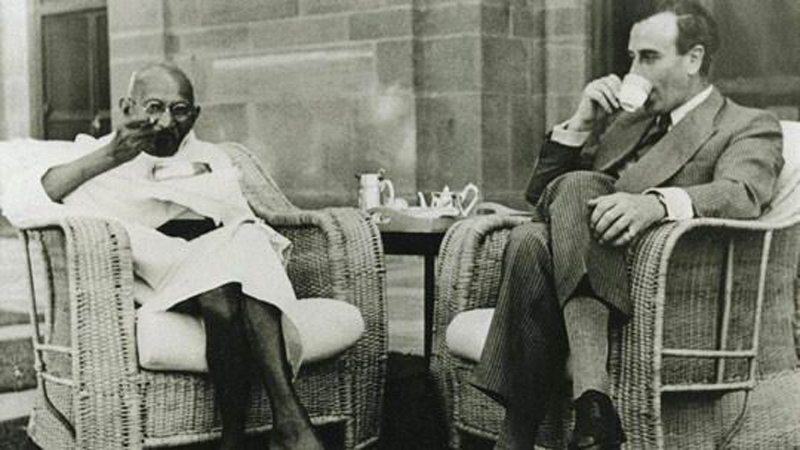 His wife’s dalliances with Nehru were well known and amused her husband. In their own way, they ensured Mountbatten’s partiality toward the Indian position. Years later, recent letters from Nehru were found on Edwina’s deathbed.
Nehru, passionate to the point of ridicule about Kashmir, had said more than once that Pakistan would not be created. He would live to see his forecast gone awry.
Jinnah, one of India’s top attorneys, had famously declined the offer of knighthood. In his early years, he had been the ambassador of Hindu-Muslim unity. In his later years, he would reverse his position, saying Hindus and Muslims were incompatible with each other. Gandhi, his primary nemesis, considered Jinnah “an evil genius who believes he is a prophet.”
Jinnah did not live to see his dream go up in smoke when Pakistan broke up in 1971. Mountbatten, who had forecast that Pakistan would not live past a quarter-century, did witness his forecast come true. He had wanted to die in the sea. In 1979, the IRA blew up his boat, granting him his wish
In 1937, when the Muslim League lost the elections to the Unionist Party, Jinnah was disheartened: “I shall never come to the Punjab again. It is such a hopeless place.” But his aspirations for Pakistan included all of Punjab and all of Bengal. “What is the use of Bengal without Calcutta?” he had argued. The Bengalis “had much better remain united and independent; I am sure they would remain on friendly terms with us.”
His often-cited August 11, 1947 speech to the Constituent Assembly was “peculiar” with its emphasis on creating a secular state, since Jinnah “had long hindered independence precisely by reinforcing the division between Hindu and Muslim.”
The biggest bombshell in the book comes from a conversation that Von Tunzelman attributes to the doctor who attended to Jinnah during his final hours. Cautioning that there is no way to prove it, she says that the doctor heard Jinnah saying to Liaquat: “Pakistan was the biggest blunder” of his life. If he were to get an opportunity, he would “go to Delhi and tell Jawaharlal to forget about the follies of the past and become friends again.”
 Jinnah did not live to see his dream go up in smoke when Pakistan broke up in 1971. Mountbatten, who had forecast that Pakistan would not live past a quarter-century, did witness his forecast come true. He had wanted to die in the sea. In 1979, the IRA blew up his boat, granting him his wish.
Reflecting on the colossal life in the partition, Von Tunzelman says that some blame lies with the Indian leaders who exacerbated unrest, “but the real responsibility rests with Churchill and Clement Attlee, both of whom as prime minister treated India with a contempt they would not have shown to Europeans.”
A million or two died during the partition. Did the killers become “normal” afterwards and meld into the crowd? How does one live a normal life after having massacred defenseless men, women and children? Why were the killers not found and tried?
The book does not discuss these issues. And its discussion of the post-partition period is almost entirely focused on India. Despite these limitations, it is a fine piece of work.
Title: Indian Summer — The Secret History of the End of an Empire
Edition Language: English
Other editions: 14
Hardcover, 464 pages
Published July 1st 2007 by Simon & Schuster
The writer is the author of ‘Rethinking the National Security of Pakistan.’ He can be reached at [email protected]
Published in Daily Times, December 30th 2017.