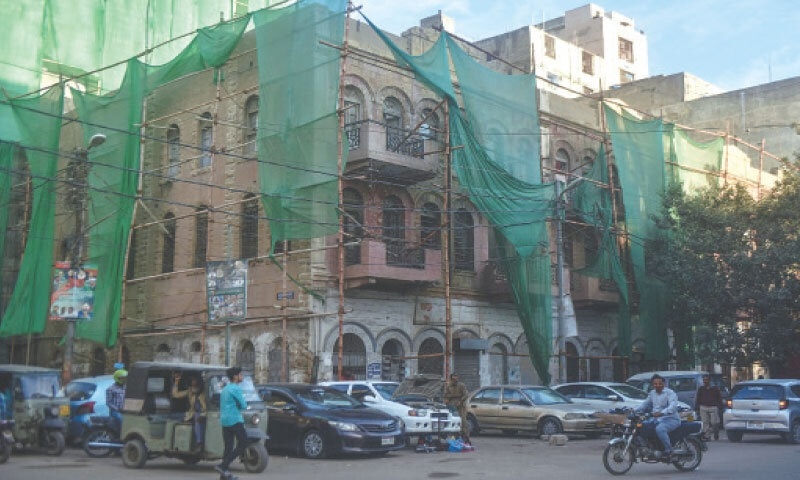
Karachi authorities have ordered the sealing of the Baweja Building, a protected heritage site, after illegal renovation and demolition work was detected at the century-old structure. The Sindh Antiquities and Archaeology Department directed the Sindh Building Control Authority (SBCA) to take immediate action on Thursday.
Read More: SBCA officials in hot water over illegal demolition of heritage building
The Baweja Building, located on Mir Karam Ali Talpur Road in Saddar, was constructed in 1925 and is renowned for its Anglo-Mughal architectural style, featuring ornate cupolas, domes, arches and detailed stonework. Originally built as a commercial office, the structure now houses serviced apartments, corporate offices, and a small shopping mall. Its well-preserved facade has earned it a listing in Karachi’s cultural heritage register (SD-P-192).
Abdul Fatah Shaikh, Director General of the Antiquities and Archaeology Department, told Dawn that the building owner and contractor, Muhammad Asif Sultan, had been issued a show-cause notice in October 2025 for carrying out unauthorised demolition without prior approval, in violation of the Sindh Cultural Heritage (Preservation) Act, 1994. Despite multiple directives to appear before the department, Sultan failed to respond.
“The demolition and renovation work was stopped temporarily, but the owner again ignored a follow-up notice in November,” the DG said. He added that he had written to the SBCA, the deputy commissioner, the SSP of District South, and the local SHO to ensure strict action against the illegal activities.
Under the law, no demolition, alteration, or construction is permitted on or near a declared heritage site without approval from the Technical/Advisory Committee on Sindh Cultural Heritage. The DG emphasized that the Baweja Building must remain sealed until the committee issues a final decision.
Read More: SBCA launches operation to vacate, seal dilapidated buildings
Karachi’s architectural heritage continues to face threats from unauthorised demolition and illegal construction, highlighting the need for stricter enforcement and preservation measures at colonial-era buildings and historic monuments.