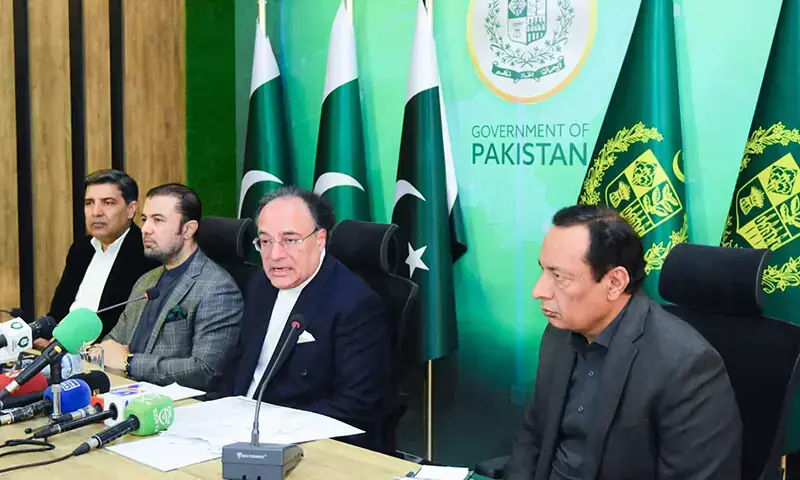
ISLAMABAD: Finance Minister Muhammad Aurangzeb on Sunday cautioned against a “gold rush” approach to economic growth, stressing that Pakistan must prioritise sustainable, long-term reforms.
He emphasised that both the federation and provinces must enhance their revenue contributions ahead of the crucial National Finance Commission (NFC) meeting on December 4.
Read More: PM approves digital ecosystem for FBR to boost revenue
Speaking at a press conference, the minister said he expected the NFC stakeholders to adopt a “Pakistan First” approach, similar to the consensus that previously produced the National Fiscal Pact and provincial legislation for the Agriculture Income Tax (AIT). He said there was no disagreement on the need for structural and institutional reforms, echoing the IMF’s governance and corruption diagnostic assessment.
Aurangzeb highlighted that provinces had, for the first time, legislated AIT, though discussions on its implementation remained separate. He noted that expenditure controls must also improve, following global standards similar to Know Your Customer (KYC) and Anti-Money Laundering regulations, especially after Pakistan’s recent exit from the FATF watch list.
Federal Minister for Finance & Revenue Senator Muhammad Aurangzeb held an extensive press conference today, outlining the Government’s clear shift toward an inclusive, private-sector-driven and export-led growth strategy, while also emphasising ongoing institutional reforms… pic.twitter.com/XrDOdpFVVj
— Ministry of Finance, Government of Pakistan (@Financegovpk) November 30, 2025
He explained that the NFC’s Terms of Reference were designed to ensure that all stakeholders—federal and provincial—presented their respective fiscal positions. He warned that Pakistan could not operate sustainably with an 8–10% tax-to-GDP ratio. “We don’t need a gold rush; we need sustainable economic growth,” he remarked.
The minister said the government was shifting toward an export-led, private sector-driven growth model. Abolishing the decades-old 0.25% Export Development Surcharge (EDS), he added, was a key step in that direction. Recommendations to transfer the Export Development Fund to the private sector were also under consideration.
Finance Minister Mohammad Aurangzeb cautioned that the government will keep a close eye on balance of payment and current account to ensure sustainability in growth, but ready to reduce taxes on formal sectors with the help of Tax Policy Office fully engaged to facilitate formal…
— Business Recorder (@brecordernews) December 1, 2025
Aurangzeb avoided directly addressing the Rs580bn revenue shortfall but said overall revenue growth remained healthy at 11%. He reaffirmed the government’s commitment to structural reforms, calling the IMF’s GCDA report a “catalyst” rather than a critique.
Read More: Overhauling tax system to boost revenue
He noted strong export performance, IT sector growth above 20%, and progress on major projects including the Reko Diq financing syndication. He added that Pakistan’s inaugural panda bond would be launched in December and forecast remittances to exceed $41bn this year.