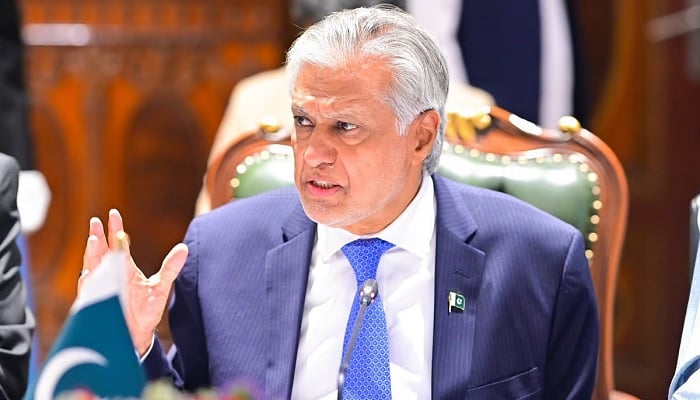
ISLAMABAD – Deputy Prime Minister and Foreign Minister Ishaq Dar has warned that India’s decision to place the Indus Waters Treaty (IWT) in abeyance poses “a real threat to regional stability,” urging its immediate reversal while emphasizing that water should remain “a source of cooperation, not weaponised for politics.” Speaking at the EU Indo-Pacific Ministerial Forum Roundtable, Dar said South Asia faces deliberate acts of aggression, including inflammatory rhetoric and unilateral actions, which threaten peace and security.
Read More: Playing with fire: the Indus waters treaty and the looming catastrophe
Dar stressed that a durable peace in South Asia remains impossible without a resolution of the Indian Illegally Occupied Jammu and Kashmir (IIOJK) dispute, in accordance with relevant United Nations Security Council resolutions and the aspirations of the Kashmiri people. He also highlighted Pakistan’s commitment to regional stability through constructive engagement with international partners, including the EU High Representative, to calm recent tensions.
Deputy Prime Minister/Foreign Minister Senator Mohammad Ishaq Dar @MIshaqDar50 delivered remarks at the 4th Indo-Pacific Forum roundtable on “Geopolitical and Security Challenges in the Indo-Pacific.” pic.twitter.com/ftn2aLybIT
— Ministry of Foreign Affairs – Pakistan (@ForeignOfficePk) November 21, 2025
Turning to Afghanistan, the foreign minister described the country as a “consequential relationship” for Pakistan, reiterating Islamabad’s desire for a peaceful, stable, and prosperous Afghanistan. He urged the Afghan Taliban regime to act responsibly, honour commitments, and work toward eliminating terrorism from Afghan soil.
Read More: Ishaq Dar defends Indus waters treaty amid India’s suspension threat
Dar also discussed broader global challenges, including rising conflicts, major-power rivalries, food insecurity, inflation, cyber threats, and AI-driven disruptions. He cautioned against the Indo-Pacific becoming a theatre of great-power rivalry and called for an inclusive cooperative approach grounded in dialogue, connectivity, and peaceful dispute resolution. Pakistan’s July 2025 UN Security Council presidency, during which it spearheaded Resolution 2788 aimed at strengthening mechanisms for peaceful conflict resolution, was highlighted as an example of its proactive diplomacy.
Read More: Dar discusses regional matters with EU counterparts
On the Middle East, Dar condemned violence in Gaza and welcomed the Sharm El-Sheikh Peace Agreement. He reaffirmed Pakistan’s support for a contiguous, independent Palestinian state based on pre-1967 borders. Addressing Ukraine, he noted the war’s impact on global food and energy markets, reiterating Pakistan’s position for a peaceful resolution anchored in the UN Charter. Dar concluded by pointing to the EU’s cooperative model as a guide for regional connectivity, suggesting synergies between the China-Pakistan Economic Corridor and the EU’s Global Gateway to foster a more interconnected EU-Asia-Pacific region.