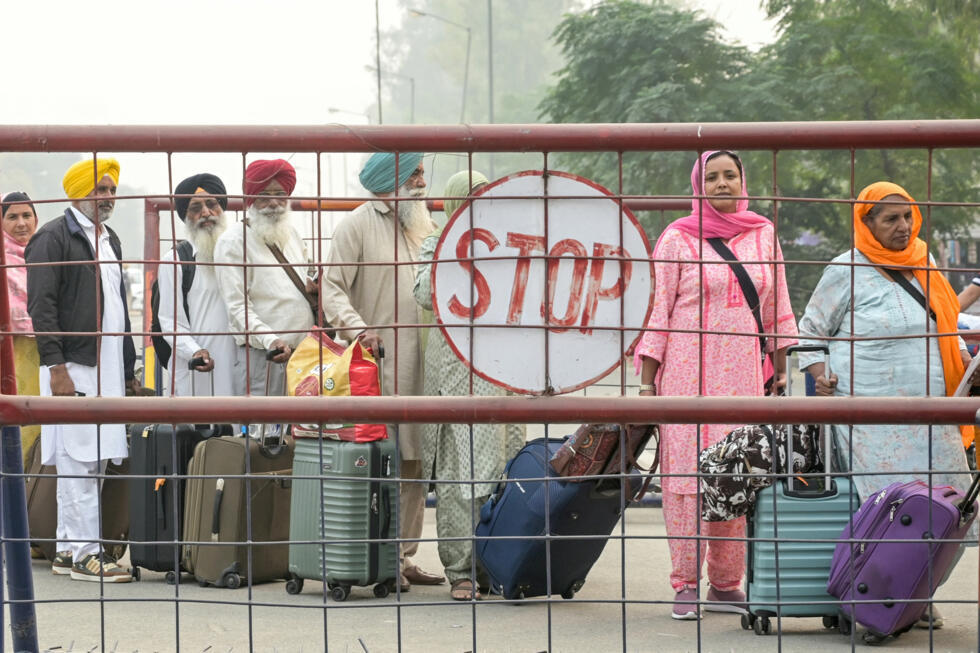
WAGAH BORDER– Pakistan on Tuesday welcomed dozens of Sikh pilgrims from India in the first major cross-border movement since deadly clashes between the two countries led to the closure of the Wagah-Attari land route in May, AFP reported.
More than 2,100 Sikh pilgrims were granted visas to attend a 10-day festival marking the 556th birth anniversary of Guru Nanak, the founder of the Sikh faith, according to Pakistan’s High Commission in New Delhi.
The Wagah-Attari border — the only active land crossing between Pakistan and India — had been closed to general traffic following the worst fighting since 1999, which left over 70 people dead in missile, drone, and artillery exchanges earlier this year.
Read More: Special train arrives with Sikh pilgrims at Nankana
On Tuesday morning, pilgrims queued on the Indian side, many carrying luggage on their heads as Indian Border Security Force personnel monitored the process. AFP journalists on the Pakistani side witnessed dozens of pilgrims crossing into Pakistan, where they were greeted by officials with flowers and rose petals.
Indian media outlets reported that around 1,700 pilgrims were expected to enter Pakistan, though Indian authorities have not yet confirmed the exact figure.
The visitors will gather at Nankana Sahib on Wednesday — Guru Nanak’s birthplace located around 80 kilometres west of Lahore — before visiting other sacred Sikh sites including Kartarpur, where the guru is buried.
Pakistan’s High Commission said the move was part of its ongoing efforts to promote “inter-religious and inter-cultural harmony and understanding.”
Indian newspapers, meanwhile, reported that only “selected groups” of pilgrims had been permitted to travel to Pakistan amid lingering tensions.
Read More: Special wards to be set up for Sikh pilgrims in Lahore, Faisalabad hospitals
The Kartarpur Corridor, a visa-free route launched in 2019 to allow Indian Sikhs to visit the temple without passing through the main border, remains closed following the May conflict.
Sikhism, founded in the 15th century in Punjab, spans both sides of the Indo-Pak border. While most Sikhs migrated to India during the 1947 Partition, some of their holiest shrines — including those in Nankana Sahib and Kartarpur — are located in Pakistan.