
That President Xi Jinping has been anointed the new high priest of China’s core leadership — on a par with Mao Zedong and Deng Xiaoping — was as good as a foregone conclusion. After all, he has the highest international standing of any Chinese leader today.
By incorporating Xi’s thoughts on a “New Era” of Chinese socialism into its constitution, the Communist Party of China (CPC) has made this new ‘ideology’, which has its roots in Maoism,compulsory learning for the country’s students and party cadres at all levels.
Nevertheless, it has been said that Xi has a Machiavellian side. After all, he rather expertly succeeded in removing all potential rivals from their respective positions. Indeed, by not appointing his successor in the recently concluded 19th National Congress of the CPC — he has all but guaranteed the quiet demise of the party’s collective leadership.
Today, Xi’s China has emerged an economic and political player. The Economist recently described the president as “a dominant engine of global growth” who “presents himself as an apostle of peace and friendship, a voice of reason in a confused and troubled world”. Yet the real credit for the Xi’s rising star goes directly to waning American influence, especially under the current Trump leadership, not only in Asia but in Europe as well as Africa. In reality, all President Xi has done is take advantage of the Trump’s effective abdication of leadership.
Many traditional US allies like Japan and South Korea have realised that they can no longer rely on Washington to save the day in times of conflict. Especially given that the latter is no longer in a sufficiently secure position to counter either Beijing or Moscow. Thus we today see countries like the Philippines realising the prudence of engaging with China directly to settle disputes, especially regarding the contested South China Sea islands. In short, they recognise that they would be on the losing end of any potential aggression with Beijing, suffering unimaginably disastrous consequences.
Though to be fair, China has responded positively to such overtures, agreeing to resolve all outstanding issues through dialogue. Nevertheless how this may translate into reality is anyone’s guess given that the Middle Kingdom is not known to cede its territory. In other words, it is not at all certain that the latter would welcome any compromise over the disputed Paracel and Spratly Islands.
Yet China has been smart about its so-called peaceful rise. It has reached out to many smaller nations to assist in boosting its economic clout in its near backyard and also further afield. The most notable venture being the mammoth One Belt, One Road (OBOR) infrastructure project that comes with a $1 trillion-price tag.The aim of which is to see China comfortably straddle both the economic and geo-political spheres.
Not everyone is particularly happy with this, however. China’s neighbours — especially Japan, India and South Korea — as well as the South East Asian Nations are already bearing the brunt of what they see as Beijing’s recidivist policies. And without the US playing the part of regional sheriff they feel hung out to dry.
President Xi, with both political and economic might stacked to his advantage, is striving to become a world leader. Yet if he is to succeed, he needs to recalibrate. Meaning that the only way forward can be the peaceful resolution of neighbourhood disputes combined with the spirit of mutual accommodation
Nevertheless, India managed to diffuse this summer’s standoff over the Doklam plateau by direct engagement with the Chinese leadership. This was despite the latter’s media blitz that chose to accuse India of military aggression in the valley that Beijing claims as its own, yet which remains disputed by Bhutan. Thus China warned New Delhi of severe fallout if it did not withdraw its forces from the area. Yet India has remained steadfast. In addition, many Chinese allies like Russia have remained outwardly neutral while advising Beijing behind-not-so-closed doors to settle the issue through negotiations. Indeed, it is to the credit of both the Indian and Chinese leaderships that the two sides reached an agreement whereby all discord was resolved peacefully. Thus President Xi successfully silenced the hawks in his country who were calling for aggression towards India.
Thus Xi, with both political and economic might stacked to his advantage, is striving to become a world leader. Some say that he is a vulture waiting to swoop in and fill the shoes of Trump, who has single-handedly been credited with squandering what remaining goodwill currency that Washington had previously enjoyed globally. Yet if he is to succeed, Xi needs to recalibrate. Meaning that the only way forward can be the peaceful resolution of neighbourhood disputes combined with the spirit of mutual accommodation. Thus far, China has been bullish in refusing to accept the ruling of the United Nations Arbitral Tribunal at The Hague that has awarded the Philippines sovereignty of the aforementioned disputed islands.
Today, China has emerged as one of the fastest growing economies globally; and is on track to displace the US as the world’s largest by 2050. Yet pursuit of a combative foreign policy could jeopardise all this. It would be good for everyone if the Doklam standoff was taken as a lesson in textbook diplomacy.
India for its part should reconsider joining the OBOR project, engaging directly with China to dispel any genuine apprehensions it may have. This would give a positive boost to bilateral relations. Not only that, New Delhi would do well to be wary of joining any axis to counter Beijing; especially given that US support is no longer guaranteed in practical terms regardless of public lip service. Meaning that while Washington has expressed willingness to supply F16 and F18 fighter jets to New Delhi while also promising to upgrade its military hardware — it should not necessarily be taken as an automatic sign of genuinely helping modernising Indian defence forces. Arms sales, as we all know, largely come with hidden costs and these will likely be out of New Delhi’s reach. Thus India should adopt a two-pronged approach to foreign policy. Firstly, continued engagement with the US. Secondly, actively seeking improved ties with Beijing in a move towards counter-conflict. The latter would go a long way to ensuring that precious Indian resources are saved for nation-building initiatives.
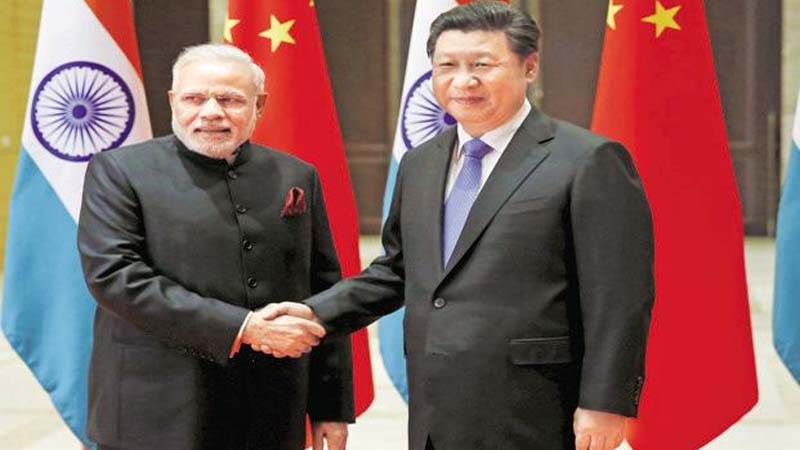
Thus the hope is that President Xi and Prime Minister Narenda Modi agree to settle all outstanding issues in a true spirit of cooperation and mutual accommodation by way of bilateral engagement. This way everyone wins in terms of regional peace and stability.
The author is an independent columnist and political commentator
Published in Daily Times, November 3rd 2017.