
 This is the ninth article in a special series by Ally Adnan that brings to life memorable incidents from the rich and fascinating life of Hazrat Amir Khusrau, whose timeless legacy continues to inspire the world.
The doha can be traced back to the Abhiras of the Gandhara region, as far back as the second century BCE.
It gained popularity in the Prakrit and Apabhramsha languages in medieval India and was widely adopted by Buddhist monks and Jain and Sufi poets. The form of poetry flourished during the Bhakti and Sufi movements, where it was used as a natural and rhythmic medium for the oral transmission of ethical, spiritual and devotional teachings.
Svayambhudev, Hemchandra, Pushpadant and Gorakhnath composed dohas in medieval India. Baba Farid Ganjshakar, Amir Khusrau and Bu Ali Shah Qalandar made significant contributions to the development and popularisation of the poetic form in the 13th century. Kabir Das, Guru Nanak, Meera Bai, Tulsidas, Surdas, Abdul Rahim Khan-e-Khanan, and Bihari Lal continued the tradition in the 15th, 16th and 17th centuries.
A doha is a self-contained rhyming couplet consisting of two lines (hemistichs) that express a complete idea, often philosophical, spiritual or didactic in nature.
It uses the matrika meter, in which meter is defined in terms of beats, unlike the bahr-based system used in Urdu, Persian and Arabic prosody, where metre is constructed from specific arrangements of long and short syllables, known as the arkan. Each line of a doha consists of 24 beats arranged in groups of 13 and 11 beats, separated by a caesura (pause). Even when written in Urdu, the doha retains its beat-based metrical structure.
Amir Khusrau composed dohas in Hindavi, instead of in Persian, giving the form prestige in royal courts and among the literati. A number of his dohas blend Islamic Sufi thought with indigenous Indian spiritual motifs, creating a bridge between Hindu Bhakti poetry and Islamic Sufi expression. He employed the structural economy of the doha to deliver potent spiritual messages succinctly in just two lines. His linguistic, spiritual and stylistic innovations lent the doha a unique lyrical and mystical vitality, laying the foundation for an enduring tradition of vernacular mystic poetry that transcended religious, cultural and linguistic boundaries
Khusrau, the river of love flows in a strange way
Whoever stepped in drowned, but the one who drowned crossed over Khusrau, I play the game of love with my beloved
If I win, my beloved is mine; if I lose, I am with my beloved
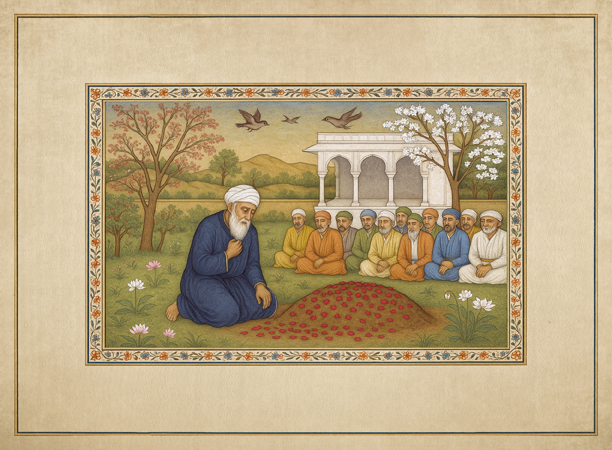
Amir Khusrau was away on royal duty when Nizamuddin Auliya passed away. He rushed back to Delhi, heartbroken, disoriented and profoundly sad upon hearing of his spiritual master’s death. When Khusrau reached the grave, he broke down in grief and spontaneously recited one of his most famous dohas.
The fair maiden sleeps on her bed, her face covered by her hair Khusrau, go home now; the dark of the night has spread in all directions
Amir Khusrau refers to Nizamuddin Auliya as gori, stating that his master now rests in complete peace, having departed for the hereafter. The world, without him, has become a place of darkness and Khusrau, too, must leave it in order to be reunited with his beloved master. Indeed, he passed away just six months after the death of Nizamuddin Auliya.
The writer lives in Dallas, Texas and writes about culture, history and the arts. He tweets @allyadnanjanjua and can be reached at [email protected]