
• Skip to primary navigation
  • Skip to main content
  • Skip to primary sidebar
  • Skip to footer
Trending:
  • Kashmir
  • Elections
Saturday, June 6, 2026

Daily Times

Your right to know

  • HOME
  • Latest
  • Iran-Israel war
  • Gilgit Baltistan Election
  • Pakistan
    • Balochistan
    • Gilgit Baltistan
    • Khyber Pakhtunkhwa
    • Punjab
    • Sindh
  • World
  • Editorials & Opinions
    • Editorials
    • Op-Eds
    • Commentary / Insight
    • Perspectives
    • Cartoons
    • Letters to the Editor
    • Featured
    • Blogs
      • Pakistan
      • World
      • Lifestyle
      • Culture
      • Sports
  • Business
  • Sports
  • E-PAPER
    • Lahore
    • Islamabad
    • Karachi
Ally Adnan

Ally Adnan

Khusrau and the tradition of doha: Amir Khusrau — a life in verse and vignette

Published on: June 18, 2025 1:07 AM

This is the ninth article in a special series by Ally Adnan that brings to life memorable incidents from the rich and fascinating life of Hazrat Amir Khusrau, whose timeless legacy continues to inspire the world.

The doha can be traced back to the Abhiras of the Gandhara region, as far back as the second century BCE.

It gained popularity in the Prakrit and Apabhramsha languages in medieval India and was widely adopted by Buddhist monks and Jain and Sufi poets. The form of poetry flourished during the Bhakti and Sufi movements, where it was used as a natural and rhythmic medium for the oral transmission of ethical, spiritual and devotional teachings.

Svayambhudev, Hemchandra, Pushpadant and Gorakhnath composed dohas in medieval India. Baba Farid Ganjshakar, Amir Khusrau and Bu Ali Shah Qalandar made significant contributions to the development and popularisation of the poetic form in the 13th century. Kabir Das, Guru Nanak, Meera Bai, Tulsidas, Surdas, Abdul Rahim Khan-e-Khanan, and Bihari Lal continued the tradition in the 15th, 16th and 17th centuries.

A doha is a self-contained rhyming couplet consisting of two lines (hemistichs) that express a complete idea, often philosophical, spiritual or didactic in nature.

It uses the matrika meter, in which meter is defined in terms of beats, unlike the bahr-based system used in Urdu, Persian and Arabic prosody, where metre is constructed from specific arrangements of long and short syllables, known as the arkan. Each line of a doha consists of 24 beats arranged in groups of 13 and 11 beats, separated by a caesura (pause). Even when written in Urdu, the doha retains its beat-based metrical structure.

Amir Khusrau composed dohas in Hindavi, instead of in Persian, giving the form prestige in royal courts and among the literati. A number of his dohas blend Islamic Sufi thought with indigenous Indian spiritual motifs, creating a bridge between Hindu Bhakti poetry and Islamic Sufi expression. He employed the structural economy of the doha to deliver potent spiritual messages succinctly in just two lines. His linguistic, spiritual and stylistic innovations lent the doha a unique lyrical and mystical vitality, laying the foundation for an enduring tradition of vernacular mystic poetry that transcended religious, cultural and linguistic boundaries

Khusrau, the river of love flows in a strange way

Whoever stepped in drowned, but the one who drowned crossed over Khusrau, I play the game of love with my beloved

If I win, my beloved is mine; if I lose, I am with my beloved

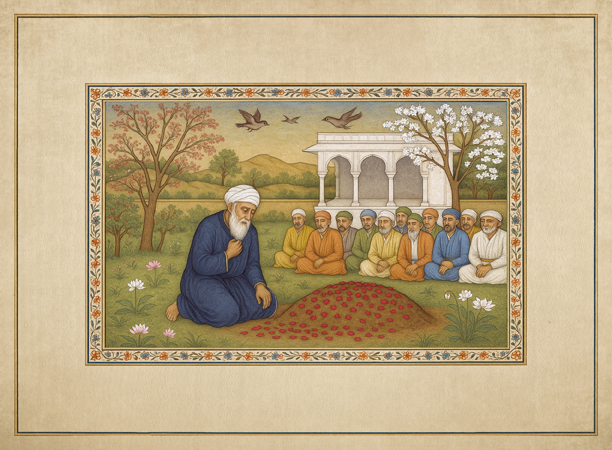
Amir Khusrau was away on royal duty when Nizamuddin Auliya passed away. He rushed back to Delhi, heartbroken, disoriented and profoundly sad upon hearing of his spiritual master’s death. When Khusrau reached the grave, he broke down in grief and spontaneously recited one of his most famous dohas.

The fair maiden sleeps on her bed, her face covered by her hair Khusrau, go home now; the dark of the night has spread in all directions

Amir Khusrau refers to Nizamuddin Auliya as gori, stating that his master now rests in complete peace, having departed for the hereafter. The world, without him, has become a place of darkness and Khusrau, too, must leave it in order to be reunited with his beloved master. Indeed, he passed away just six months after the death of Nizamuddin Auliya.

The writer lives in Dallas, Texas and writes about culture, history and the arts. He tweets @allyadnanjanjua and can be reached at [email protected]

Filed Under: Lifestyle

Submit a Comment


Primary Sidebar


Latest News

Alexander Zverev eases past Jakub Mensik in French Open semifinals

Taylor to face Pili in Croke Park farewell

FIFA bans vuvuzelas from World Cup stadiums

France brush off Ivory Coast loss, call it timely World Cup reminder

Legendary boxer Muhammad Ali’s 10th death anniversary observed

Pakistan

JAAC declared proscribed party ahead of AJK polls on July 27

Fixed tax scheme for small retailers launched to raise Rs 50bn annually

Govt cuts petrol price by Rs 4 per litre, keeps diesel’s unchanged

Bilawal promises GB voters with land and job rights

Iran declares support for Hezbollah with wider peace deal in doubt

More Posts from this Category

Business

SBP’s ‘Go Cashless’ campaign saw Rs 34bn in digital transactions on Eid

Short-term inflation down by 0.56%

Saudi-Pak Business Council shows interest in infrastructure investment

‘Govt, allies united in efforts to craft people-centric budget’

Rupee records gain against US dollar

More Posts from this Category

World

CENTCOM space post signals wider US military footprint

US official delivers Trump’s “good hello” to Putin

NASA lifts ISS evacuation alert after leak

More Posts from this Category


Footer

Home
Lead Stories
Latest News
Editor’s Picks

Culture
Life & Style
Featured
Videos

Editorials
OP-EDS
Commentary
Advertise

Cartoons
Letters
Blogs
Privacy Policy

Contact
Company’s Financials
Investor Information
Terms & Conditions

Facebook
Twitter
Instagram
Youtube

© 2026 Daily Times. All rights reserved.

Manage Consent
To provide the best experiences, we use technologies like cookies to store and/or access device information. Consenting to these technologies will allow us to process data such as browsing behavior or unique IDs on this site. Not consenting or withdrawing consent, may adversely affect certain features and functions.
Functional Always active
The technical storage or access is strictly necessary for the legitimate purpose of enabling the use of a specific service explicitly requested by the subscriber or user, or for the sole purpose of carrying out the transmission of a communication over an electronic communications network.
Preferences
The technical storage or access is necessary for the legitimate purpose of storing preferences that are not requested by the subscriber or user.
Statistics
The technical storage or access that is used exclusively for statistical purposes. The technical storage or access that is used exclusively for anonymous statistical purposes. Without a subpoena, voluntary compliance on the part of your Internet Service Provider, or additional records from a third party, information stored or retrieved for this purpose alone cannot usually be used to identify you.
Marketing
The technical storage or access is required to create user profiles to send advertising, or to track the user on a website or across several websites for similar marketing purposes.
  • Manage options
  • Manage services
  • Manage {vendor_count} vendors
  • Read more about these purposes
View preferences
  • {title}
  • {title}
  • {title}
We use cookies to ensure that we give you the best experience on our website. If you continue to use this site we will assume that you are happy with it.