
A few years back, there was a book that stood out among the new arrivals in the local library. It was called Professor Borges – A Course On English Literature. It was edited by two of his former students, Martin Arias and Martin Hadis.
On the dust jacket, John Updike called Professor Borges, “A giant of world literature.” The last time I had taken a class in English was at Karachi University in my second year. Borges came home with me. It was based on 25 lectures that Jorge Luis Borges had given in 1966 at the University of Buenos Aires where he taught English Literature. He was blind and would sit without notes before his students, extemporaneously giving his lectures.
Unsurprisingly, the book began with a discussion of the poem “Beowulf”, and then got bogged down with various Anglo-Saxon tracts in which I had no interest.
On page 64, there was a reference, which caught my eye.
It was to the year 1066, arguably the best known date in British history since it was the year in which the game-changing Battle of Hastings was fought.
But for this battle, Borges writes, “England today would be, let us say, another Denmark, a very educated country, and politically admirable, but a provincial country” with no great influence on world history.
He goes on to argue that without the Norman Conquest there would have been no British empire and probably no United States of America. I was moved. Perhaps the British Raj would just have been a figment of the imagination. There would have been no Queen Victoria, no Winston Churchill, and no Lord Mountbatten. No Field Marshal Montgomery. No Duke of Wellington. In fact, no Henry VIII or Elizabeth I. Perhaps no Shakespeare. Such a life would be unthinkable.
The book begins with a discussion of the poem ‘Beowulf’, and then gets bogged down with various Anglo-Saxon tracts in which I have no interest. On page 64, there is a reference to the year 1066, arguably the best known date in British history since it was the year in which the game-changing Battle of Hastings was fought
Borges had indeed made a bold statement and a profoundly disturbing one. Of course, it was hard not to have heard of the battle of 1066. But I had never imagined the multitudinous consequences it had unleashed until I read his lecture on it.
My sister, who lives in London, had often wanted to show me a town called Battle where it was fought. And one of my partners at work had introduced me to the satirical history of England, “1066 and all that,” making me finally wanting to read “The Enigma of Hastings.”
So I began to read Professor Borges further and learned that the famous battle had been preceded by another battle close to the town of York on the 25th of September.
In that battle, King Harold Godwinsson of England, a Saxon, faced off with his brother Tostig and Harald Hardrada, the King of Norway.
These two, along with the Duke of Normandy, were claimants to the throne of England.
The wars of succession were triggered by the death of King Edward the Confessor in January 1066, who had died without an heir.
Before the battle, Harold offered his brother a third of England and his forgiveness.
So Tostig asked what was being offered to Harald and was told, “Six feet of English ground, and because he is so tall, one extra foot.”
The offer was rejected and the Battle of Stamford Bridge began.
Harold won and Tostig and Harald were slain.
Just as victory was about to be toasted a courier brought the grim news that the Normans, led by William the Bastard, another claimant to the English throne, had invaded England. Harold hurried southward, covering the 200 miles from York to London in just five days.
In another two days, he had arrived at Hastings.
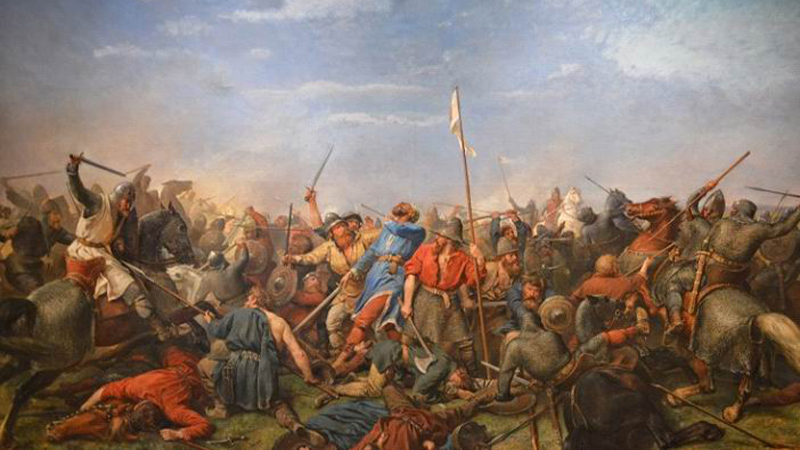
On October 14, he met William, the duke of Normandy, in battle.
There were roughly 5,000 to 7,000 troops on each side. Initially it seemed to go England’s way.
The Normans withdrew in a feint, which drew the English troops into a massacre.
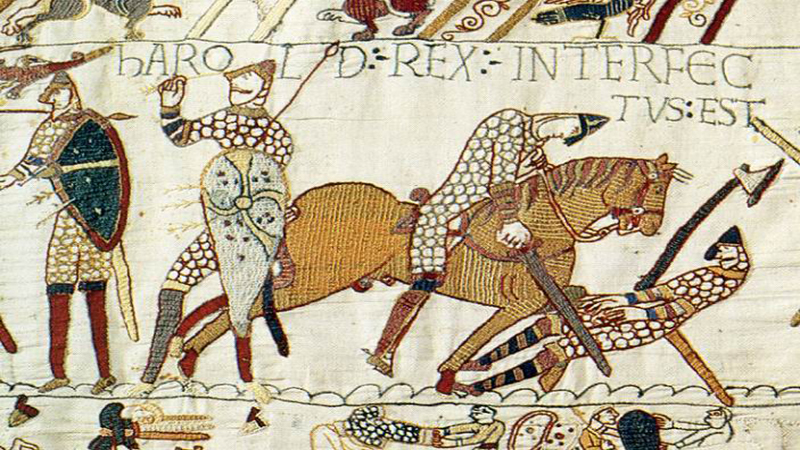
A chance arrow hit Harold in the eye, slaying him.
His corpse, stripped of all clothing, lay among the hundreds of naked men who had fallen.
It was identified by a woman who was variously described as a common law wife by some and as a friend by others.
William built an abbey over the gravesite to honour the fallen and to commemorate his victory.
After some skirmishes, he prevailed over the remaining Saxon resistance.
William was crowned the King of England on Christmas Day in Westminster Abbey. But he spent most of his remaining years in France and died there.
For two centuries, the English language went underground.
French became the court language, Latin was spoken by the clerics and the people spoke Saxon.
In the “Atlas of Military History,” Parragon, 2013, Aaron Ralby writes that prior to the battle of Hastings, “Harold and the English forces spoke a Germanic language known as Old English.
William, though of Norse descent, spoke old French.
Over time, Old English and Old French merged together as languages, creating the language we know today as English.
According to a scholarly source, “No battle was ever more hard-fought than Hastings; no battle has had more momentous results. In one respect this was merely the conclusion of a dynastic war. But in fact this battle was a turning point in history; the initiation of a series of events which would lead a revitalized Anglo-Saxon-Norman people to a world leadership more extensive than that of ancient Rome.”
Of course, the Norman Conquest is introduced by Borges to set the stage for a discussion of English literature, which the New Yorker magazine calls “both shamelessly comprehensive and entirely idiosyncratic.”
I felt like a student in his class, perched on the edge of my seat as the Los Angeles Times put it.
The book, besides adding to my limited knowledge of English literature, has convinced me to move up a visit to the town of Battle on my Bucket List.
The writer has visited 35 countries on six continents. He can be reached at [email protected]
Published in Daily Times, October 9th 2017.