 Satellite images appear to show China developing areas along a disputed border with Bhutan, igniting deep strategic and demographic ramifications for India.
 Satellite images appear to show China developing areas along a disputed border with Bhutan, igniting deep strategic and demographic ramifications for India.
India-China tensions flared after the release of new satellite images which revealed the Chinese construction of a village along a disputed border shared by India and Bhutan, previously the site of months of military standoff.
Tensions were already high after India and China engaged in a bloody clash along another disputed border in the Himalayas earlier this year, leaving at least 20 soldiers dead. It marked the worst conflict between the two countries since they fought a war over the same territory in 1962.
Military build-up
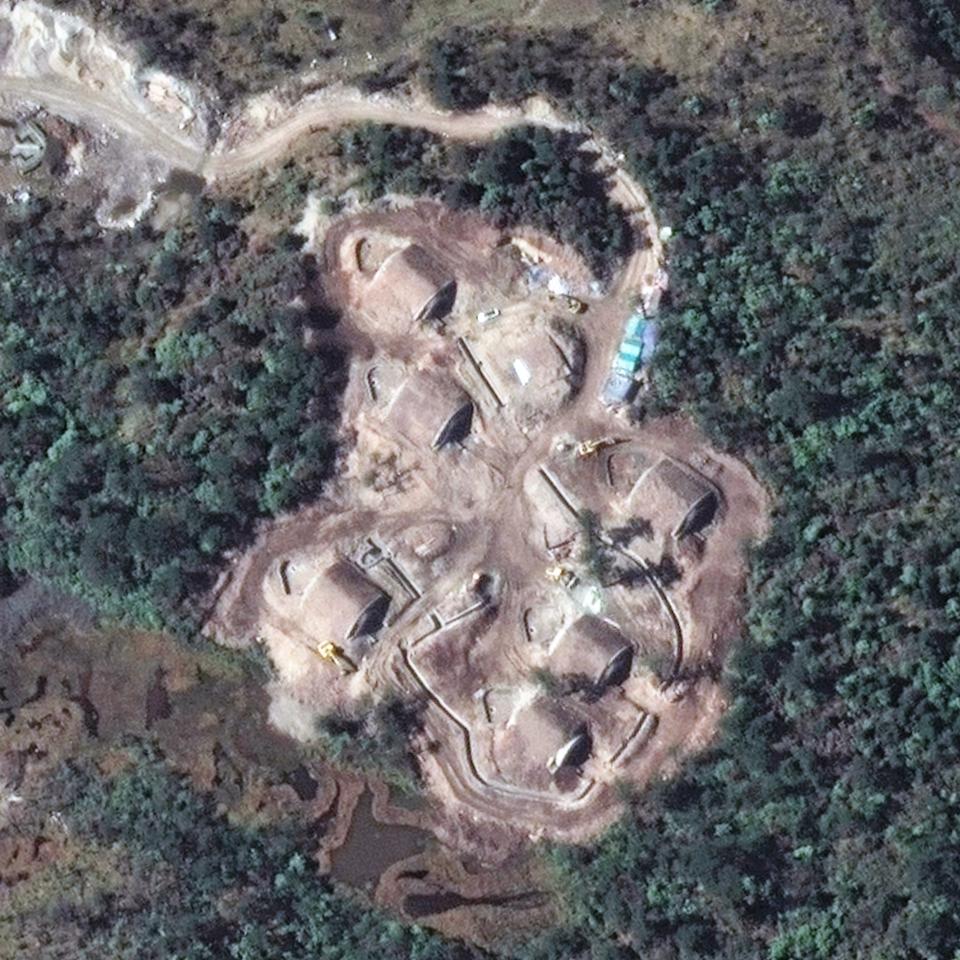
The US-based satellite operator, Maxar Technologies, which published the images on October 28 2020, notes “significant construction activity this year all along the Torsa River valley area.” More recent footage further identified “new military storage bunkers” near Doklam.
The satellite imagery appears to show military-grade, hardened ammunition depots, 2.5 kilometres away from the strategic eastern periphery of the contested Doklam plateau near the border between Bhutan and China in the area.
Bhutan’s claimed border runs along the northern ridge of the strategic Doklam plateau, where a 73-day military standoff between India and China previously took place in 2017. China’s claim of the border includes the large majority of the Doklam area within its Chumbi Valley.
Gamble or gambit?
China’s Chumbi Valley, north of the contested Doklam plateau, and India’s Siliguri Corridor, to the south of Doklam, are deeply important strategic mountain chokepoints, critical to both India and China.
The Chumbi Valley has also been described as the single most strategically important piece of real estate in the entire Himalayan region. In essence, it gives China the ability to cut off India’s Siliguri corridor, a 24 kilometre wide corridor between Nepal and Bangladesh, often called the Chicken’s neck, which connects New Delhi to its North-Eastern states.
The Siliguri corridor is a major strategic vulnerability for India, remaining the only land bridge spanning its eight north-eastern states and the rest of its country. It’s no less important for Bhutan either, representing a main supply route into the country.
The new ammunition dumps, just 7 kilometres from the Doklam plateau, could indicate an enhanced level of military readiness by Chinese forces. In the mountainous, hardy Himalayan terrain, victories aren’t won through tank battles or conventional tactics, but by who arrives first, and who can hold out the longest. In such battles of attrition, resupply and logistics are a matter of life and death.
Great view
The elevated Doklam Plateau also affords a militarily advantageous view, making it desirable to both China and India.
China’s foremost ancient military strategist, Sun Tzu, wrote in the Art of War that the army that holds the high ground, often possesses an offensive and defensive advantage. For modern Chinese military planners, this adage still holds true.
If China maintains control of the ethnically-Tibetan Chumbi valley, and establishes control over Bhutan’s contested Doklam Plateau, it gains the advantage of being able to outflank heavy Indian defensive entrenchments aligned in the northeastern state of Sikkim against China’s Chumbi Valley, in addition to being able to cut off the previously mentioned Siliguri corridor.
This poses momentous implications for India. Chinese control of the Doklam plateau not only means losing the ability to mount a strategic counter offensive or defensive from the state of Sikkim, but also grants the People’s Liberation Army a launch pad for an offensive towards India-controlled Kalimpong, historically considered a rebellious thorn in the side of China’s Tibetan ambitions.
India’s chief concern with China’s newly entrenched position is China’s ability to easily project force and cut off the Indian central states from 50 million other Indian citizens.
Old playbook
China’s build-up of positions reflects a tactic it has wielded to great effect in the South China sea, with the steady encroachments of artificial militarised islands that gave it de-facto control and a claim to sovereignty over territory contested by six other nations.
A September 2020 publication by STRATFOR, says that after the 2017 Doklam crisis, China’s objectives towards the region appear to have shifted, with China “more than doubling its total number of air bases, air defence positions and heliports near the Indian border over the past three years.”