
In district Tharparkar, around 32 kilometers in the south of Chachro city, village Chonpani Bheel consists of 100 households of poor Bheel community. The total population of the village is more than 1,200 humans and shockingly for such a large population there is not any basic human facility available in the entire village. They have never been offered anything by the governments since inception of the country which could at least insist them to sing the songs of prosperity or of governments’ dedication towards them. Miserably, whatever few resources they could put together by the self-help initiative for their restless souls are about to be vanished. There are only two wells in this village to quench the thirst of more than 1,200 humans and 300 livestock including camels, goats, sheep and donkeys.
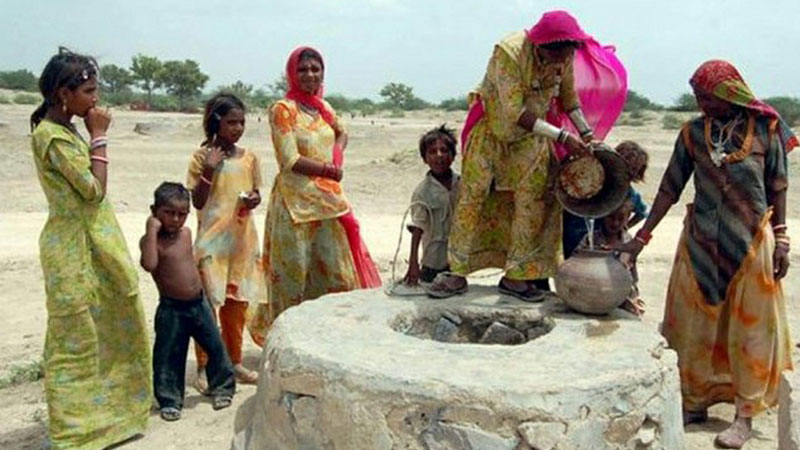 The well which they call ‘the old one’ was built before Partition while the other one was built later on by the Late Chonpo Bheel (head of this village) and some villagers during the 1960s. Since then these two wells are fulfilling water needs of this remote village of Thar but as the population burden augmented here the water in wells also started getting decreased and consequently today 70 percent of the population of this village has to wander for water in nearby settlements for almost the whole day. The luckiest villagers who become successful in getting some untreated saline water from this village’s wells have to stand barefoot on hot sand in a long queue for hours.
Fifty Five-year-old Laxmi Bheel who was waiting in such a queue for water along the well innocently says: “This is our daily life for years. Every one of us tries to reach the well by dawn so that he/she can get at least some water for drinking and other household purposes otherwise he/she has to wander for water. If you have water once in a day, you can’t get it again on the same day because after every hour or two the wells become out of water and after the break of 2 to 4 hours’ water once again appears in the wells”.
“What’s the condition of wells in other parts of Sindh? Is water playing hide and seek with villagers there too or not?” she smiled but suddenly became silent and veiled her face with dupatta as her son- in-law Ramesh arrived there. At that moment I whispered to my soul and posed a question: ‘In this post modern age when the world is busy in searching for the availability of water on other planets how disgraceful and deplorable is the fact that we are unable to even provide contaminated water to these poor Tharis?’
There are around 30 villages in this Union Council namely ‘Rajhorri’ in Taluka Chachro of district Tharparkar and most of the villages have been facing similar water woes. The years old traditional wells have failed to provide even the unhealthful water to the people as the groundwater level in many wells have gone further deeper while the RO (Reverse Osmosis) plants installed by the government in many villages have been found nonfunctional for more than one year. According to the reports of local journalists 75 percent RO plants are nonfunctional in district Tharparkar while Chachro is the Taluka which is badly affected in the whole desert because more than 80 percent water providing facilities here have become unproductive for the locals. In such unkind circumstances, everyone in remote rural regions of this desert seems wandering for water from one sand dune to another.
Bhaghisal, Rajhorro, Neharo Bheel, Ramo Bheel and Bhonha are some villages in this Union Council having average population more than 1,500 humans per village are facing severe water shortage these days. The rainwater in natural dams and in handmade storage tanks have dried up long ago while the last hope for the populace is ‘wells’ in which water has begun playing hide and seek with villagers.
The rainwater in natural dams and in handmade storage tanks have dried up long ago while the last hope for the populace is ‘wells’ in which water has begun playing hide and seek with villagers
As one travels to Chachro-Mubarak Rind road they can see the villagers of different villages after every kilometer or two, carrying water pitchers on their donkeys and travelling miles to get some water. Same is the case with women, who travel in between sand dunes from one village to another covering up to 20 kilometers in a day under the scorching sun only for a single water pitcher of water. Will this be called the development, coal corporations excavating coal in Thar have been claiming to undermine Thar?
Devan Kumar Bheel, a local social activist based in Chachro said, “What else should we do now? We have notified the government and coal corporations several times about the worst water crisis we have been facing for years through protests and hunger strikes but no one came forward to help us practically. They come, meet us, awaken fake hopes and leave. We need a sustainable solution to this water scarcity issue”.
Recently, a social media campaign ‘#TharNeedsCanalWater’ has also been launched by the Tharis to lift up their genuine demand for providing canal water because they believe that if the government can supply freshwater to the Thar Coal Field why Tharis are being ignored who are the indigenous people of the desert?
The government is temporarily supplying water to Thar Coal Field via Naukot-Mithi freshwater supply pipeline which has been the only way to supply canal water to Mithi once in a month through Naukot branch. Initially the pipeline was laid with the intention to provide fresh water to Mithi on a weekly basis but due to water shortage in the tail of Nara canal it’s now supplying water on a monthly basis only.
Since 2013 the government of Sindh is working on a water carrier project to carry and treat the water of LBOD (Left Bank Outfall Drain) in a reverse osmosis plant being built near Thar Nabisar and supply it to a reservoir located near Vajhiyar (near Thar Coalfield) in Islamkot Taluka but nobody knows when this project will be completed and Thar will be provided water. Moreover, the government of Sindh is also claiming to work on another project to supply canal water to Thar via Makhi-Farash Mori link canal which is located in north east of district Umerkot.
In the past, the government initialized many water schemes for Thar and kept shouting ‘Thar is being developed’ but not a single one could ever provide a drop of water to the thirsty people of the thirsty land. Once again a hope against hope is being stimulated among the empty stomached masses and time will tell rather these ongoing projects will solve the water issue of Thar forever or not? In last I second the words of a Thari intellectual who in a Facebook post said “Governments can see the billions of ton of coal reservoirs under the land of Thar but why it can’t see the thirsty Tharis crying for the drop of water above the land of Thar?”
The writer is a freelance contributor