How did a Georgian, raised in a village, having studied at the puritanical seminary during childhood and beaten by his sadist father, rise to lead the empire once ruled by Tsars?
 Iosif Vissarionovich Dzhugashvili, later called Stalin (man of steel), joined Bolshevik movement. For his subversive activities, he was arrested and exiled to Siberia by the Tsarist authorities. It was in Siberia that Stalin spent the most memorable time of his life. Later in his last years, he repeatedly told his courtiers about his adventures in Siberia. Stalin was a voracious reader, a meticulous administrator, fanatical Marxist and a supreme politician.
Before the 1917 revolution, he worked day and night for the Bolshevik cause. He was arrested numerous times. He also became the editor-in-chief of Pravda, where he published his most famous work, “Marxism and National Question.” Acknowledging Stalin’s potential, Lenin and Grigory Zinoviev (later executed on Stalin’s order, in the famous “Moscow Trials”) appointed him to the Central Committee. In the words of Lenin, Stalin was the ruthless enforcer of Bolshevik will.
He returned from exile and joined the October revolution. After the successful overthrow of the Tsarist regime, Lenin appointed Trotsky as the defence commissar, Stalin as the secretary-general of the communist party and formed the Politburo (Political Bureau) with Zinoviev, Kamenev, Trotsky, Stalin, Sokolnikov, Bubnov, and himself as its members. During the early half of the 1920s, Lenin’s health deteriorated, and he moved to his dacha in the outskirts of Moscow. During this period, Stalin started appointing his followers on key political posts and projected himself as the true heir of Lenin. The rivalry between Lenin and Stalin exacerbated during the Georgian affair. Lenin believed Georgia should join the union as a semi-independent state while Stalin wanted the inclusion of Georgia and Armenia into the greater Russian state. But Stalin backed off from his point of view and accepted Lenin’s proposal. Lenin’s resentment and anger towards Stalin increased when he threatened his wife and told her not to apprise Lenin of political affairs occurring in Moscow. The furious Lenin called Stalin and demanded an immediate apology.
In the final days, Lenin also wrote his testament; criticising both Stalin and Trotsky. He predicted a brutal confrontation between the two giants of communism. After his death, a power struggle emerged between all Politburo members. But Stalin, with the help of Zinoviev and Kamenev, removed Trotsky from the post of defence commissar and later as a member of Politburo. Trotsky underestimated Stalin’s bureaucratic capabilities. Stalin would act naïve as Trotsky puts it, nothing more than an ordinary clerk. Poor Kamenev and Zinoviev did not realise the true intentions of the sardonic, sarcastic and utterly vigilant, the supreme politician, the messianic egotist, fanatical Marxist and superlative mass murderer, Joseph Stalin: that he will kill them both in the purges of 1936. Stalin consolidated his grip on power in the early 1930s and eliminated all rivals on false charges of treason.
In the final days, Lenin wrote his testament; criticising both Stalin and Trotsky
The above picture is taken from Simon Sebag Montefiore’s book, “The Court of the Red Tsar.” The author stated this was how the Stalin ruled his empire: with his family and friends around him, sitting out in the sun at the Sochi dacha, reading hundreds of pages and writing his orders in a red crayon, while his henchmen fought brutal duels for his favour. Beria stands like a guard behind him, having already with his patron, Lakoba (right), while Svetlana (who called Beria’s uncle, Lara) plays around them. Within five years, Lakoba and his entire family were dead.
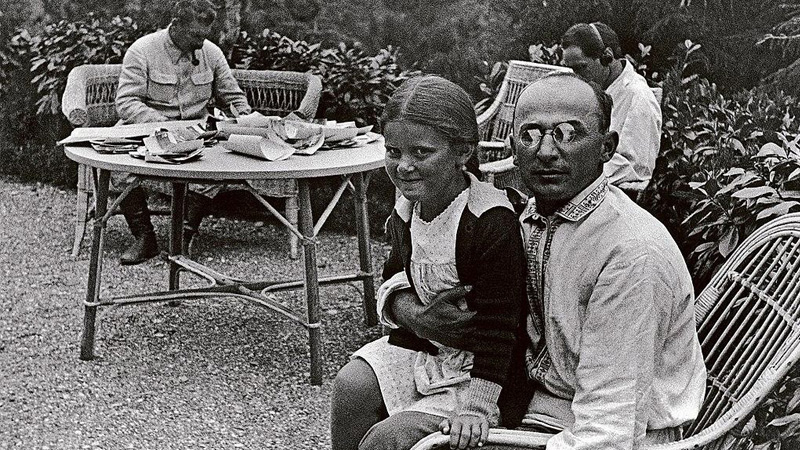 pSvetlana, Stalin’s daughter from his beloved wife, Nadya, which committed suicide due to chronic depressive episodes was the pearl of Stalin’s eyes. Nadya’s suicide broke Stalin about which he said, “With the death of Nadya my last feelings for humanity perished, she softened my heart of stone.”
Stalin ruled through the group of four, Lavrenteiy Beria, the ambitious, energetic, ruthless and workaholic NKVD (secret police) boss; Malenkov (Stalin’s loyalist during his war with Trotsky), Molotov (the top diplomat of Stalin’s administration and due to his indomitable energy, Stalin called him iron arse) and Mikoyan. The four reshuffled from time to time so no one could become powerful enough to challenge his authority. Nikita Khrushchev’s prominent role on the Ukrainian front during the Second World War also made him a part of Stalin’s inner circle.
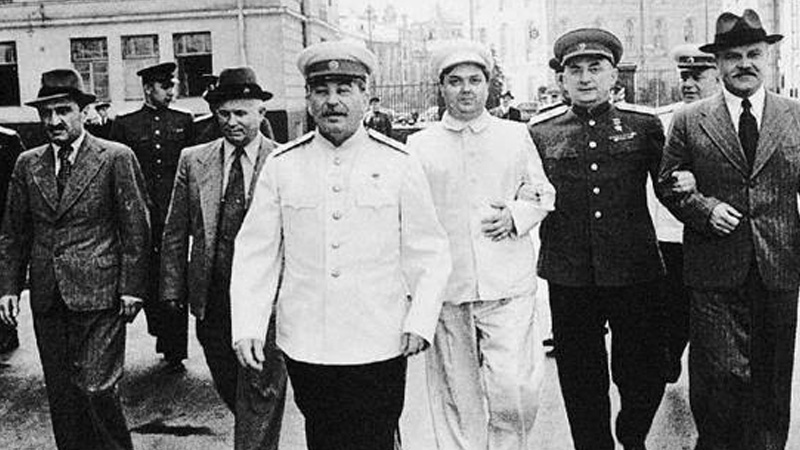
On August 12, Generalissimo Stalin cheerfully led his magnates for the parade: Mikoyan, Ukrainian Viceroy Khrushchev, Malenkov, Beria in Marshall’s uniform and Molotov.
After the swift extermination of all opposition to his rule, Stalin embarked upon enforcing Bolshevik reforms. This was an arduous journey but Stalin the man of indomitable will, implemented it. The collectivisation of agriculture resulted in the deaths and arrests of millions.
Stalin predicted Hitler would never attack the union. And a few weeks before the German invasion, he did not believe the intelligence reports regarding the massing of German troops across the Soviet borders. When the full-blown German attack began on Sebastopol, General Timoshenko, the senior general in the red army, tried to contact Stalin but failed. Russian Generals were petrified from both Stalin and German attack.
Finally, General Zhukov told him and asked his permission for a counter-attack. But Stalin called Politburo’s meeting. Molotov met German Ambassador and rushed to Stalin’s office announcing, “Germany has declared war on us.” Montefiore wrote in his book, “The court of the Red Tsar,” “Stalin subsided into his chair, lost in thought. The silence was long and pregnant. Stalin looked tired, worn out, recalled Chadaev. His pockmarked face was drawn and haggard. This recalled Zhukov, was the only time I saw Stalin depressed. Then, he roused himself with a wild slogan: ‘The enemy will be beaten along the line.’ And he turned to the Generals: ‘What do you recommend?’
Zhukov suggested that the frontier districts must hold up the Germans.
“Annihilate,” interrupted Timoshenko, “not hold up.”
The writer is a public policy and international relations scholar and is associated with reputed thinktanks.