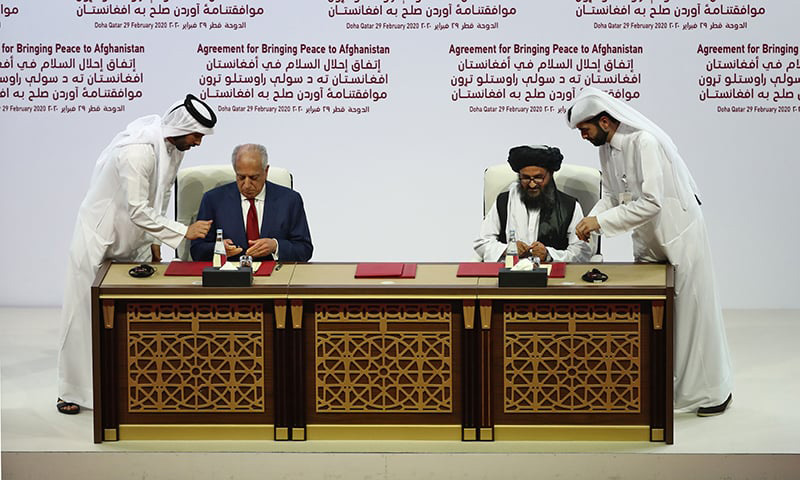
February ended with jubilation for many across the world, as the United States of America and the Afghan Taliban signed a peace deal, apparently putting an end to the 18-year-long war, fought on the land rightly called “the graveyard of empires”. A recent testimony to which came from US Secretary of State Mike Pompeo, right after the signing of the “Agreement for Bringing Peace to Afghanistan” in Doha.
The costs of the war have been high.According to the United Nations, in the past one decade only, it has consumed more than 38,000civilian lives. The total number of casualties rose above 147,000, which includes military, militants, humanitarian workers and journalists. This exceptionally high number of deaths and the economic outlays of the US-Afghan war for the American taxpayer was one reason-besidethere being no other logical conclusion to the war -inthe past two decades that compelledthe USA to sit across the Taliban in 2018 and sought a withdrawal from the region.
 If there’s one state outside of NATO, and apart from Afghanistan itself, which has suffered the US-Afghan war more than anyone it is Pakistan. Losing over 80,000 civilians and soldiers to the war on terror, Pakistan has paid a price mainly for its strategic geography that keeps it from being indifferent to the developments in its neighbour Afghanistan. Hence, what to the USA, at the time, was a “hypocritical approach”of Pakistan as it was obstinately fighting an unwinnable war is what the USA used to its benefit when it urged Pakistan to play a role in the US-Afghan peace dialogue. A role that Mike Pompeo was first to acknowledge post the agreement between the two parties, and that President Trump had, to the dismay of India, appreciated in a public gathering in Narendra Modi’s home state of Gujrat during his recent visit to India.
However, the picture is not as rosy for either of the parties as the jubilation over the deal signalled in the beginning. For Pakistan, the truth of the matter is that the real test of its diplomatic finesse in its so-called influence over the Afghan Taliban has just begun. For the Trump administration, the agreement may have been a step forward in taking its troops back home, what transpires further in the intra-Afghan dialogue is to determine whether it can be seen as asuccess for the USA and other parties seeking mediation or Afghanistan is plunged into another era of violence and destruction.
A huge drawback that Pakistan has in case the Taliban gets hold of power in Afghanistan is a spillover effect of the ideology
The intra-Afghan dialogue, beginning from March 10 between the rival groups in Oslo, Norway, is conditioned with the release of 5,000 Taliban prisoners, and 1,000 “prisoners of the other side” on the first day of intra-Afghan negotiations. A day after the signing of the deal, Afghan President Ashraf Ghani criticised the clause saying Washington had no authority to negotiate such an exchange. On the other hand, the Afghan Taliban does not accept the legitimacy of the current government of Afghanistan. Earlier, they refused to sit down with theGhani government on the grounds of it being a “puppet government installed by an occupying force.”
Another important factor to consider in the current scenario is the ongoing rift between the former Chief Executive of Afghanistan Abdullah Abdullah on the election results. The inability of the Afghan government to present itself as a united front further put questions on its legitimacy in the dialogue process.
The Talibanalso indicated towards the end of reduction in violence, making it limited to only the international forces the day before a blast rocked the Afghan capital. Continuity in violence against the Afghan administrative forces will pressurise the government for a confrontation, in case of which the capabilities of the Afghan forces are doubtful. The USA can only act apathetic to it to a limit; Afghanistan will remain its headache for many years to come.
Besides, Taliban and Afghan government are only two of the many groups. Afghanistanis a tribal society, and there are multiple stakeholders. Any interruptionin the dialogue process will increase the grievances between the groups, leading the country towards yet another civil war. In which case, the USA is unlikely to return to the ground itself and will need another country to interfere.Pakistan is well aware of the costs of “boots on ground” by now. The government of Pakistan, fully supported by its military establishment, however keen on peace in Afghanistan, has categorically stated on multiple occasions that it will not take part in someone else’s war.
Yet there is only limited influence that Pakistan can assert on the Afghan Taliban who are not the only party in the field.Even if the Taliban successfully regain power in Afghanistan, they are unlikely to return many of the wanted TTP commanders living in Taliban strongholds to Pakistan. They may even use them as an asset against Pakistan, since the trust level between the two parties is not the same as before 9/11.
The Afghan government and the liberal circles of Afghanistan enjoy a better relationship with India and are already sceptical of Pakistan’s increased role in the politics of Afghanistan, fearing a relapse of Taliban extremism and the demise of the little democracy the country has. While Iran has similar fears, India also sees its”strategic” investment in Afghanistan going down the drain with the possibility of the Taliban regaining strength in the politics of the region. The deal thus does come at the cost of disappointment for some of the important players in the region. The only reassurance amid these factors though is that Russia and China have maintained a positive interest in the process and are keen over the USA’s withdrawal.
Pakistan is looking towards an economic revival, which is bound to peace; most of its future plans rely on the success of CPEC and BRI for which stability in Afghanistan is essential. An instable Afghanistan would also mean a refugee inflow; Pakistan is already hosting an estimated 2.4 million registered and undocumented people from Afghanistan. The repercussions of that range from economical stress to social and environmental deterioration. A huge drawback that Pakistan has in case the Taliban gets hold of power in Afghanistan is a spillover effect of the ideology, as their aspiration is not only taking over the country but enforcing their model of sharia. Many powerful fractions in Pakistan find the idea attractive.
For the USA and NATO forces, there is no alternative to withdrawal at this point. But this escapist approach of the USA has high costs for the entire region, especially with the possibility of Afghanistan becoming a safe haven for terrorist organisations like the TTP and ISIS as it plunges into another phase of violence without the deterrence of an external force present. It is safe to say that Pakistan may have had a temporary success in rendering the USA a face saving in Afghanistan, but the road ahead is a slippery one for both the people of Afghanistan and the policy makers in Pakistan.
The writer is a Research Associate with Sustainable Development Policy Institute