 The sandy strip of Kachho dotted with several old graveyards, historical and archaeological sites is a treasure trove for historians and researchers.
Muridani jamali ja Quba (tombs of Muridani Jamali) is one of such site clearly endorsing the fact that now semi desert area of Kachho was once a lush green and one of most prosperous area in Sindh.
A majority of the tombs in this historic graveyard where generations of Jamali Tribe are buried, belong to Talpur dynasty era who ruled Sindh and parts of Punjab from 1783 to 1843.
The style of paintings generally resembles those at Allahyar Ja Quba graveyard near Dirgh Bala, another graveyard near Haji Khan and other tombs in several graveyards but the poignant paintings of vegetables and fruits, buffaloes, cows and fish painted in interiors of the most of the tombs at Muridani jamali ja Quba is slightly different from rest of the tombs in the area. This shows that before British period all kinds of crops were cultivated in this area on water from labyrinth of several torrential streams and springs.
The style of paintings generally resembles that of the Allahyar Ja Quba graveyard near Dirgh Bala, another graveyard near Haji Khan and other tombs in several graveyards but the poignant paintings of vegetables and fruits, buffaloes, cows and fish painted in interiors of most of the tombs at Muridani jamali ja Quba is slightly different from the rest of the tombs in the area
And livestock and wild life also thrived there. But now only dry crops like sorghum, cluster bean, Mustard sesame and Janbho are cultivated that too only when there is heavy rain or high flow of torrential streams. Otherwise the area remains in clutch of famine.
But during glorious past, whole area was flooded with high flow of torrential streams. Main stream was Nai Gaj which brought high flows and inundated vast areas of land. The Nai Gaj not only irrigated thousands of acres in Kachho but also was lifeline of agriculture in present barrage area. According to Sharaf Din Panhwar, a local expert of torrential streams feed agriculture, Nai Gaj have two main flows from west to east. One branch flowed from west to Dirgh Bala Village and besides irrigating present Taluka Headquarter Johi released in River Indus from the point of Johi. Other northern flow was from west to village pat Gul Muhammad and after inundating present barrage area released in river Indus in the east at the point of historical Village Paat. All this superb natural irrigation system was transformed when British put in place barrage and canal system. To safeguard the newly created irrigation system in barrage area of Johi, first a flood protection bund was constructed few kilo meters in the west of Taluka Headquarter Johi by British colonial government.
But finding it inadequate in the face of mighty flow and realizing that it would not withstand the furry of Nia Gaj water due to high steep nature of the landscape, the British decided to diverted the Nai Gaj flow from west to southward. A strong 10-mile boulder was constructed in 1930s and Nai Gaj’s centuries old course was changed. Now shackled Nai Gaj water roared to southward to Manchar lake. British also constructed and improved 8 water courses. One of these courses called karo wah flowed permanently due to low flow originated from natural springs which flow thorough out the year. Other wahs or channels got water during monsoon from up and part of mid-stream. At downstream part a series of Earthen Bunds were constructed in anticipation of water before monsoon by famers by pooling their financial, human and machinery resources.
 As the most of historical graveyards, stupas and other historical sites locations were intentionally chosen in the light of old irrigation system, with diversion of Nai Gaj these cultural symbols were also affected. The diverted system washed away major parts of the graveyards, thus wiping major chunks of history forever. Others are in grave danger. As elsewhere in other graveyards, the greedy superstitious elements have not spared Muridani Jamali Graveyard. In search of Gold, many big graves in and outside tombs has been ravaged by digging these deep by Gold Hunters. It is responsibility of the present government to take preservation measures to save these historical and cultural signs but cry of media and cultural activists fall on deaf ears of the successive government as well as present government one.
Besides causing irreparable damage to the historical and cultural assets, the British diversion system destroyed this excellent natural irrigation system because thousands acres of land previously irrigated by unfettered Nai Gaj and other smaller streams had been rendered barren since 1930s. Said Mr Abdul Fatah Dahri, local landlord and expert on water system of Nai Gaj.
Clarifying his point further Abdul Fatah further maintains that ‘now restricted flow doesn’t reach most of the land in the eastern part of the upstream and previously 8 to 10 small streams were feeding thousands of acres of land but after diversion, many of these smaller streams either dried up due to blockage of their natural flow by might Nai Gaj or brought very littler water and merged into Nai Gaj’.
the paintings on the walls of the tombs endorse past glory and greenery of the area.
Apples, grapes and all kind of other fruits adorned the inner parts of the tombs are proof of this fact. Experts are of the opinion that due to high fertility of soil and plenty of stream water containing high quantities of fertile silt, all the crops, fruits and vegetables were grow in past which are now improbability.
A minority of the locals differ, they call this past glory as exaggeration, they say that the painters from other locality might have painted the fruits and vegetables which are cultivated in their own area.
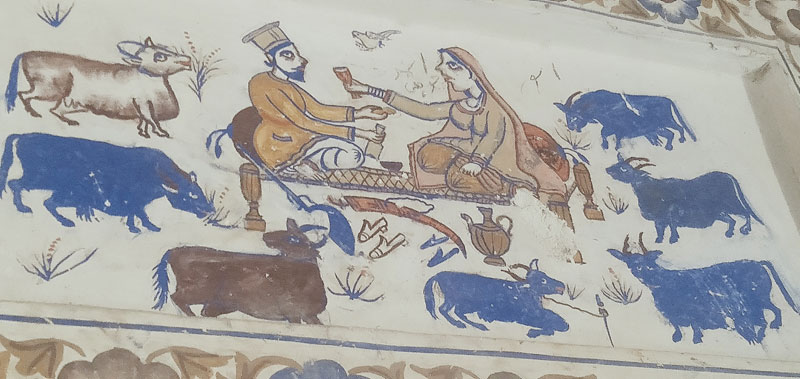
Besides fruits and vegetables there are scenes painted on tombs depicting popular folk stories like Sohini Mehwal, Heer Ranjha and Sasui Punho, in one seen Sohni Mehihwal are depicted siting on a cot and buffaloes are surrounding them.
Other paintings also paint local way of life.
On the top of the majority of the graves beautifully made cots are carved. Purpose of the carving cot or bedstead on every major grave symbolically shows that the buried person is resting in peace on bedstead. Furthermore, livestock and other daily routines of village life are exquisitely painted on the walls of the graveyards of Murdaini jamali ja Quba.
As barrage or canal area part of Taluka Johi has been completely destroyed and only 5 to 10 percent land is under cultivation due to acute shortage of water. Thus the whole pressure is on Nai Gaj Command area, people are installing solar run Tube wells in thousands. Off course, this provides livelihood to the locals and those from barrage area but at the same time, immense pressure is put on ever deepening underground water. What government needs to do is to regulate mushrooming up of solar run tube wells, restore buried water channels of Nai Gaj Command area, improve irrigation and road infrastructure by putting enough standardized culverts to ensure smooth flow and avoid inconvenience to the commuters due to usual breakup of the roads. urgent measure to preserve historical sites particularly historical graveyards are much wanted. Such kind of package would restore and expand the irrigation system, expand livelihood opportunities, help in protecting the environment by mitigating the climate change impacts including reducing the chances of natural disasters like drought and floods, enhance natural beauty of the area and most importantly would persevere the historical and cultural assets of the area.
The writer can be reached at [email protected]