
The world was on the watch for the ruling from the UN top court, the International Court of Justice (ICJ), on the Rohingya genocide case. The Court, based at the Hague, made its historicand unanimous decision (17-0)on January 23, 2019, and ordered the Myanmar government to “take all measures” to protect its Rohingya people, who “remain at a risk of genocide.” The case titled The Gambia v Myanmarwas brought to the ICJ in November 2019 by the Republic of the Gambia on behalf of the Organisation of the Islamic Countries (OIC), and later fully supported by other states such as Canada and the Netherlands.
In its application to the ICJ, Gambia alleged that Myanmar has “committed and continues to commit genocidal acts against the members of the Rohingya groups,” who are a distinct ethnic, racial and religious group in Myanmar’s Rakhine state. The application further contained a request for the indication of “provisional measures” seeking to preserve, pending the Court’s final verdict, the rights of the Rohingya group in Myanmar and its members under the 1948 UN Convention on the Prevention and Punishment of the Crime of Genocide.
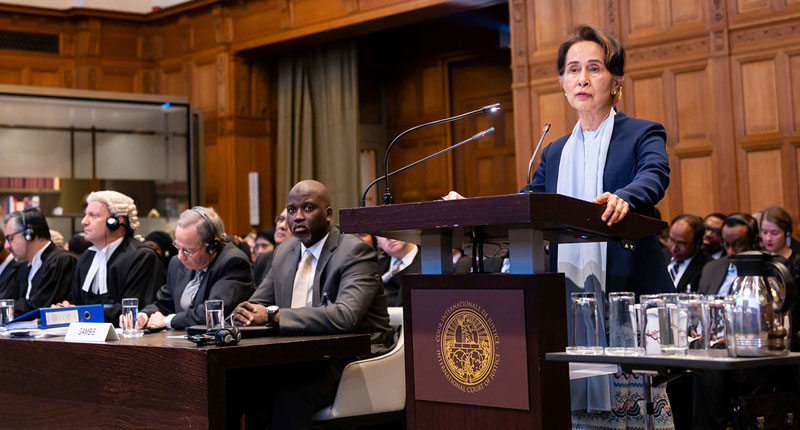
Public hearings on the provisional measures were held at the Hague from December 10-12, 2019. The Myanmar delegation, headed by the State Counsellor and de facto leader Aung San Suu Kyi, rejected the accusation of genocide, disputed the jurisdiction of the Court, and finally, urged the Court to reject the case. Aung San Suu Kyi further argued that what happened to Rohingyas in 2017 fell short of genocide, and that Myanmar should be left to deal with any human rights abuses through its own internal judicial systems. In view of the unique and rare case such as this, the ICJ, through the decision of provisional measures, first established its jurisdiction over the case, and held prima facie Myanmar accountable for its atrocities against the Rohingyas.
 In 2017, more than 800,000 Rohingyas, men, women and children, were forced-following the armed Arakan Rohingya Salvation Army (ARSA) attacks on police stations-toflee the country across the border to Bangladesh.They joined 200,000 others from previous waves of violence in Myanmar in 1996. This clearance operation was spearheaded by the Myanmar military and security forces that reached a peak with unlawful killings, rapes, murders, and indiscriminate burning of Rohingya villages in the northern Rakhine state. An estimated 600,000 remained inside Myanmar, mostly in squalid camps supervised by the army and without any access to emergency healthcare or formal education. According to the UN court, the Rohingyas in Myanmar remain extremely vulnerable and needed protection from further bloodshed.
The ICJ ruling is a clear message to Myanmar that the world will no longer accept their false statements and empty rhetoric on the reality in the Rakhine state
In the light of the complaint filed by Gambia against Myanmar and responses presented during the oral proceedings, the top UN court found “real and imminent risk of irreparable prejudice” against the Rohingyas, and therefore, ordered Myanmar, in accordance with its obligations under the Genocide Convention, to prevent genocide against Rohingyas. The Court ordered four provisional measures: first, Myanmar takes all measures within its power to prevent killings of the members of the Rohingya group, causing bodily or mental harm, inflicting any physical destruction, and imposing measures intended to prevent births; second, Myanmar must ensure that its military does not commit genocide or attempts to commit genocide or conspire to commit genocide; third, Myanmar must take steps not to destroy or render inaccessible any evidence related to alleged genocide; and fourth, the court ordered Myanmar to report back within four months, and then every six months after that.
The genocide case attracted immense attention worldwide as the former democracy icon and Nobel Laureate Aung San Suu Kyi personally defended the undefendable Myanmar case at the ICJ. Her defence of the Myanmar military atrocities horrified human rights advocates, who accuse her of indifference to the plight of the Rohingya people. The decision at the Hague came just days after Myanmar’s so-called Independent Commission of Enquiry (ICE), which admitted military atrocities against the Rohingyas, but declined to recognise any genocidal intent by the Myanmar state. The ICE was neither independent nor impartial for conducting any credible investigations of crimes against the Rohingyas.
The ICJ ruling is a clear message to Myanmar that the world will no longer accept their false statements and empty rhetoric on the reality in the Rakhine state. The Myanmar ruling sets important precedent for genocide prevention. More than 100 civil society organisations inside Myanmar voiced their support to the Gambia v Myanmar case and other ongoing accountability processes. The ICJ ruling on Myanmar is a first important step towards justice and accountability for the Rohingya people. It was a welcome news to all Rohingyas globally, particularly to the 1.2 million Rohingya refugees in Cox’s Bazar camps. Myanmar must now fully implement the provisional measures of the Court’s order.
The ICJ do not have any enforcing power but it works through the UN Security Council. The permanent members of the Security Council, particularly China and Russia, should reconsider their positions in view of the ICJ verdict and take steps to resolve the crisis in earnest without playing politics any further. Other nations such as India and Japan, must also support this independent judicial process. For Myanmar, the implementation of the provisional measures is compulsory under the international law.
The Myanmar government must now face up to its responsibilities, international obligations and duties. The dark daysmust be left behind for a new beginning. Accountability of perpetrators of human rights violations must be a part of the transition to the new beginning. We urge Myanmar to implement all necessary measures immediately. Further, as a step towards this new transition, the Myanmar government should immediately grant the Rohingya people full citizenship, freedom of movement and other human rights. It should simultaneously allow all investigators, humanitarian agencies, and media full access to the central and northern Rakhine state to create conditions for and facilitate a voluntary, safe, dignified and sustainable return of the Rohingyas to Myanmar.
The writer is an international development and resettlement expert, and advisory professor at the National Research Centre for Resettlement, Hohai University, Nanjing, China