
 While the Indicative Generation Capacity Expansion Plan (IGCEP) 2018-40, recently submitted by National Transmission and Despatch Company (NTDC) to NEPRA for review and approval, is a carefully-crafted comprehensive plan, it misses on some features that an “indicative” plan was supposed to have. Since, preparing of this plan by NTDC is an annual regulatory requirement, some suggestions are offered in the ensuing paragraphs for NTDC and NEPRA to consider for making theseplans truly “indicative” in the future.
When the power sectors of many countries around the world were opened to competition and choice in the late 80s and 90s, there were two major motivations behind these reforms. One wasto share the financial burden of this sector’s capital-intensive schemes with the private sector. Another was to subject it, wherever possible, todisciplineof private markets, hoping to remove the inefficiencies that were rampant throughout this industry’s value chain. Though the past couple of decades have seen substantialprivate investments in the generation side of the business and some success in improving efficiency in its various tiers, it has also led to a rude awakening that not everyaspect of thisbusinesscan be left to themarket.
NTDC’s IGCEP 2018-40, we notice that it is more of a definitive nature than indicative, and as such, may not be able to fullyserve the regulatory objective for which it has been developed
One such aspect in which the private markets failed to deliverhas to do with profit-maximizing mindset of the private investors which inclined them to prefer investments in projects and schemes that ensuredthem quickand hefty returns and cut corners on many critical aspects of this industry that did not carrysuch lucrative prospects. Consequently, many of the otherwise attractive (but with longer gestation periods) generation options were ignored and there were hardly any mentionable investments in the transmission and distribution (T&D) networks.This often resulted in frequent price spikes, bottlenecks in the T&D system, and poor performance in some other aspects of the business.
To counter these tendencies-lack of sufficient investment in less-attractive generation options and T&D networks and facilities-the regulators decided to intervene by issuing “indicative” plans. These plans identified the preferredchoices for investment, incentives that were to be available topotential investors, and constraints that must not be violated. This was the regulators’ way of correcting the market failure without actually disturbing its functioning.The field was still level-playing for all parties, but now with somedefined guideposts and boundaries.
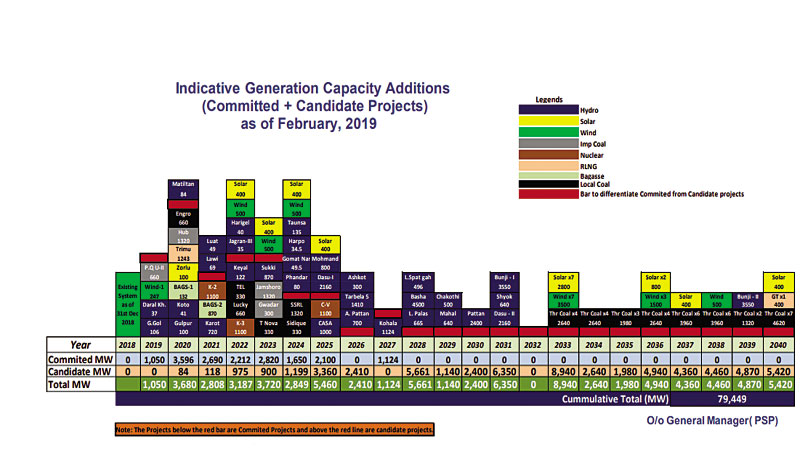
It is through the above lens that when we see the NTDC’s IGCEP 2018-40, we notice that it is more of a definitive nature than indicative, and as such, may not be able to fullyserve the regulatory objective for which it has been developed. Otherwise it is quite a comprehensive plan, prepared painstakingly, and is also very nicely structured and presented.The IGCEP already specifies the various generation requirements till 2040 in concrete and definitive terms: the fuel choices, technologies, plant sizes, timing of their addition into the system, and in many cases their location as well. This leaves very little choice for the potential participants to offer any innovative, creative, and economically more viable solutions to serve the forecast demand, thus defeating its essential purpose.
Indicative generation plan is among the few documents in which the government’s preferences, goals, and targets in the power sector are to be specified in more concrete terms. The present plan ignores the potential role that options such as energy conservation, demand-side management, and efficiency improvement can serve in lessening the electricity demand in the country, and in turn, reducing the need for costly new capacities. It also overlooks the scope of electric transportation in the country which is expected to have tremendous impact on the power grid, both on the demand as well as supply sides. Though renewables have been considered, there addition is not in line with the government’s ambitious targets to upscale their penetration in the grid to 25% by 2025 and 30% by 2030. These national goals and targets, perhaps, were not issued well in time, to enable the NTDC to include these in its strategic plan.
Nothing is, however, still lost. The NTDC in fact has done a great job in providing a sound foundation by preparing this plan, after a gap of many years. We only need to build further from here. Four key suggestions are offered below that the NTDC should consider when developing the future versions of this indicative plan.
The present plan ignores the potential role that options such as energy conservation, demand-side management, and efficiency improvement can serve in lessening the electricity demand in the country, and in turn, reducing the need for costly new capacities
First, it should clearly define the various perspectives from which the optimization of generation capacity expansion will be sought. It is important that the NTDC and NEPRA reach a consensus on the objectives that the generation plan has to serve. Next step should be to work out the attribute(s) for each of these objectivesthat can be used to assess the extent to which a portfolio meets that particular objective. Some of these attributes maydefy easy quantification or monetization. These can be kept out of the first round of the optimization process, butcan be used subsequently in a second roundto further filter the set that has successfully passed the first phase’s criteria.
 Second, instead of a single generation portfolio, NTDC should work out a set of portfolios that meet the primary (quantifiable) criteria but differ on secondary (qualitative) attributes. It will also be important that the NTDC,when developing multiple candidate portfolios,varies the values of variouskey variables in the optimization, and see how their variations impact the choice, sequence, and timing of various plants. For example, instead of using point estimates for major variables like GDP and population growth, fuel prices, discount rates, and capital costs of candidate technologies, the NTDC should vary the assumptions over a reasonably expected range to assess their influenceon the final choice. NTDC should present these results to NEPRA and finalize the selection of the most viable generation portfolio via a stakeholder consultative process.
Third, the NTDC should present a set of choices in the future power sector development that will be available to potential investors in terms of specific targets for demand-side management, induction of renewable plants, adoption of clean technologies, and diversity of primary energy suppliesthat are to be pursued. The future plans should also specify the various incentives that will be available to investors if they offered acceptable solutions in the selected categories, clearly indicating the constraints and boundaries that should be respected, for instance, limits on emission of pollutants, acceptable share of foreign funding in projects, and minimum share of local employment and equipment in each project, etc.
Fourth, NEPRA should consider changing the frequency of developing this plan to five years, with minor fine-tuning allowedannually. The lead times for most power projects vary from 3 to 10 years. Once these projects are set in motion, it is difficult as well as costly to roll them back or change their major features. Developing a capacity expansion plan annually for a system whose major components require multi years to mature is not a good idea. It would be more prudent if therelevant provision in the Grid Code that mandates the NTDC to develop this plan annually is relaxed and made every five years instead, with annual review and minor adjustment. This relaxation will enable the NTDC to expand the depth and breadth of its optimization exercise. It will also help it considerably in managing the review and finalizing of its draft plans in consultation with NEPRA and other key holders in the country.
The writer is a freelance consultant, specializing in sustainable energy and power system planning and development.