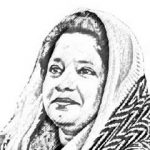
My first introduction to word ‘blind’ was through a personality who was a true personification of bravery, vision and conviction. I was just a kid when I saw Mrs Fatima Shah’s interview on national television. At that age, I was unable to grasp all that she was explaining, but her grace, confidence and oration kept me spellbound. It was later in life that I learned about her; she was a medical doctor, and due to a medical condition gradually lost her vision. She was among the pioneers of the Pakistan Association of the Blind and the International Federation of the Blind. She was among the early yet strongest voices for the rights of persons with visual impairment in Pakistan.
Another inspirational revelation of the world of blind came to me in the form of Helen Keller’s essay “Three days to See”. It is a masterpiece not only scholastically but also as a worldview from a genius that never got the chance to see or hear the world around her. Keller became deaf and blind due to an illness during infancy. But nothing stopped her from learning, excelling and communicating. She started communication through tactile signing, and later, through speech lessons, she started following lip movements of people. Learning braille enabled her to transmit her thoughts to paper. Her autobiography The Story of My Life and the 1962 movie The Miracle Worker describe the miracles of human conviction and courage in such a way that readers and audiences are simply mesmerised.
Keller wrote in her essay “Three Days to See”: “I have often thought it would be a blessing if each human being was stricken blind and deaf for a few days. Darkness would make him appreciate sight. Silence would teach him the joys of sound.”
While studying the history of Islam it became more evident to me that, even fifteen hundred years ago, Muslim society was a diversity-friendly and an inclusive society. On many occasions, when Prophet Mohammad (PBUH) had to leave Madina for jihad, he gave responsibility of imamat to Abdullah Ibn-e-Maktum who was blind by birth. Since the early days of Islam, students with visual impairment have been learning the Quran, and many of them became famous hafiz-e-Quran. Abdul Aziz Ibn-e-Abdullah, the former Imam-e-Kaaba is an example from the recent past.
Persons with visual impairment use Braille-a system of embossed dots-to read and write. Louis Braille who became blind in early childhood due to an accident developed this system. Inspired by military cryptography, he developed a system of embossed dots during his student days. This system is still used by persons with blindness across the globe. Gradually, technological innovations like screen reading software have made computers and the world of information more accessible for them and reading and writing easier.
There are many challenges in availability of quality and equitable education for diverse learners in our part of the world. But today my focus is on the best practices and success stories, so I will discuss those challenges some other day. There are universities like the Punjab University and the University of Management and Technology that allow their students with visual impairment to take their examinations on Braille, with the help of a writer or through an audio recording. Universities are also developing disability resource centres, equipped with required technology and aptly staffed. These provisions are facilitating students with visual impairment, and we get to see more students with visual impairment in universities now.
Orientation and mobility training are among the most important steps toward independent living for children and adults with visual impairment
I remember meeting Saima Saleem while she was a probationary officer in the Civil Services Academy, Lahore. She secured 6th position in CSS examination, but was not allowed to take up the foreign service group because she was blind. She fought a legal battle and won her right. Following her footsteps, her brother, Yousaf Saleem, topped in LLB examination from the Punjab University, topped the judiciary examination, and won the legal fight against the rigid system to become the first blind judge of Pakistan.
Orientation and mobility training are among the most important steps toward independent living for children and adults with visual impairment. There are many techniques that enable them to follow different cues to navigate safely in familiar surroundings. With proper training and practice, mobility becomes reasonably convenient for children and adults with visual impairment.
White cane safety day is celebrated on October 15 every year. White cane helps persons with visual impairment to move around safely, scanning the environment for obstacles. Different types of white canes (static tip, rolling tip, folding, laser guided, smart canes etc) are used according to the preferences and requirements of individual users. The white colour of cane also provides the information to people in the surroundings that the person using the cane is with visual impairment, and they should provide required facilitation. If you see someone using red and white-stripped cane, it means that the person is deaf-blind (with hearing and visual impairment).
Helen Keller said; “Character cannot be developed in ease and quiet. Only through experience of trail and suffering can the soul be strengthened, ambition inspired and success achieved.” As a member of this diverse world, we should all try to honour our struggles and respect the challenges faced by others. More empathy than sympathy is required for an equitable, just and inclusive society.
The writer is a Director Programs & Projects at Rising Sun Education & Welfare Society