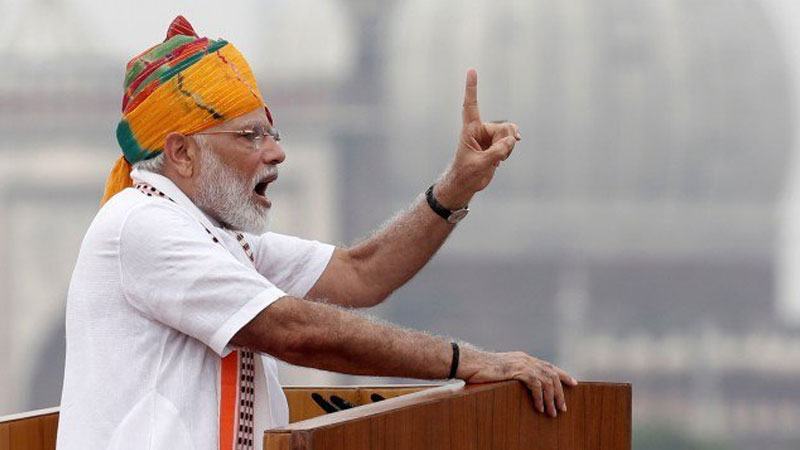
 Indian Prime Minister Narendra Modi on Sunday said it would take four months for Indian-held Jammu and Kashmir to return to normal after his government revoked the disputed territory’s special status in August and imposed harsh restrictions.
At a rally in the western state of Maharashtra, Modi said that his government had taken the necessary steps to maintain security in Indian-held Kashmir (IHK).
Alongside the withdrawal on August 5 of constitutional provisions that gave IHK special autonomy, Modi’s government flooded the region with additional troops and imposed curfew-like restrictions to keep a lid on protests.
Months after the move, mobile telephone and internet connections in the occupied valley, home to around seven million people, remain cut off.
Some mobile phone connections are set to be restored on Monday, the Indian government said on Saturday. “I assure you that it won’t take more than 4 months to normalise the abnormal situation that has persisted there for 40 years,” Modi said at the rally, speaking in Hindi.
“[Occupied] Jammu Kashmir and Ladakh aren’t just a piece of land for us,” Modi said, referring to the remote Buddhist enclave that borders China.
He also dared the country’s opposition to restore Article 370 in the occupied valley.
Members of the opposition, including those from Congress, had criticised the continued lockdown and communications blackout in the valley.
“Can these leaders, who’re trying to fool the people with their crocodile tears, bring back Article 370 in Kashmir? Will the people of India allow them to? Will the people of India accept it? I challenge opposition to declare in their manifesto they will bring back Article 370,” Modi was quoted as saying by Hindustan Times on Sunday.
He accused the Congress of politicising the government’s decision on IHK to “reap benefits” in the upcoming Maharashtra assembly elections.
“Congress and Nationalist Congress Party (NCP) think completely opposite to what the country thinks. They speak the language of a neighbouring country and hesitate to stand by the country,” Modi alleged, without naming the ‘neighbouring country’.
New Delhi insists that its move in August was essential to integrate IHK fully into India and bring development to the disputed Himalayan region, but there are anger and discontent among many locals over the decision.
Modi also claimed that India has “tried its best to ensure normalcy in the area, amidst all the negative powers in and around the area”, and last week, the IHK government published full-page advertisements in local newspapers asking people to resume normal life, including reopening businesses and sending children to schools. Reports emerging from the valley, however, tell a different reality. Millions have been left isolated from the world since the lockdown was enforced, with concerns raised about lack of medical supplies in the area. The crisis has upended the education of millions of children in the disputed Himalayan region, and many have been caught up in street violence.
Reports from the region also suggest that children – some as young as 14 – have been injured in actions by government forces.
An article published in The New York Times on October 7, titled “In Kashmir, a race against death, with no way to call a doctor”, gave accounts of doctors and patients in occupied Kashmir who say the crackdown has taken many lives.
“At least a dozen patients have died because they could not call an ambulance or could not reach the hospital on time, the majority of them with heart-related disease,” Sadaat, a doctor who did not want to be identified by his full name out of fear or reprisals, told NYT. Despite the curbs, Kashmiris have come out on to the streets, and many shops and other commercial establishments in the Kashmir valley have remained mostly shuttered in protests against the withdrawal of the special status.
Facing international pressure to ease people’s suffering and restore normal life, Indian authorities announced this past week that they would allow tourists back into the region after ordering them to leave in August because of security concerns. But tourists are unlikely to experience ‘normal life’ in the disputed area or be able to use mobile internet or cell phones, which remain cut. Some tourist operators expressed surprise over the Indian government’s decision.
“When everything is shut, what kind of tourist will take a risk to come here without basic amenities like phones and public transport?” said Bashir Ahmed, a tourist operator whose business has been shut since August.
India “has always tried to use tourism as a sign of normality”, said Nazir Ahmed, a Kashmiri schoolteacher.