• Skip to primary navigation
  • Skip to main content
  • Skip to primary sidebar
  • Skip to footer
Trending:
  • Kashmir
  • Elections
Saturday, June 6, 2026

Daily Times

Your right to know

  • HOME
  • Latest
  • Iran-Israel war
  • Gilgit Baltistan Election
  • Pakistan
    • Balochistan
    • Gilgit Baltistan
    • Khyber Pakhtunkhwa
    • Punjab
    • Sindh
  • World
  • Editorials & Opinions
    • Editorials
    • Op-Eds
    • Commentary / Insight
    • Perspectives
    • Cartoons
    • Letters to the Editor
    • Featured
    • Blogs
      • Pakistan
      • World
      • Lifestyle
      • Culture
      • Sports
  • Business
  • Sports
  • E-PAPER
    • Lahore
    • Islamabad
    • Karachi

Noor ul Ain Ali

Ladies, you can divorce your husbands

Published on: September 23, 2019 12:00 PM

Do you know Islam gives the right to divorce women if the husband delegates it in the marriage contract?

Both the mainstream sects of Islam, Sunnis and the Shias recognize the concept of Talak-i-tafweez or delegated divorce. The Muslim husband is free to delegate his power of pronouncing divorce to his wife or any person. He may delegate the power, absolutely or conditionally, temporarily or permanently.

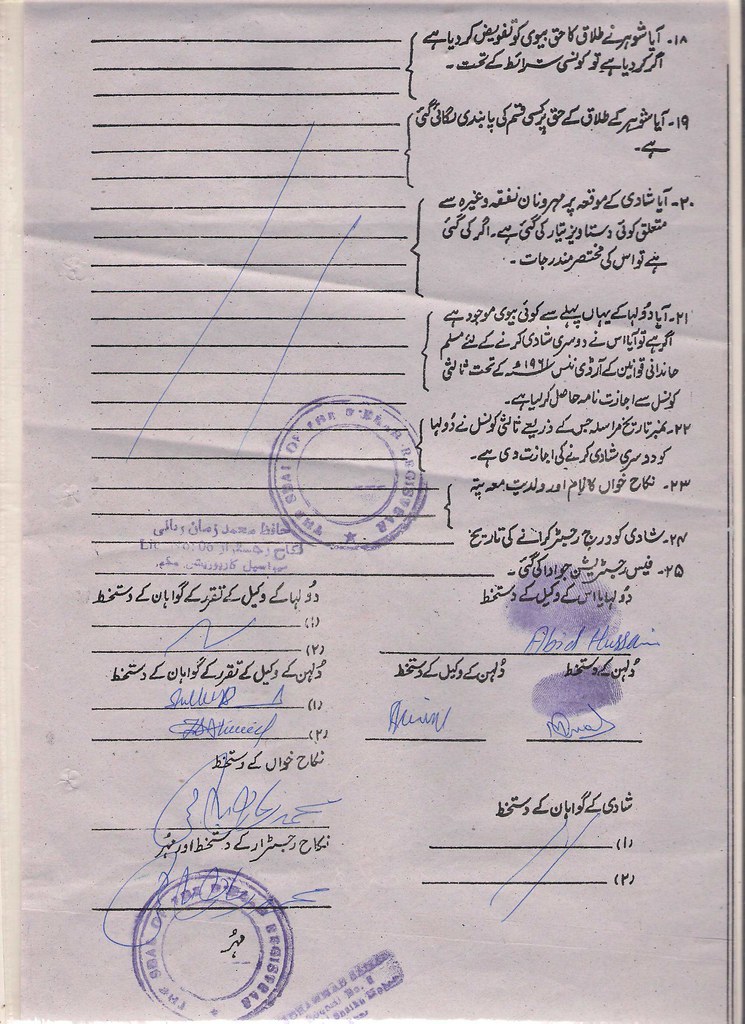
Husband may delegate the right to divorce while contracting marriage as per clause 18 of the Nikahnama. Otherwise, it is the exclusive right of the husband. But if the wife has no such right and she wants the dissolution of marriage then she can file a suit for the “Dissolution of Marriage” on the basis of Khula or seeks divorce both through the intervention of the court.

Likewise, in order to get rid of a toxic marriage, Islam empowers the women and gives them the right to divorce their husbands. Furthermore, it is important because in case of Khula (dissolution of marriage with the intervention of court), the woman has to forgo the Haq Mahr which is her fundamental right. This makes her financially vulnerable.

Moreover, some women succumb to abusive marriages just because of their financial insecurities. In such cases, the 8th clause of Nikkah Nama delegates the right to divorce to women without forgoing the Haq Mahr.

The Dilemma

The girls focus on a lot of things at their wedding. The dress. The makeup. The celebrations.

Then after she wears her dress for the one time in her life, removed the makeup she applied a couple of hours ago, and the celebrations die down, she’s officially into a relationship. Still smiley-faced.

She isn’t married because she’s done any of the above things and yet they’re the things that took up all her time and attention. Even vast amounts of money.

She’s married because of a legal document she signed. A document that lays down some terms and conditions she is free to impose in her contract she’s entering with the man who aspires to be her husband. Sadly like with the pop-up windows begging us to read the Terms and Conditions before clicking ‘Next’ on our computers, this document is signed largely unread.

Related image

This form of delegated divorce is perhaps the most potent weapon in the hands of a Muslim wife to obtain freedom from a toxic and abusive marriage without the intervention of any court.

Notably, the delegation of power to divorce may be made even in the post-marriage agreements between the husband and the wife. Such an agreement is valid, and such conditions are reasonable and not against Islam or the law.

Importance of Delegation of Divorce

Usually, Muslim majority countries are less developed and therefore, have not much women protection laws and mechanisms. However, Islam has granted the highest forms of protection to the women in all regards. For instance, Haq Mahr is obligatory for men to ensure the financial security of their spouses.

Despite the fact Islam has given ample security and rights to women, our society does not let women enjoy these right. Ironically, the families and the nikkah reciter do not let the bride and groom to review their marriage contract that rests the foundation of their relationship. Moreover, the elders struck off the most sensitive and important clause of the marriage contracts without the consent of the bride.
Ladies, you can divorce your husbands

However, if a bride tries to voice her opinion regarding the marriage contract, the families of both sides silence her.

Pakistani Law

Notably, Pakistani legislatures took worth mentioning initiatives to address the issue. The advocacy campaigns took a number of NGOs on board. According to the recently passed laws, the marriage registrar and the nikkah reciter would be placed behind the bars if he struck off the clause 18, 19 or 20 which are about woman’s security and well-being.

So ladies, if you’re thinking Pakistani girls simply HAVE to hang their heads submissively and accept their rights being slashed out of the document, that’s not true. Know your Rights and fight for them!


Filed Under: Blog

Submit a Comment


Primary Sidebar


Latest News

Alexander Zverev eases past Jakub Mensik in French Open semifinals

Taylor to face Pili in Croke Park farewell

FIFA bans vuvuzelas from World Cup stadiums

France brush off Ivory Coast loss, call it timely World Cup reminder

Legendary boxer Muhammad Ali’s 10th death anniversary observed

Pakistan

JAAC declared proscribed party ahead of AJK polls on July 27

Fixed tax scheme for small retailers launched to raise Rs 50bn annually

Govt cuts petrol price by Rs 4 per litre, keeps diesel’s unchanged

Bilawal promises GB voters with land and job rights

Iran declares support for Hezbollah with wider peace deal in doubt

More Posts from this Category

Business

SBP’s ‘Go Cashless’ campaign saw Rs 34bn in digital transactions on Eid

Short-term inflation down by 0.56%

Saudi-Pak Business Council shows interest in infrastructure investment

‘Govt, allies united in efforts to craft people-centric budget’

Rupee records gain against US dollar

More Posts from this Category

World

CENTCOM space post signals wider US military footprint

US official delivers Trump’s “good hello” to Putin

NASA lifts ISS evacuation alert after leak

More Posts from this Category


Footer

Home
Lead Stories
Latest News
Editor’s Picks

Culture
Life & Style
Featured
Videos

Editorials
OP-EDS
Commentary
Advertise

Cartoons
Letters
Blogs
Privacy Policy

Contact
Company’s Financials
Investor Information
Terms & Conditions

Facebook
Twitter
Instagram
Youtube

© 2026 Daily Times. All rights reserved.

Manage Consent
To provide the best experiences, we use technologies like cookies to store and/or access device information. Consenting to these technologies will allow us to process data such as browsing behavior or unique IDs on this site. Not consenting or withdrawing consent, may adversely affect certain features and functions.
Functional Always active
The technical storage or access is strictly necessary for the legitimate purpose of enabling the use of a specific service explicitly requested by the subscriber or user, or for the sole purpose of carrying out the transmission of a communication over an electronic communications network.
Preferences
The technical storage or access is necessary for the legitimate purpose of storing preferences that are not requested by the subscriber or user.
Statistics
The technical storage or access that is used exclusively for statistical purposes. The technical storage or access that is used exclusively for anonymous statistical purposes. Without a subpoena, voluntary compliance on the part of your Internet Service Provider, or additional records from a third party, information stored or retrieved for this purpose alone cannot usually be used to identify you.
Marketing
The technical storage or access is required to create user profiles to send advertising, or to track the user on a website or across several websites for similar marketing purposes.
  • Manage options
  • Manage services
  • Manage {vendor_count} vendors
  • Read more about these purposes
View preferences
  • {title}
  • {title}
  • {title}
We use cookies to ensure that we give you the best experience on our website. If you continue to use this site we will assume that you are happy with it.