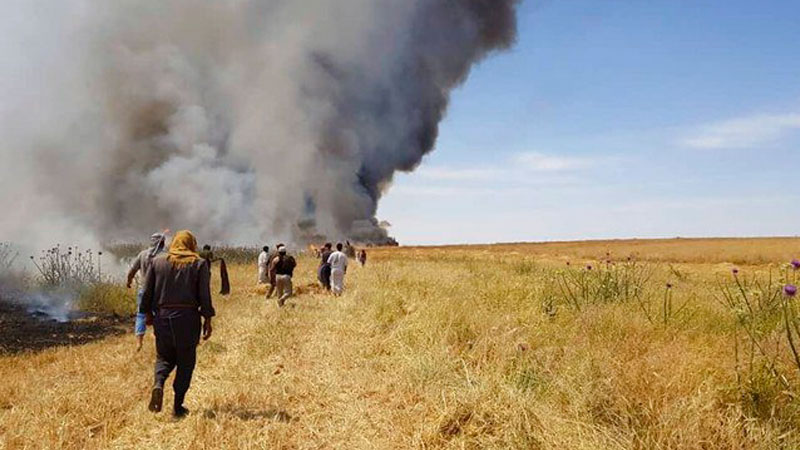
Iraqi farmer Riyadh woke on May 13 to find his wheat crop ablaze. In his fields in Diyala province, he found the remains of a mobile phone and plastic bottle which he believes was an explosive device detonated in the night to start the fire.
Riyadh and his neighbors in Sheikh Tami village put out the blaze and saved most of his crop but hundreds of other farmers in Iraq have been less fortunate since Daesh urged its supporters to wage economic warfare with fire.
Since the harvest began in April, crop fires have raged across Diyala, Kirkuk, Nineveh and Salahuddin provinces while the government, battered by years of war and corruption, has few resources to counter a new hit-and-run insurgency.
The government in Baghdad is playing down the crisis, saying very few fires have been started deliberately and only a fraction of the country’s farmland has been affected.
But officials in Iraq’s breadbasket province Nineveh warned that if the fires spread to storage sites, a quarter of this year’s bumper harvest could be at risk, potentially ending Iraq’s dream of self-sufficiency after years of disruption due to drought and Daesh rule.
Iraq declared victory over Daesh in December 2017 but the militants have regrouped in the Hamrin mountain range which extends into the northern provinces — an area described by officials as a “triangle of death.”
In recent weeks, Daesh has published detailed instructions online about how to carry out hit-and-run operations and weaken the enemy by attrition — without taking losses.
“It looks like it will be a hot summer that will burn the pockets of the rejectionists and apostates, as well as their hearts,” Daesh wrote in its Al-Naba newspaper last month, referring to Shiite Muslims and Sunnis who do not subscribe to its interpretation of Islam.
Prime Minister Adel Abdul Mahdi said last week that only about a 10th of the fires were the result of sabotage, with the rest caused by electrical faults, cigarette butts or faulty agricultural machinery.
He said just 40,000 donums (10,000 hectares) of wheat and barley had been destroyed by fire nationwide, a tiny proportion of the estimated 13 million donums of cultivated land.
“We are following up on the issue but it must not be blown out of proportion,” he told a weekly news conference on June 11.
‘Invisible hands’
Figures cited by federal officials, however, don’t tally with data given by officials and farmers in 10 areas of Diyala, Nineveh and Salahuddin provinces visited by Reuters. Based on their figures, at least 145,000 donums had gone up in flames in those areas alone by June 16.
The prime minister said there had been 262 fires nationwide this year, but Salahuddin’s civil defense chief told Reuters there were 267 fires during May in that province. Officials in Diyala also said the federal figures were too low.
In Nineveh, which accounts for almost half Iraq’s cultivated land with 6 million donums devoted to grain, officials recorded 180 fires between May 18 and June 11. By June 10, 65,000 donums of wheat and barley had gone up in flames in the province, well above Baghdad’s estimate for all of Iraq.
“Some days we have 25 fires reported,” Nineveh’s agriculture chief Duraid Hekmat told Reuters in his Mosul office.
During a 48-hour visit to Nineveh, Reuters witnessed five major fires and thick black smoke regularly clouded the skies.
Nevertheless, Nineveh is still expected to produce 1.3 million tons of grain this year, which would help it regain its status as the country’s breadbasket.
In the town of Alam in Salahuddin, council chairman Jassem Khalaf has spent much of this year’s harvest consoling distraught locals who have lost a combined 250 hectares to fire.
On May 15, his entire 50 donums of land caught fire too, destroying an estimated 60 tons of wheat that would have earned him 40 million Iraqi dinars ($34,000).
“It went up in flames in a moment,” he said, standing in his scorched field of blackened crops holding a lone golden bushel.
Khalaf was adamant some of the fires were man-made and said they could have been caused by Daesh, or other groups.
“In the past we would hear of one field being burned once every few years. This year, the situation is out of the ordinary,” he said. “Maybe there is short-circuiting, but there are also culprits and hidden hands.”
Tale of many arsonists
While scorching temperatures and tinder-dry fields in Iraq lead to fires every year, local officials said there are far more than usual this season and they’re finding more evidence that blazes have been started deliberately.
Daesh has claimed responsibility for burning hundreds of hectares of farmland in Diyala, Kirkuk and Salahuddin provinces as well as Syria. But it was impossible to determine how many fires had been started by the militants.
The challenge for the government is even greater because some have taken advantage of fires sparked by militants to start their own — to settle scores or ethno-religious feuds, farmers said.
Some farmers accused Shiite militias of burning the land of Sunni farmers they believe supported Daesh during their reign. They also said some security forces were burning fields to flush out insurgents holed up in farms.
Reuters could not verify their accusations and neither the militias nor security forces were immediately reachable for comment.
Local officials said the kind of device discovered by Riyadh in his burnt fields in Diyala was an example of just one method being used to start fires this year.
Riyadh, who declined to give his full name for fear of reprisals, shared a photo of the device. Reuters could not independently verify the authenticity of the evidence.
Local officials said magnifying glasses have been found in many scorched fields in western Nineveh and south of Mosul. They said gunpowder had been placed under the lenses in the hope it would ignite under prolonged exposure to the sun.
“This gunpowder doesn’t go in one direction, it goes into several directions to spread into a wide fire,” said Nineveh’s agriculture chief Hekmat.
Explosive devices have also been planted to target fire trucks as they arrive to battle the flames. Two of the 53 fire engines serving Nineveh province have been hit, stretching already meagre resources, said Col. Hossam Khalil, chief of Nineveh’s civil defense unit.
“It is not enough, but we are working with what we have,” he told Reuters.
Silo risk
Hazem Jebbo, a farmer in the Christian town of Qaraqosh southeast of Mosul, knows the blaze that destroyed most of his crops was not started by Daesh. He blames the authorities for negligence.
Jebbo, 63 fled in 2014 when Daesh burnt down his 100 olive trees, used his chicken coop as a shooting range and dug tunnels beneath his house. He returned to pick up the pieces in 2017. ?For two years nothing grew due to drought but then the rain came and his crops flourished.
But a bullet-riddled electricity pole in the middle of one field fell over on May 31 and the live wire sparked a fire. The district’s only fire truck arrived swiftly but its water pump failed and Jebbo lost 122 donums, the bulk of his crops. Forty other farmers lost land that day as the blaze spread.
Jebbo said he had begged the local authorities to fix the damaged pole for more than a year. They did — an hour after the fire had died down.
“Let them hear me carefully,” he said in tears in the charred remains of his farm. “Their negligence burned hundreds of donums, led to these losses.”
In Nineveh, agriculture chief Hekmat said grain silos were now his biggest concern, a worry shared by security experts.
“All our efforts are stored there. If something happens to these areas it will be a catastrophe,” he said.
Abdul Khalek Jassem, director of the Bazwaya silo in Nineveh, said they had stationed security forces at the entrance of the silo, which can hold up to 130,000 tons of wheat. The center has a single checkpoint manned by a Shabak paramilitary force affiliated to Iranian-backed Shiite militias.
Jassem reassured that all was under control, as thick black smoke rose from a new blaze in the fields beyond the silo. The emergency services took an hour to arrive and the fire had killed one person by the end of the day.