 Eyeing that can of soda in the supermarket cooler? Or maybe you’re craving a pint of ice cream? A camera could be watching you.
But it’s not there to see if you’re stealing. These cameras want to get to know you and what you’re buying.
It’s a new technology being trotted out to retailers, where cameras try to guess your age, gender or mood as you walk by. The intent is to use the information to show you targeted real-time ads on in-store video screens.
Companies are pitching retailers to bring the technology into their physical stores as a way to better compete with online rivals like Amazon that are already armed with troves of information on their customers and their buying habits.
With store cameras, you may not even realize you are being watched unless you happen to notice the penny-sized lenses. And that has raised concerns over privacy.
“The creepy factor here is definitely a 10 out of 10,” said Pam Dixon, the executive director of the World Privacy Forum, a nonprofit that researches privacy issues.
At the National Retail Federation trade show in New York earlier this year, a smart shelf on display by Mood Media tried to detect “happiness” or “fear” as people stood in front it – information a store could use to gauge reaction to a product on the shelf or an ad on a screen. Cineplex Digital Media showed off video screens that can be placed in malls or bus stops and try to tell if someone is wearing glasses or sporting a beard, which in turn can be used to sell ads for new frames or razors.
The screens can also be placed at the drive-thru. A minivan pulling into a fast food restaurant, for example, might get an ad for a family-sized meal on the video screen menu.
For now, the cameras are in just a handful of stores.
Kroger, which has 2,800 supermarkets, is testing cameras embedded in a price sign above shelves in two stores in the suburbs outside Cincinnati and Seattle. Video screens attached to the shelves can play ads and show discounts. Kroger said the cameras guess a shopper’s age and sex but the information is anonymous and the data is not being stored. If the tests work out well, the company said it could expand it into other locations.
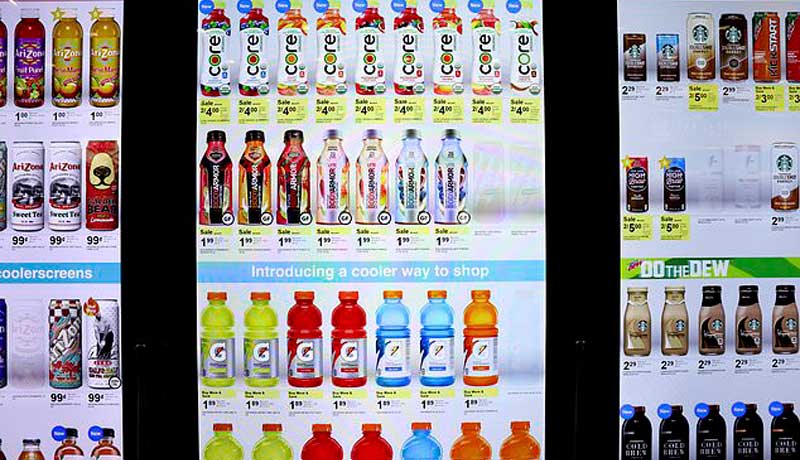
Walgreens, which has more than 8,000 drugstores, installed cooler doors with cameras and sensors at six locations in Chicago, New York, San Francisco and Bellevue, Washington. Instead of the usual clear glass doors that allow customers to see inside, there are video screens that display ads along with the cooler’s contents.
Above the door handle is a camera that can try to guess ages and track irises to see where you are looking, but Walgreens said those functions are off for now. The company said the cameras are currently being used to sense when someone is in front of the cooler and count the number of shoppers passing by. It declined to say if it will turn on the other functions of the camera.
“All such enhancements will be carefully reviewed and considered in light of any consumer privacy concerns,” Walgreens said.
Advocates of the technology say it could benefit shoppers by showing them discounts tailored to them or drawing attention to products that are on sale. But privacy experts warn that even if the information being collected is anonymous, it can still be used in an intrusive way.
For instance, if many people are eyeing a not-so-healthy dessert but not buying it, a store could place it at the checkout line so you see it again and “maybe your willpower breaks down,” said Ryan Calo, a professor at the University of Washington School of Law and co-director of its Tech Policy Lab.
“Just because a company doesn’t know exactly who you are doesn’t mean they can’t do things that will harm you,” Calo said.
The technology could also lead to discriminatory practices, like raising prices when an older person walks in or pushing products based on your perceived mood such as ads for anti-depression medication if the cameras think you look sad, adds Dixon of the World Privacy Forum. .
“We shouldn’t be gathering the emotional state of anyone,” Dixon said.
At a Walgreens in New York, a sign above a rack of wines said the store is testing cameras and sensors that “do not identify you or store any images.” The sign doesn’t say where the cameras or sensors are, but it does have a web address for the privacy policy of Cooler Screens, the company that makes the doors.
Calvin Johnson, who was looking for a Snapple, said he visited the store before, but didn’t notice the cameras until a reporter pointed them out.
“I don’t like that at all,” Johnson said.
Another shopper, Ray Ewan, said he noticed the lenses while grabbing a Diet Coke, but isn’t concerned since cameras are hard to avoid.
“There’s one on each corner,” Ewan said.
Not all retailers are keen on adding embedded cameras. Walmart’s Sam’s Club, which is testing shelves with digital price tags, is cautious about them.
“I think the most important thing you do with tech like that is to make sure people know,” said John Furner, Sam’s Club’s CEO. “You don’t want to surprise people on how you use technology or data.”
Jon Reily, vice president of commerce strategy at consultancy Publicis.Sapient, said retailers risk offending customers who may be shown ads that are aimed at a different gender or age group. Nonetheless, he expects the embedded cameras to be widely used in the next four years as the technology gets more accurate, costs less and shoppers become used to it.
For now, he said, “we are still on the creepy side of the scale.”