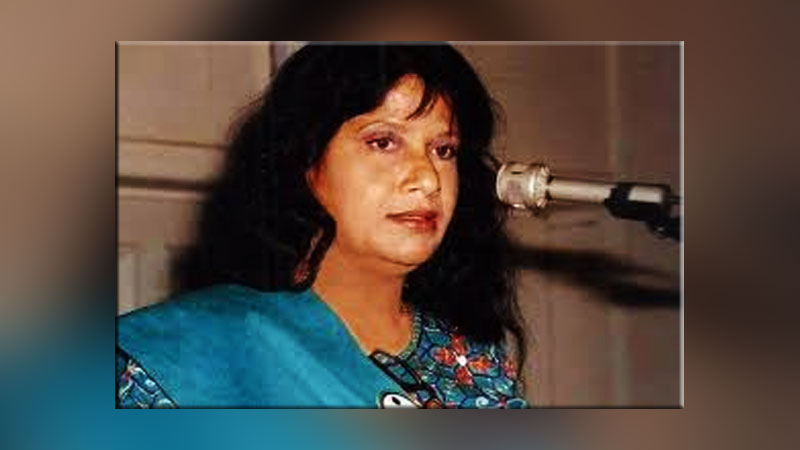
 Fans and admirers would mark the seventh death anniversary of the celebrated author, activist, poet and journalist, Abeda Iqbal Azad, who breathed her last on April 20, 2012.
Her untimely death cut short her career, which was at its high point. To commemorate her anniversary, several literary organisations have planned memorial sessions and reference meetings.
The organisation for arts and creative writing, Momasslat-e-Asrar, would also announce the results of ‘Bahaar Awards’ contest for Urdu poetry on the occasion. Launched on February 5, the contest continued till April 9. It received a large number of entries from all over Pakistan and abroad.
Similarly, Karachi Press Club’s literary committee and Halqa-Arbab-Zauq have also chalked out sittings to mark the day.
Azad was born to a businessman-cum-educationist, Gholam Rabbani, in Bangladesh. She did her MBBS from Dhaka and moved to Karachi after her marriage to the advertising executive, Iqbal Azad Syed.
Azad started her journalistic career with Bangladesh Observer and Bangladesh Times as a feature reporter. At the same time, she continued contributing to other newspapers and magazines.
Famous for her activism through poetry and simple reader-friendly diction, she was a voice against injustice and violence against women.
The giant was an established columnist who hit the fame with her poetic venture “Aasman,” a book of poems and two popular columns; “Aaina” and “Chehre”; published simultaneously in Daily Jurrat and Urdu Express.
She also wrote for other newspapers in Pakistan, such as Hurriyat, Jang, Jurrat, Nawa-e Waqt, Khabrain and Ash-Sharq.
Azad’s works also include translations of Saadat Hasan Manto and Kahlil Gibran. ‘Dateline Dhaka’, her feature series, which is a historical record of the 1971 fall of Dhaka, was widely published in some leading newspapers and caught the attention of academics, scholars and writers.
Her poetry acclaimed extensive appreciation from the media and critics alike. She had a tremendous competence for in-depth analysis of concurrent social, civic, economic, politics and governmental affairs.
She will always be remembered for her deep and flawless socio-political analyses. The fine words she used to construct her short stories and poems conveyed her intricate workmanship of literature.
Azad was a life member of the Arts Council of Pakistan. The social activist was associated with many non-profit and women’s organisations. She was the chartered president of the Karachi Rhythm Lions Club and Shah Faisal Lioness Club, as well as the district officer of Lions Clubs International and Lioness Clubs.