
A country’s foreign policy always keeps changing. Its base gets roots from the saying “there is no eternal friend, no eternal enemy but only national interest is eternal. Thus, external policy always passes through evolution. The foreign policy of Japan has also passed through various phases.
After the conclusion of the US-Japan Friendship Treaty in 1951, the US occupation of Japan came to an end. However, the US maintained its forces on the soil of Japan to deter possible armed attack against the host country.
Before signing this treaty, the constitution of Japan was promulgated on November 3, 1946 and came into effect on May 3, 1947. Article 9 of the Japanese constitution renounced the war. It states “Aspiring sincerely to an international peace based on justice and order, the Japanese people forever renounce war as a sovereign right of the nation and the threat or use of force as means of settling international disputes”.
In order to accomplish the aim of the preceding paragraph, land, sea, and air forces, as well as other war potential, will never be maintained. The right of belligerency of the state will not be recognised.” This article of the constitution laid the foundation of pacifist foreign policy of Japan.
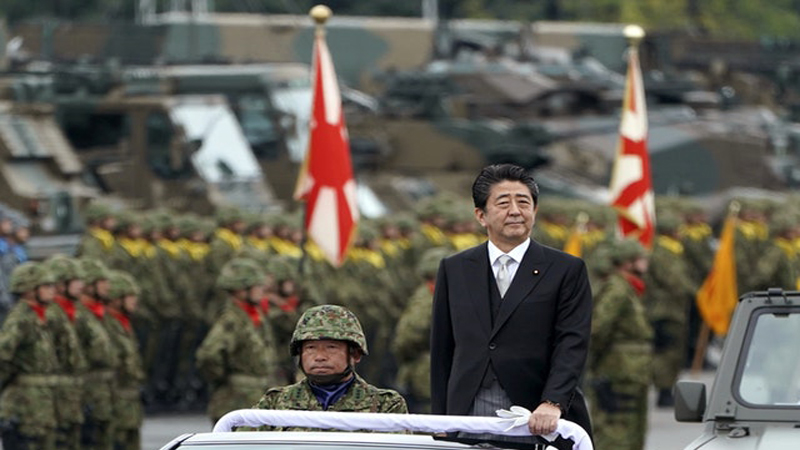 It restrained Japan from raising military force for offensive purposes. Thus, Japan created a Self Defence Force. Japan focused on designing a foreign policy which might help it from coming out of the consequences of World War II and restore its prestige and honour in the world community. It also required infusing confidence in its citizens and wanted to revive its economy. Thus, foreign policy passed through various phases.
Japan became part of the capitalist bloc led by the United States and began playing its role in international organisations. The US defense shield, including with other factors worked for the economic development of Japan.It emerged as a global economic power and entered the ‘Group of 7 (G-7)’ — a group of the world’s most industrialised countries. The main events which affected the world, particularly Asia, included the Korean war (1950-1953) ), U.S military presence in Vietnam (1960s),the Soviet invasion of Afghanistan (1979-1988), Iran-Iraq War (1980-1988), Iraq’s attack on Kuwait (1990) and nuclear armament in Korean peninsula and the region of South Asia.
The Soviets landed their forces in Afghanistan in December 1979. The US and its allies, including Japan, opposed the Soviet move and demanded immediate withdrawal of the invading forces.Japan supported the resolutions in the United Nations demanding the withdrawal. It extended aid to refugees through United Nations High Commissioner for Refugees. It supported Pakistan on the Afghan problem.
The United Nations appointed Diego Cordovez as its envoy on Afghanistan. After holding more than five rounds of talks, an accord was signed between Pakistan and Afghanistan in 1988. The US and the Soviet Union signed the accord as guarantors. Thus, the nine-year occupation of Afghanistan came to an end.
Terrorists attacked the US on September 11, 2001. 24 Japanese citizens died in the attack. It joined a 24-country strong coalition led by the US
Japan considered nuclear armament in the Korean peninsula against its security. Due to the nuclear race in South Asia, Japan held Kashmir as a flashpoint.
Iraq invaded Kuwait in 1990. It put the peace of the region of the Persian Gulf in jeopardy. The US and its other allies including Japan have interests in the region. According to one report, Japan spent $13 billion to help the military operations supported by the U.S. It did not earn positive fame for Japan. According to one media report, Tetsuya Nishimoto, retired Senior Japanese Ground Self Defense Force said, “We learnt from the Gulf War that just sending money and not people would not earn us international respect”.
In the post-Cold War period, a few changes took place in the external policy of Japan. For the first time, it decided to send its forces as a part of Peace Keeping Forces of the United Nations in Cambodia in 1992. Japan sent about 2000 troops. Though this action was in consonance of the pacifism policy of the country, its scope extended beyond self defence.
Japan continued its aid to Afghan refugees after Soviet withdrawal from Afghanistan. It did not recognise the Taliban Government. The US and its other allies including Japan, left the country without any substitute for the Soviet occupation. Probably, they failed to foresee the importance of Afghanistan in the post-Cold War period. Thus, the Taliban strengthened their position.
Terrorists attacked the US on September 11, 2001. Twenty-four Japanese citizens died in the attack. It joined a24-country strong coalition led by the United States. Japan said that incidents of terrorism were totally unacceptable. It extended refueling facility under Operation Enduring Freedom-Operation Interdict Maritime (ORF-OIM) to the ships of the coalition in the Indian Ocean. The operation started in 2002 and till its completion, ships were refueled 938 times and delivered 510,000 kiloliters of oil. This facility was discontinued in 2010.
The US took a new turn in its foreign policy after the election of Donald Trump as the President. Japan has US influence, to some extent, on its foreign policy. However, Japan has also exercised its independent view on different occasions.
In 2017, the US President announced the shifting of American capital from Tel Aviv to Jerusalem. The international community condemned the US decision. The United Nations General Assembly adopted resolutions, moved by Pakistan and other countries with 128 votes in favour. Japan also voted against the US decision.
Japan has various challenges on its foreign front. Its success depends on decisions to keep changing its foreign policy in accordance with requirements in the national interest.
The writer is an author and has a doctorate in Political Science
Published in Daily Times, February 28th 2019.