
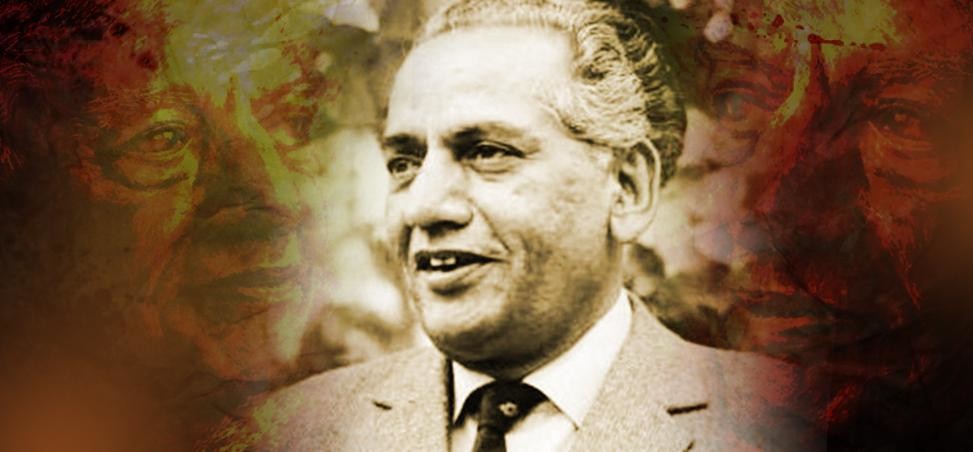
 In 1981, when I was a lawyer in Allahabad High Court, the poet Faiz saheb came to Allahabad, my home town.
A function was organized in his honour in the Allahabad University lawns. The university lawns are massive, and so was the crowd that evening. There were many poets on the dias that day: Firaq Gorakhpuri, Mahadevi Verma and, of course, Faiz saheb. It was like a galaxy of poetic stars on the firmament. Firaq saheb was so old that though mentally alert, he could not walk, and so he had to be carried by some university boys onto the dias.
Since I am very fond of Urdu poetry, and since I am particularly fond of Faiz’s poetry, I went to the function. I took along with me my son Vikram, who was then only 6 years old, knowing that he would not be able to understand anything, but yet in later life he could tell his friends he had seen Faiz and Firaq.
The function began with the convenor reciting a sher of Firaq:
“Aane waali nuslein tumse rashk kareingi hum aasron
Jab woh jaanengi ki tumne Firaq ko dekha hai”
He then said that he would like to slightly alter the sher:
“Aane waali nuslein tumse rashk kareingi hum aasron
Jab woh jaanengi tumne Faiz, Firaq aur Mahadevi ko dekha hai”
Thereafter, a well-known nazm by Faiz, “Gulon mein rang bhare baad-e-naubahaar chale” was sung by some Allahabad University girls.
I have heard that song sung innumerable times, but I have never heard it sung as beautifully as it was sung that memorable evening 34 years ago by the Allahabad University girls. The poets on the dias then recited some of their poems. The last to be called upon, and the one we were really waiting for, was Faiz saheb himself.
There was massive cheering when Faiz saheb rose to speak. Here was the man who had stood by his principles all his life, who was jailed for several years in Pakistan by the martial law regime, falsely implicated in the Rawalpindi Conspiracy case, who had written “Bol kay lab azad hain tere, bol zubaan ab tak teri hai.”
Faiz saheb first said that he was proud to be in Allahabad, the city of Rishi Bharadwaj, where Lord Rama had come during his exile from Ayodhya, and of other Rishis and Munis. He then related to us about his association with the Progressive Writers Association in the 1930s and the work he had done. He ended by reciting some of his kalaam.
The recollection of that memorable evening is indelibly etched into my memory. Faiz saheb is my favourite Urdu poet of the 20th century (though I regard Mirza Ghalib the greatest Urdu poet of all times). So, I quoted him in some judgments of mine in the Supreme Court, beginning the judgment with his sher.
When I decided to issue an appeal through my judgment to the Pakistan government to release an Indian citizen, Gopal Das, who was undergoing a life sentence in Pakistan for espionage, and had been in Pakistani jails for 27 years, I began with a couplet of Faiz:
“Qafas udas hai yaaron, saba se kuch to kaho
Kaheen to beher-e-khuda aaj zikr-e-yaar chale”
The sher had such a powerful impact on the Pakistani authorities that they announced that the Pakistan government would honour the appeal made by the Indian Supreme Court. Gopal Das was released a few days later, and he came back to India and has gotten married.
This was unprecedented. Never perhaps in the world’s judicial history was such an appeal made by any court, and never was it so honoured. Such is the power of Urdu poetry.
In another judgment in the Supreme Court, I again began by quoting a sher by Faiz:
“Bane hain ahal-e-hawas muddai bhi munsif bhi
Kise vakeel karein kisse munsifi chaahen?”
i.e.
“When selfish people are both petitioners and judges
Who should be appointed lawyer? Whom should we seek justice from?”
I was informed by a lawyer friend who went to Pakistan that soon after I gave the judgment quoting the above sher, printouts of my judgment were distributed like hot cakes in Lahore, Karachi and other cities. I was told by another friend that when one of my judgments was cited in a high court in Pakistan, the judge asked the lawyer “Is he the same judge who quotes Faiz?”
Let me end by mentioning a mischief from over 40 years ago, which I haven’t revealed to anyone until now.
The incident happened in the year 1972 or 1973. I was then a very junior lawyer in Allahabad High Court. I have so much fire in me even at the age of 69. You can imagine the fire in me at the age of 26 or so.
It so happened that a very “dismissing judge” elevated from the subordinate judiciary and came to the Allahabad High Court. He dismissed almost all petitions and appeals. Some lawyers came to me and said “Katju saheb, bachaiye, yeh to hamein barbaad kar dega.” (Katju saheb, save us, this judge will ruin us.”)
I told them not to worry.
That evening I wrote a leaflet with the heading “High Court ya kasai ghar?” (High Court or slaughterhouse?”). I quoted the “Bane hai ahal-e-hawas muddai bhi munsif bhi” sher by Faiz in it. I then wrote that since the judge came, he dismissed almost all cases, turning the high court into a slaughterhouse.
The leaflet was secretly printed in some press, and the next morning, long before the court could assemble, was distributed widely in the high court premises. In each of the courtrooms, a copy was placed on the judges’ desk and in the front row where the senior lawyers would sit. When the judges came to their courtrooms, they saw the leaflet, read it, and there was an uproar. Many judges retired to their chambers saying, “Yeh kya badtameezi hai?” (“What is this impertinence?)
But the leaflet had its effect, and the judge became more liberal afterwards.
The credit, again, must go to Faiz.