• Skip to primary navigation
  • Skip to main content
  • Skip to primary sidebar
  • Skip to footer
Trending:
  • Kashmir
  • Elections
Saturday, June 6, 2026

Daily Times

Your right to know

  • HOME
  • Latest
  • Iran-Israel war
  • Gilgit Baltistan Election
  • Pakistan
    • Balochistan
    • Gilgit Baltistan
    • Khyber Pakhtunkhwa
    • Punjab
    • Sindh
  • World
  • Editorials & Opinions
    • Editorials
    • Op-Eds
    • Commentary / Insight
    • Perspectives
    • Cartoons
    • Letters to the Editor
    • Featured
    • Blogs
      • Pakistan
      • World
      • Lifestyle
      • Culture
      • Sports
  • Business
  • Sports
  • E-PAPER
    • Lahore
    • Islamabad
    • Karachi

Ibrahim Mahmood Batla

Blasphemy law is vague, violates human rights

Published on: October 10, 2018 2:57 PM

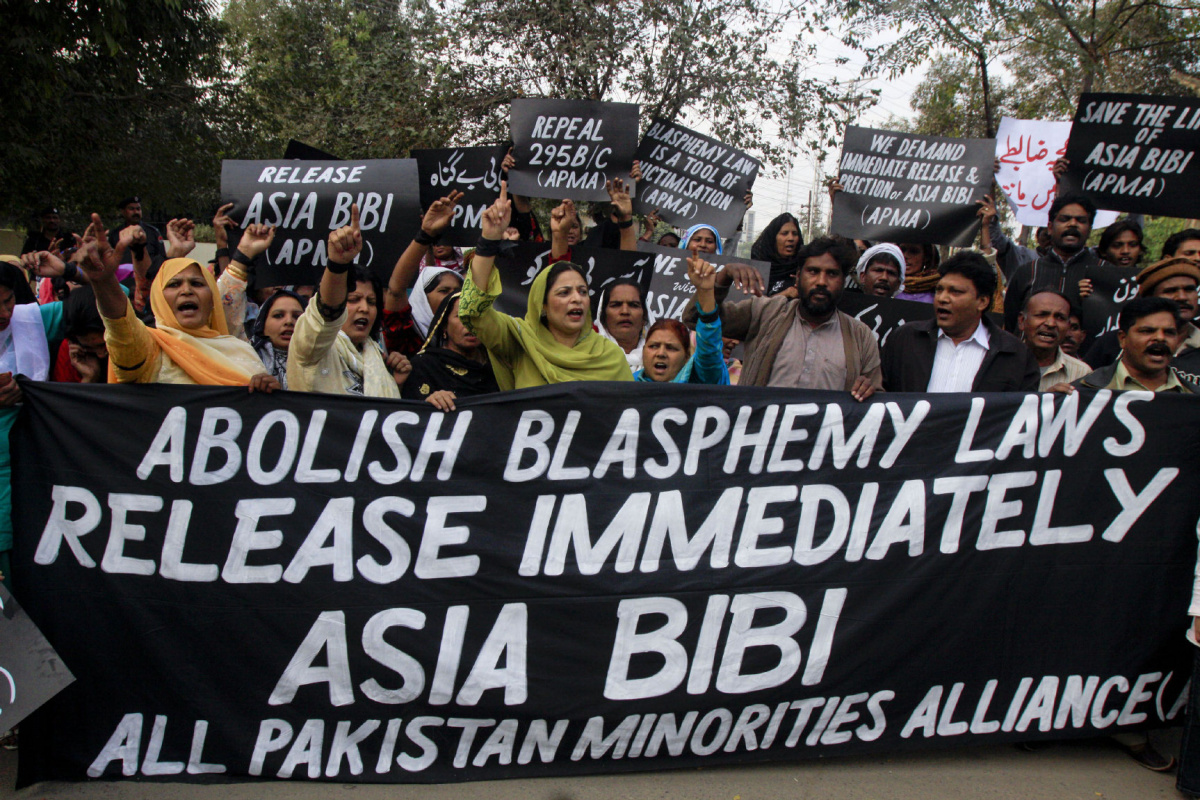
In this Sunday, Nov. 21, 2010 photo, supporters of All Pakistan Minorities Alliance hold a demonstration against blasphemy laws in Lahore, Pakistan. A court sentenced Mohammad Zulfiqar, 50, to death on blasphemy charges in eastern Pakistan, a government prosecutor said Tuesday, July 15, 2014. Zulfiqar was mentally ill and should not have been tried on the charges, said Kashif Bokhari, who was appointed by the government to plead the case because no one turned up to defend the accused. (AP Photo/K.M. Chaudary)

The Hanifi School, one of the four major schools of Sunni Islamic legal reasoning, is the most influential in our Parliament and the Federal Shariat Court. Advocate Ismael Qureshi quoted a scholar of the same school when advocating to make the punishment for blasphemy unpardonable.

A textual analysis reveals the assertion to making blasphemy unpardonable was based on misinterpretation. Ismael Qureshi, who now resides in the U.S., said mistakes were made in the judicial interpretation of Pakistan’s blasphemy law.

I don’t endorse blasphemy, but the blasphemy law of Pakistan violates human dignity. We cannot put a man to death for ill-speech. We may imprison him after a fair trial but not put him to death. That, too, for speech which is not necessarily deliberate. A mentally ill person, a naive child or an Ahmedi preaching his religion can get hanged because of the 295-C section of Pakistan’s Penal Code that prohibit use of derogatory remarks toward Prophet Muhammad. 295-C does not care whether the remarks were intentional.

But is there a need for the law?

In order to measure the feasibility of a law, one ought to see the difference the law makes. The success of a gun control policy would be evaluated by the decrease in gun violence. Applying the same methodology to blasphemy law, we would evaluate the law’s success or need by the decrease it brings in religious persecution, and the liberty it gives to people to practice their religion.

The aforementioned instrument to gauge blasphemy law is odd given that Pakistan is a Muslim-majority country. Islam hasn’t faced a threat, and there hasn’t been any movement to defame it. So, a legitimate reason for the imposition of Pakistan’s blasphemy law is absent. Even before the law was implemented, no Muslim or non-Muslim dared to defame Islam. So why was the law implemented?

Perhaps Pakistan faced an ostensible threat in a world encompassed in Western culture and democracy. And the same was taken advantage of by Bhutto and Zia, each trying to win over clerics and traditionalists when faced with waning popularity in the country. And hence, the blasphemy law was a by-product of majoritarian politics. Zia and Bhutto used it for their personal gain, and Imran Khan isn’t different.

The law lacks safeguards. It does not incorporate mens rea or intent. For instance, is it fair to punish a person who accidentally kills someone by skipping a red light the same as someone who willfully kills someone by shooting them? No, it isn’t. They both should be punished, but in separate ways.

Why does intent matter in the blasphemy law? Ghulam Abbas, a mentally unstable homeless man killed because he burnt pages of the Quran, is why intent matters.

Ghulam Abbas was held at Chanigot Police Station near Bahawalpur in Punjab, accused by local residents of burning a copy of the Quran. A local police chief stated Ghulam Abbas “was not aware of even the location of his residence.”

A mob of hundreds gathered and surrounded the police station, threatening to kill Ghulam Abbas. The police refused to hand him over, but the crowd broke in and seized hin, dragging him to the location where he allegedly desecrated the Quran. He was beaten to death before his body was set on fire.

A counter-narrative to the of abuse of blasphemy law is that the law is not wrong, but its abuse is. But statistics show the passing of 295-C has led to a dramatic and ruthless surge in extra-judicial killings. That’s because mobs know the law assumes guilt. Because the law is vague, does not require intent and does not lay down exceptions, it is regulated on the discretion of our clerics.

The law is largely manipulated for people’s own advantage. For instance, Catherine Shaheen, a Christian teacher, was accused of blasphemy by her employer after she complained about being unpaid. She’s now in hiding for 23 years.

Amnesty International’s report “As Good as Dead: The Impact of the Blasphemy Laws in Pakistan” lays out the abuse of the blasphemy law in Pakistan: Judges act like aggrieved parties. Defense lawyers are harassed by Khatm-e-Nabbuwat Lawyers Forum whose mission is to ensure anyone charged with insulting Islam is executed. Prosecutors accuse the defense lawyers of being non-Muslim, and the police expedite the investigation assuming guilt by accusation.

Asia Bibi’s case, in which she was accused of blasphemy after getting into an argument with Muslim women, was filled with irregularities and loopholes, but she was still sentenced to death by hanging. How many others will need to be hanged for us to understand that something needs to change?

Filed Under: Blogs, Pakistan Tagged With: Asia Bibi, blasphemy law Pakistan, Ghulam Abbas, Islam, Quran burning

Submit a Comment


Primary Sidebar


Latest News

Alexander Zverev eases past Jakub Mensik in French Open semifinals

Taylor to face Pili in Croke Park farewell

FIFA bans vuvuzelas from World Cup stadiums

France brush off Ivory Coast loss, call it timely World Cup reminder

Legendary boxer Muhammad Ali’s 10th death anniversary observed

Pakistan

JAAC declared proscribed party ahead of AJK polls on July 27

Fixed tax scheme for small retailers launched to raise Rs 50bn annually

Govt cuts petrol price by Rs 4 per litre, keeps diesel’s unchanged

Bilawal promises GB voters with land and job rights

Iran declares support for Hezbollah with wider peace deal in doubt

More Posts from this Category

Business

SBP’s ‘Go Cashless’ campaign saw Rs 34bn in digital transactions on Eid

Short-term inflation down by 0.56%

Saudi-Pak Business Council shows interest in infrastructure investment

‘Govt, allies united in efforts to craft people-centric budget’

Rupee records gain against US dollar

More Posts from this Category

World

CENTCOM space post signals wider US military footprint

US official delivers Trump’s “good hello” to Putin

NASA lifts ISS evacuation alert after leak

More Posts from this Category


Footer

Home
Lead Stories
Latest News
Editor’s Picks

Culture
Life & Style
Featured
Videos

Editorials
OP-EDS
Commentary
Advertise

Cartoons
Letters
Blogs
Privacy Policy

Contact
Company’s Financials
Investor Information
Terms & Conditions

Facebook
Twitter
Instagram
Youtube

© 2026 Daily Times. All rights reserved.

Manage Consent
To provide the best experiences, we use technologies like cookies to store and/or access device information. Consenting to these technologies will allow us to process data such as browsing behavior or unique IDs on this site. Not consenting or withdrawing consent, may adversely affect certain features and functions.
Functional Always active
The technical storage or access is strictly necessary for the legitimate purpose of enabling the use of a specific service explicitly requested by the subscriber or user, or for the sole purpose of carrying out the transmission of a communication over an electronic communications network.
Preferences
The technical storage or access is necessary for the legitimate purpose of storing preferences that are not requested by the subscriber or user.
Statistics
The technical storage or access that is used exclusively for statistical purposes. The technical storage or access that is used exclusively for anonymous statistical purposes. Without a subpoena, voluntary compliance on the part of your Internet Service Provider, or additional records from a third party, information stored or retrieved for this purpose alone cannot usually be used to identify you.
Marketing
The technical storage or access is required to create user profiles to send advertising, or to track the user on a website or across several websites for similar marketing purposes.
  • Manage options
  • Manage services
  • Manage {vendor_count} vendors
  • Read more about these purposes
View preferences
  • {title}
  • {title}
  • {title}
We use cookies to ensure that we give you the best experience on our website. If you continue to use this site we will assume that you are happy with it.