
Islamabad: To remove mutual mistrust between Pakistan and the United States (US) and to revive cooperation, it is important to holistically debate key irritants that affect bilateral ties, as well as to understand each other’s security concerns and acknowledge contributions made in achieving peace in the region and work on commonalities.
The key challenge for both Pakistan and the US is to build a relationship that transcends security-centric approach to bilateral engagements and focus on furthering cooperation in areas of economics, trade, development and culture. Such an approach will help achieve the goal of a peaceful and prosperous region.
It is important for Pakistan to look inwards because only economic autonomy can give the country an independent foreign policy and a sustainable future.
Both the US and China are super powers. Pakistan needs friendly and close relations with both countries. Pakistan’s relations with each cannot be at the expense of the other.
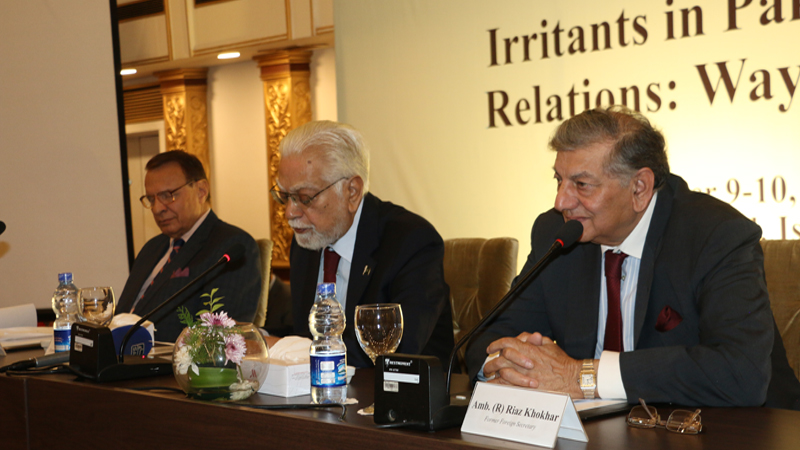
These were some of the recommendations put forth at the two-day National Conference on Irritants in Pakistan-US Relations: Way Forward organised by the Islamabad Policy Research Institute, here in Islamabad.
In his welcome address, Acting President IPRI, Brig (R) Sohail Tirmizi said that Pakistan-US relationship suffers from mutual mistrust and suspicion due to divergent approaches and interests in the region. To further put pressure on Pakistan, the US administration has ceased military training for defense personnel and the Collation Support Fund (CSF), besides resorting to use diplomatically harsh language and exercising its influence in the Financial Action Task Force (FATF). Brig Tirmizi pointed out that the US’ relations with India and Afghanistan have been instrumental in formulating its policy towards Pakistan.
In his inaugural address, Ambassador Inamul Haq, former foreign minister, said that the Conference was timely and important since it provided an opportunity to assess the present state of Pakistan’s relations with the US and their future trajectory in the wake of the recent meetings in Washington.
He pointed out that foreign policy cannot be based on self-delusion, and false assumptions. Foreign policy framers have to be clear, objective and logical, and they must factor into policy-making the complex strategic, political and economic developments, and the constantly emerging new equations. “Without an autonomous economy, no country can have an autonomous foreign policy,” he said.
On the issue of recent Pakistan-US meetings, he cautioned that ‘we should note that the discussions have so far been primarily on the end game in Afghanistan. Bilateral relations were not discussed at any length. Bilateral ties will improve only if Pakistan is seen to be helping the US achieve its objectives in Afghanistan’.
In the first session, Ambassador (R) Shamshad Ahmed, former foreign secretary, gave an overview of Pakistan-US relations. He argued that unlike other government policies, foreign policy is neither scripted nor has any bullet points, ‘it is an external reflection of a country’s internal conditions. So if a country is weak and crippled from inside, its foreign policy will not be robust and strong either.’ Ambassador Ahmed explained that for the US, Pakistan is not a ‘lost friend’ because Pakistan’s geopolitical situation is virtually important for peace in South Asia. He said that ‘Pakistan has not disappeared from the US’ radar screen rather looms large for US stakes in Asia.’ He remarked that no relationship is without problems, and Pakistan-US relationship is no exception.
Discussing his views on the making of US foreign policy, Ambassador (R) Riaz Hussain Khokhar, former foreign secretary, remarked that the Pak-US relationship should be evaluated from a dispassionate lens rather than an emotional one. “We should be frank with the Trump administration about what Pakistan can actually deliver in Afghanistan especially in terms of the Taliban because at the end of the day, Pakistan doesn’t have the kind of influence which is often projected.”
He remarked that ‘having a “strategic relationship” with the US is out-of-the-window, and one should not have high hopes in that regard since the US has already courted India.
In the session on Identifying Factors of Trust Deficit in Pakistan-US Relations, chaired by Lt General (R) Asif Yasin Malik, and Dr Salma Malik from the Department of Defense and Strategic Studies, Quaid-i-Azam University, Islamabad, expounded on the relationship between regional actors, especially India-Pakistan and the role of the US. She said that Pakistan’s relations with India and the US can be examined at bilateral, trilateral as well as at the multilateral level, where Pakistan has consistently strived for good relations with India. She said that there has not been a reciprocation of warmth and goodwill from New Delhi. Over seven decades, there have been many ups and downs in bilateral relations between the two neighbours with the US playing a proactive role of moderator during times of crises.
On the issue of promoting Pakistan-US cooperation in countering extremism and terrorism, Dr Syed Hussain Shaheed Suhrawerdi from the Department of International Relations, University of Peshawar, said that Pakistan has been at the forefront of the war on terror. “Leaving it alone with a few accusations is not the solution to the problem. More economic and financial assistance to Pakistan will contribute to the emergence of a more tolerant society. The US putting Pakistan in the grey list of the FATF will be counterproductive,” he said, adding that Washington needed to craft a vision of the future that places Pakistan into a much larger regional context beyond the prism of looking at it from the Afghan and Indian perspective.
Published in Daily Times, October 10th 2018.