
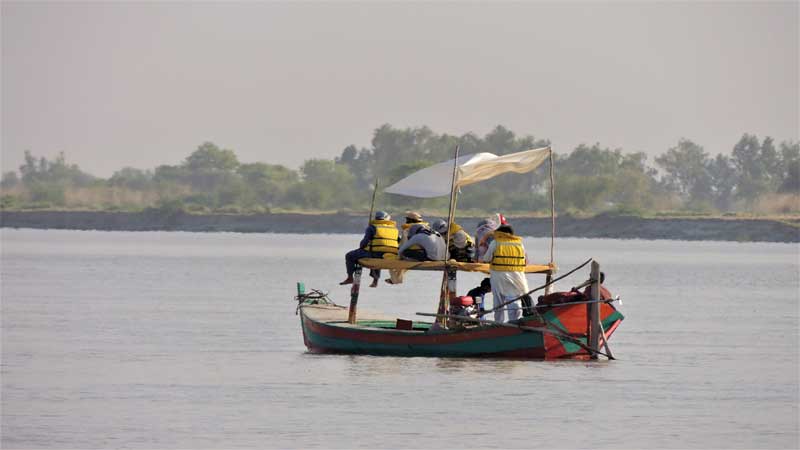
 KARACHI: A team comprising of 20 surveyors from World Wildlife Fund (WWF) Pakistan, provincial wildlife departments, Zoological Survey of Pakistan (ZSP) and other partner organisations recently conducted a survey to determine the occurrence of the endangered Indus River dolphin, far north of its range from Jinnah to Chashma Barrage in the Indus River.
This is the second year in a row that WWF-Pakistan has conducted assessments to investigate the status of this species in different locations within its historical population range. The ultimate objective of these assessments is to help make informed decisions for conservation planning.
The Indus River dolphin is an endangered freshwater cetacean that is endemic to the Indus River system. The species are found in five sub-populations separated by barrages on the Indus River.
“The survey was conducted along a 70 km long section of the Indus River, located close to the foothills of the Himalayas. This area has not been surveyed since 2006,” explained WWF Wildlife Director Dr. Babar Khan. “The survey methodology was consistent with the previous assessments used since 2001, which helps to obtain reliable and comparable data,” he added.
Dr. Babar Khan said that previous surveys had estimated less than five dolphins within this river section and this was the smallest known sub-population of the species. “There was concern that, owing to its small size, the population may be wiped out in the near future,” stated WWF wildlife director.
The survey revealed that no dolphins were recorded and this, combined with information from local communities, suggests that dolphins may have been locally wiped out between Jinnah and Chashma barrages. These results support the previous hypothesis that the Indus River dolphin is declining in the upper reaches of the Indus River.
Experts attribute this decline in the population of Indus’s blind dolphins to two main factors; reduced flow of the river during dry season and habitat fragmentation by irrigation barrages. Reduced flow has a direct impact on the dolphins as this limits the physical habitat available for them, changes the depth of river, flow velocity and temperature of the water.
According to Dr. Gill Braullik, a member of International Union for the Conservation of Nature (IUCN) Cetacean Specialists Group, the dolphin population is confined to just 20 percent of their natural habitat range due to the construction of numerous dams and barrages along the Indus River. He said that another factor contributing to the decline of dolphin populations is rapid industrialization. He explained that rapid industrialization has significantly contributed to increased surface water pollution in the country, as over 90% of industrial and domestic effluents make their way to the river untreated. “The dumping of untreated industrial waste in the river is affecting aquatic life adversely,” he explained.
According to Punjab Wildlife and Parks Department (PWPD) Director General Khalid Ayaz Khan, the survey was a part of the continuous research efforts critical to facilitate conservation policymaking for endangered species, like the Indus River dolphin, based on scientific evidences. Appreciating the collaborative efforts of WWF-Pakistan, Punjab Wildlife Department and other stakeholders, Khalid Ayaz Khan said that the study followed standard protocols for the collection of reliable and comparable data on the state of the dolphin population and its habitat.
Khalid Ayaz Khan said that the PWPD has initiated a development project along the Indus River with the aims of establishing three dolphin rescue and monitoring stations on Indus River, conducting a satellite telemetry study and translocating stranded dolphins to the stretch of Indus River between Jinnah and Chashma Barrages. “This will help in the conservation of endangered fauna of the area, particularly the Indus River dolphin,” added director general PWPD.
A comprehensive dolphin population assessment was carried out by WWF-Pakistan in March to April 2017, covering the 800 km stretch that includes the three largest dolphin sub-populations between Chashma and Sukkur Barrages.
The survey recorded a marked increase in the population of the species. There has been much focus on the largest sub-populations of Indus dolphins that are present downstream in Sindh and lower Punjab, and these populations appear to be increasing in abundance. However, the present distribution of the Indus River dolphin is about 80 percent less than what was determined in the 1870s.
Published in Daily Times, July 11th 2018.