• Skip to primary navigation
  • Skip to main content
  • Skip to primary sidebar
  • Skip to footer
Trending:
  • Kashmir
  • Elections
Saturday, June 6, 2026

Daily Times

Your right to know

  • HOME
  • Latest
  • Iran-Israel war
  • Gilgit Baltistan Election
  • Pakistan
    • Balochistan
    • Gilgit Baltistan
    • Khyber Pakhtunkhwa
    • Punjab
    • Sindh
  • World
  • Editorials & Opinions
    • Editorials
    • Op-Eds
    • Commentary / Insight
    • Perspectives
    • Cartoons
    • Letters to the Editor
    • Featured
    • Blogs
      • Pakistan
      • World
      • Lifestyle
      • Culture
      • Sports
  • Business
  • Sports
  • E-PAPER
    • Lahore
    • Islamabad
    • Karachi

AFP

Delhi reels as summer haze catches Indian capital off guard

Published on: June 15, 2018 7:54 AM

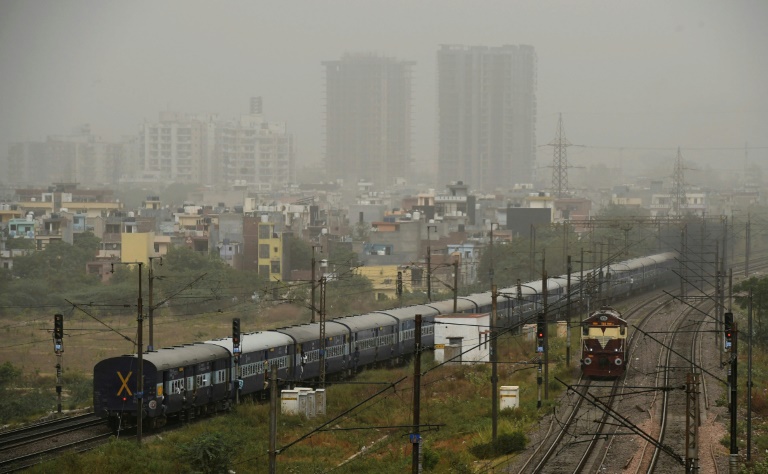
Air pollution soared in New Delhi on Thursday to hazardous levels rarely seen outside winter as sand blown from deserts enveloped the Indian capital in a once-in-a-decade phenomenon.

Doctors warned the grit carried by hot summer winds posed serious health risks to the city of 20 million and there was little to do “but pray for rain”.

Smog spikes during winter in Delhi, already one of the world’s most polluted cities, where air quality eclipses the World Health Organization’s safe levels on any given day.

Pollution levels usually ease in summer, providing some relief from the smog as temperatures soar to 45 degrees Celsius (113 Fahrenheit).

But the city woke up to stifling heat and smog 20 times safe levels Thursday, as strong winds blew dust from deserts in western India and beyond across the plains where Delhi lies.

“It is a very unusual phenomenon seen once in a decade or so. The dust is not settling down and the sky is obscure,” said Mahesh Palawat, vice president of meteorology and climate change at SkyMet Weather, a private forecaster.

“It is quite different from winter pollution. It is the dust this time that is the culprit. It may cause breathing problems to many,” he told AFP.

Levels of PM10 — dust and larger particles with a diameter of 10 micrometres — exceeded 900 per cubic metre in parts of Delhi on Thursday, according to the US embassy website. The WHO considers 50 the maximum safe level for PM10.

– Violent summer –

Readings from India’s own pollution monitor on Thursday detected PM10 closer to 1,300 — or 26 times safe exposure levels.

“I’m not able to breathe properly,” 62-year-old Lalit Malkoti told AFP on a hazy Delhi street.

“The dust gets into my eyes and I can feel a burning sensation. You can see how much pollution there is and how suffocating it is.”

AFP / PRAKASH SINGHThe sand blowing into the capital is colliding with dust from open construction sites and car and factory exhaust, compounding the crisis

The Indian summer has been especially violent this season, experts say, with hundreds killed by powerful dust storms and freak winds across the country’s north.

The sand blowing into the capital is colliding with dust from open construction sites and car and factory exhaust, compounding the crisis.

As visibility worsened Thursday, the city’s governor held an emergency meeting and ordered all civil construction work to cease until Sunday.

Such intervention typically only occurs in winter, when smog chokes Delhi as cool, still air traps pollutants close to the ground.

During these hazy months it is PM2.5 — microscopic particles that can lodge deep into the lungs — that cause the most harm.

Ozone levels, usually a lesser concern given the magnitude of air pollution woes in Delhi, are also causing particular grief this summer, according to a recent report by the Centre for Science and Environment.

“The surprise this year is the number of days when the daily air quality index has shown ozone also as a dominant pollutant along with the particulate matter,” said the centre’s executive director Anumita Roychowdhury.

Arvind Kumar, a lung surgeon at a medical facility in New Delhi, said the smog threatened all, but children, the elderly and those with asthma were at particular risk.

“If such a situation was seen in the Western world, cities would have been evacuated but for us we just need to pray for rain and the dust to settle down,” he told AFP.

Filed Under: World Tagged With: Air Pollution, breathing problems, hazardous, Headline, New Dehli, WHO

Submit a Comment


Primary Sidebar


Latest News

Alexander Zverev eases past Jakub Mensik in French Open semifinals

Taylor to face Pili in Croke Park farewell

FIFA bans vuvuzelas from World Cup stadiums

France brush off Ivory Coast loss, call it timely World Cup reminder

Legendary boxer Muhammad Ali’s 10th death anniversary observed

Pakistan

JAAC declared proscribed party ahead of AJK polls on July 27

Fixed tax scheme for small retailers launched to raise Rs 50bn annually

Govt cuts petrol price by Rs 4 per litre, keeps diesel’s unchanged

Bilawal promises GB voters with land and job rights

Iran declares support for Hezbollah with wider peace deal in doubt

More Posts from this Category

Business

SBP’s ‘Go Cashless’ campaign saw Rs 34bn in digital transactions on Eid

Short-term inflation down by 0.56%

Saudi-Pak Business Council shows interest in infrastructure investment

‘Govt, allies united in efforts to craft people-centric budget’

Rupee records gain against US dollar

More Posts from this Category

World

CENTCOM space post signals wider US military footprint

US official delivers Trump’s “good hello” to Putin

NASA lifts ISS evacuation alert after leak

More Posts from this Category


Footer

Home
Lead Stories
Latest News
Editor’s Picks

Culture
Life & Style
Featured
Videos

Editorials
OP-EDS
Commentary
Advertise

Cartoons
Letters
Blogs
Privacy Policy

Contact
Company’s Financials
Investor Information
Terms & Conditions

Facebook
Twitter
Instagram
Youtube

© 2026 Daily Times. All rights reserved.

Manage Consent
To provide the best experiences, we use technologies like cookies to store and/or access device information. Consenting to these technologies will allow us to process data such as browsing behavior or unique IDs on this site. Not consenting or withdrawing consent, may adversely affect certain features and functions.
Functional Always active
The technical storage or access is strictly necessary for the legitimate purpose of enabling the use of a specific service explicitly requested by the subscriber or user, or for the sole purpose of carrying out the transmission of a communication over an electronic communications network.
Preferences
The technical storage or access is necessary for the legitimate purpose of storing preferences that are not requested by the subscriber or user.
Statistics
The technical storage or access that is used exclusively for statistical purposes. The technical storage or access that is used exclusively for anonymous statistical purposes. Without a subpoena, voluntary compliance on the part of your Internet Service Provider, or additional records from a third party, information stored or retrieved for this purpose alone cannot usually be used to identify you.
Marketing
The technical storage or access is required to create user profiles to send advertising, or to track the user on a website or across several websites for similar marketing purposes.
  • Manage options
  • Manage services
  • Manage {vendor_count} vendors
  • Read more about these purposes
View preferences
  • {title}
  • {title}
  • {title}
We use cookies to ensure that we give you the best experience on our website. If you continue to use this site we will assume that you are happy with it.