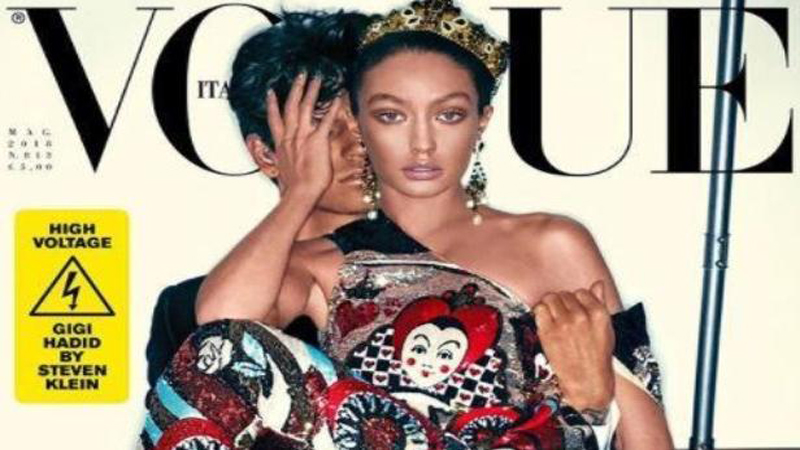
People are criticizing Gigi Hadid and Vogue Italia for the blackening of her face on the magazine’s latest cover.
On Wednesday, Vogue Italia revealed the cover for its May issue on their Instagram account. An extremely tanned Gigi is featured, sitting on a man and posing in a tiara and a sequined Dolce and Gabbana jumpsuit.
The image is captured by star photographer, Steven Klein.
Fans of the Victoria’s Secret model complained that Hadid seemed to be unrecognizable and criticized Vogue Italia for digitally changing her natural pale skin tone.
An Instagram user commented, “Can’t believe no one picked up on the fact that it looks nothing like the model, and is actually offensive.”
“Looks nothing like her, looks like she overdid it on the tan,” said another user.
One other user said, “Why are you photo-shopped to appear as a different race?”
Moreover, Vogue Italia and Hadid have been accused before as well for using “blackface” on the magazine cover.It was a shoot in November 2015 by Steven Meisel, which displayed Hadid in a visibly darker skin tone while wearing different Afro wigs.
However, Gigi Hadid has apologized for her appearance on the cover of the magazine. She explained she had no control over the final image and she acknowledges there are issues regarding diversity in the fashion industry in a statement posted on Instagram.
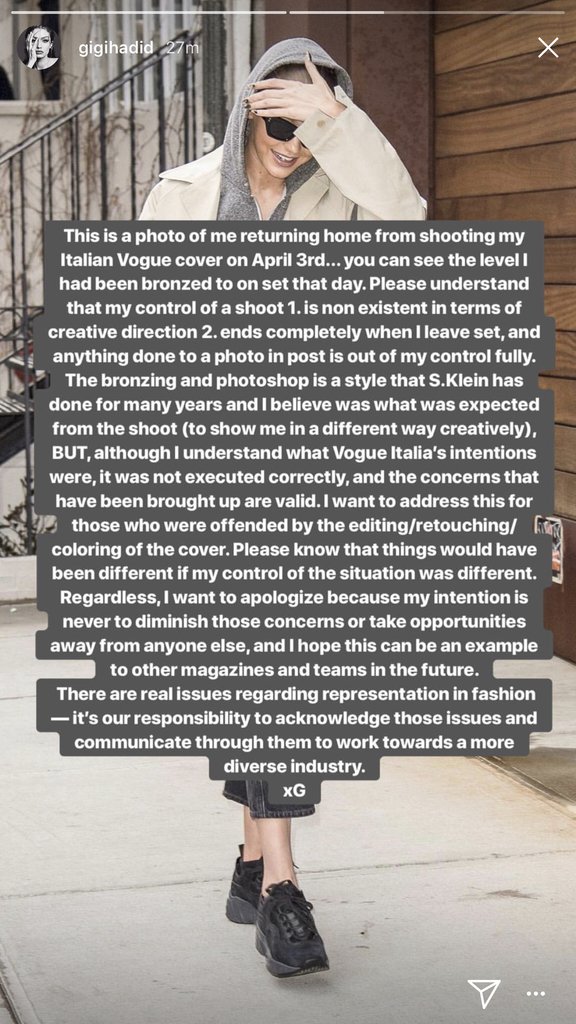
She shared a photo of herself leaving the shoot, she wrote: “This is a photo of me returning home from my Vogue shooting on April 3… You can see the level I have been bronzed to on set that day.”
“Please understand that my control of a shoot 1. is nonexistent in terms of creative direction. 2. ends completely when I leave set, and anything done to a photo in post is out of my control fully.”
Hadid further added, “Regardless, I want to apologies because my intention is never to diminish those concerns or take opportunities away from someone else, and I hope this can be an example to other magazines and teams in the future. There are real issues regarding representation in fashion – it’s our responsibility to acknowledge those issues and communicate through them to work towards a more diverse industry”