
Japan Prime Minister Shinzo Abe’s visit to the US marks the third US-Japan summit since Donald Trump took office last year. The top-level meetings, other than bilateral issues, have focused on regional developments. The timing of the recent summit ahead of North-South Korea talks scheduled on April 27 and the President Trump’s meeting with North Korean leader Kim Jong-un (likely in May or June) carries a lot of significance. The leadership of both countries affirmed commitment for strong US-Japan alliance, economic cooperation and resolve over North Korea. During the summit, Japan was not able to secure exemption from the tariffs on steel and aluminium products. The reason cited, as per the US Department of Commerce, was the trade deficit of US $56.1 billion last year. Meanwhile, the US has exempted Australia, Canada, Mexico and the EU from the tariffs.
Abe’s visit to the US, ahead of US-North Korea talks, shows that Japan wants its concern to be heard during the talks
On the North Korea nuclear issue, the US, as apparent from past diplomatic moves, does not support a nuclear North Korea. But how strategically are the US and its regional allies aligned over the issue? Will the US assure that the threat to the US allies will not be over-looked? Or will Pyongyang’s willingness for dialogue will soften the stringent measures? Kim Jong-un’s statement that North Korea “no longer needed to conduct nuclear tests or Intercontinental Ballistic Missile tests,” is a marked shift from the country’s past policies. Such a statement before talks with South Korea and the US indicates that DPRK is serious for a dialogue. The statement has been welcomed by South Korea and is being viewed optimistically. China has seen North Korea’s decision as a positive move towards diffusing tensions and promoting denuclearisation. It appears that North Korea is playing at the diplomatic front. It is trying to build its image as a responsible state regionally with the ultimate goal of economic progress.
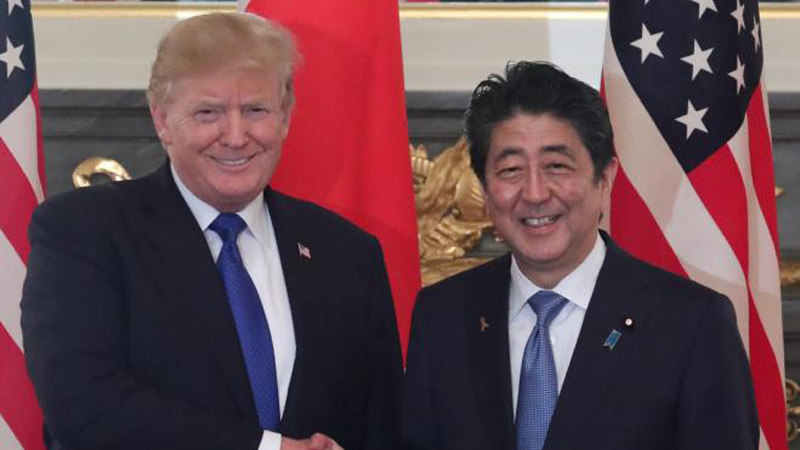 Abe’s visit to the US, ahead of US-North Korea talks, shows that Japan wants its concern to be heard during the talks. President Trump has stated that “Japan and ourselves are locked, and we are unified on the subject of North Korea.”How much say Japan will have cannot be speculated till the talks are concluded. The decision for US-North Korea talks was made without consultation with Japan. There had been news that CIA Director Mike Pompeo visited North Korea for a meeting with Kim Jong-un. Japan may not support a flexible approach towards North Korea; the issue of the abduction of 17 Japanese citizens by North Korea (in 1970-80) is an irritant in the bilateral ties. Korean authorities had acknowledged the abduction of 13 Japanese. As per their claim, eight have died,and five have been returned to Japan.
In case of the peace treaty with the DPRK, it would open up the prospects for further talks.Other countries including China, South Korea and Japan may also step in.It might lead to the restoration of six-party talks or a similar arrangement. This could lead to betterment in North-South relations, thereby positively impacting the regional environment.
The writer is a researcher at Islamabad Policy Research Institute (IPRI)
Published in Daily Times, April 28th 2018.