
The inquisitive observers of the Middle Eastern politics would naturally wonder why do western powers prop up the Gulf’s petro-monarchies, knowing fully well that they are the ones responsible for nurturing Islamic extremism?
Seemingly, the Western powers support the Gulf’s autocrats because it has been one of their firm policy principles to promote ‘stability’ in the region instead of representative democracy. They are mindful of the ground reality that the mainstream Muslim sentiment is firmly against any western military intervention in the Middle East.
Also, the western policymakers also prefer to deal with small groups of Middle Eastern ‘strongmen’ rather than cultivating a complex and uncertain relationship on a popular level, certainly a myopic approach which is the hallmark of so-called ‘pragmatic’ politicians and statesmen.
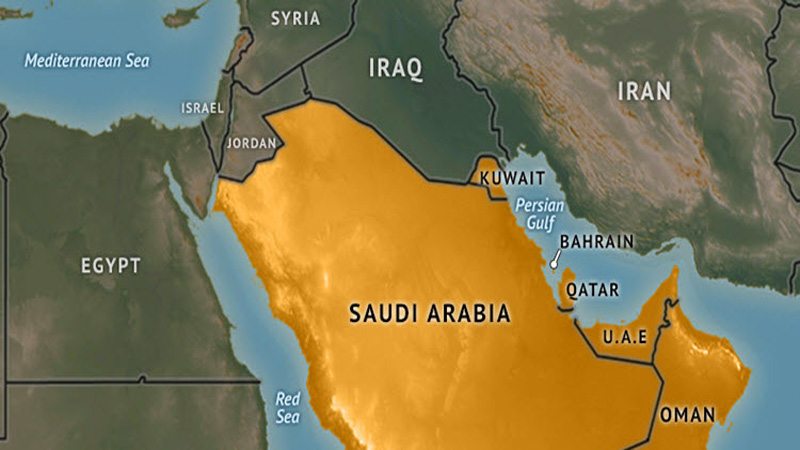
Left to their own resources, the Persian Gulf’s petro-monarchies lack the workforce, the military technology and the moral authority to rule over the forcefully suppressed and disenfranchised Arab masses along with the South Asian and African immigrants. One-third of the Saudi Arabian population is comprised of immigrants. Similarly, more than 75 percent of the UAE’s population is also comprised of expats from Pakistan, Bangladesh, India and Sri Lanka.
The rest of the Gulf states, including Kuwait, Qatar, Bahrain and Oman, also have a similar proportion of immigrant workers from the developing countries. Unlike the immigrants from the western countries who hold the citizenship status, the Gulf’s immigrants have lived there for decades, and they are still regarded as unentitled foreigners.
Regarding the question that is there a way for the international community to persuade the Gulf states to implement democratic reforms, it’s worth noting that the nuclear sanctions on Iran from 2006 to 2015 have brought to the fore the enormous power that the western financial institutions wield over the global financial system.
Despite the sanctions being unfair, Iran felt the heat so much that it remained engaged in negotiations throughout and the issue was finally settled in the form of the Iran nuclear deal in April 2015. Such was the crippling effect of those ‘third party’ sanctions on the Iranian economy. However, had it not been for Iran’s enormous oil and gas reserves, and some Russian, Chinese and Turkish help in illicitly buying Iranian oil, it could have defaulted under those sanctions.
There are ways to persuade the Gulf’s petro-monarchies to implement democratic reforms and to desist from sponsoring Islamic extremism, provided we have just and upright international arbiters.
As in the case above, sanctioning the Gulf states also seems plausible. However, there is a caveat: Iran is only a single oil-rich state which has 160 billion barrels of proven oil reserves and can produce 5 million barrels per day (mbpd) of crude oil.
On the other hand, the Persian Gulf’s petro-monarchies are actually three oil-rich states. Saudi Arabia with its 266 billion barrels of proven oil reserves and 10-mbpd of daily crude oil production, and the UAE and Kuwait with 100 billion barrels of proven reserves and 3-mbpd of crude daily output each.
There are ways to persuade the Gulf’s petro-monarchies to implement democratic reforms and to desist from sponsoring Islamic extremism, provided we have just and upright international arbiters
Together, their share amounts to 466 billion barrels, almost one-third of the world’s 1477 billion barrels of total proven oil reserves. Moreover, if we add Qatar to the equation, which isn’t oil-rich as such, but has substantial natural gas reserves, it will take a morally very upright arbiter to sanction all of them.
Therefore, though enforcing economic sanctions on the Gulf states to implement democratic reforms sounds like a good idea on paper, but the relationship between the industrialised world and the Gulf’s petro-monarchies is that of a consumer-supplier. The Gulf states are the suppliers of energy, and the industrialised world is its consumer.
If anything, the Gulf’s petro-monarchies have ‘sanctioned’ the western powers in the past by imposing the oil embargo in 1973 after the Arab-Israel war. The 1973 Arab oil embargo against the west lasted only for a short span of six months during which the price of oil quadrupled. But Washington became so paranoid after the blockade that it put in place a ban on the export of crude oil outside the US borders — which is still in place — and began keeping 60 days stock of reserve fuel for strategic and military needs.
Recently, some very upbeat rumours about the shale revolution have been circulating in media. However, the shale revolution is primarily a natural gas revolution. It has increased the ‘probable recoverable’ resources of natural gas by 30 percent.
More than the size of oil reserves, it is about per barrel extraction cost, which determines the profits for the multinational oil companies, and in this regard, the Persian Gulf’s crude oil is the most profitable.
Further, regarding the supposed US energy independence after the so-called ‘shale revolution’, the US produced 11 million barrels per day (bpd) of crude oil in the first quarter of 2014, which is more than the output of Saudi Arabia and Russia, each of which produces around 10 million bpd. But the US still imported 7.5 million bpd during the same period, which is more than the oil imports of France and Britain put together.
More than the total volume of oil production, the volume which an oil-producing country exports determines its place in the hierarchy of petroleum and the Gulf’s petro-monarchies constitute the top tier of that pyramid.
The writer is an Islamabad-based attorney, columnist and geopolitical analyst focused on the politics of Af-Pak and Middle East regions, neocolonialism and petro-imperialism
Published in Daily Times, January 23rd 2018.