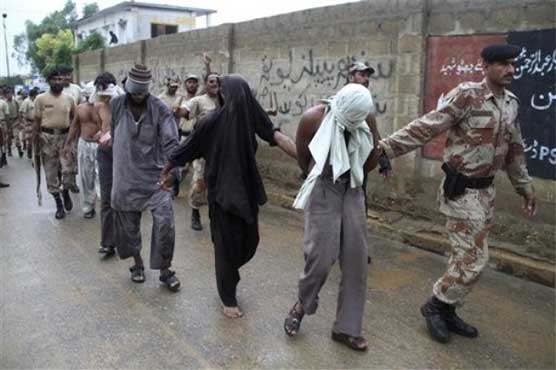
That terrorist attacks and incidents of targeted killings have dramatically reduced in Karachi over recent past years is beyond doubt. Gangsters, who once could be spotted in various areas of the city, maintaining their hegemony, have been replaced by rifle-wielding law enforcers deputed under the famous, much-hyped Karachi operation, to the relief of many citizens. But at what cost this change – for better indeed – has come? And can that cost, if true and worrying, be discussed by the various stakeholders of society?
While praises for the agencies involved in the Karachi operation, which began in September 2013 with the help of paramilitary forces, get highlights all over media platforms, seldom do we discuss the collateral damage – caused with impunity and powerful authority – that comes along.
As the operation marks another anniversary, perhaps now is the time to debate on its intricacies and devise strategy which can help us find a political solution for issues plaguing the city that runs Pakistan.
Let’s start from the very outset. The operation, reminiscent of notorious Operation Cleanup, was started without taking onboard the political stakeholders of the metropolis. The aim was set to eradicate terrorism from Karachi but the secular forces fighting the religious extremists were never taken into confidence before the showdown began.
Muttahida Qaumi Moevemnt (MQM), a Karachi-based party with middle-class cadres and an utterly secular outlook, had initially demanded that a full-fledged military operation be launched to root out the Talibanization taking place in the outskirts of the city. MQM founder had very well before the action called upon the civilian and military leaders to take notice of the worsening situation and shut down all seminaries, terrorist hubs, and extremists-controlled mosques spreading sectarianism and terrorist ideology in the city. No one bat an eye. Instead, the citizens saw closure of MQM offices which were catering to their needs of instant issues’ resolution such as domestic violence and money disputes settlement etc.
Pakistan People’s Party (PPP) also supported the operations against ‘militants, extremists and criminals. However, its leaders also observed that there had been acute transgression of authority and human rights violations. The party also raised this issue in the corridors of power to demand parliamentary oversight of the operation. PPP’s senator Farhatullah Babar and Senate Chairman Raza Rabbani have repeatedly made calls for this. The left-leaning party also acknowledges the required role of media and civil society for mending the grave situation.
Let alone political parties, agencies never deigned discussing the pressing matter with the civil society and human rights organisations that kept raising questions on the operation following reports of extra-judicial killings, severe torture of political workers, enforced disappearances, occupation of various public properties by the law enforcers in the city and what not.
In October 2015, the HRCP organised a meeting with Pakistan Rangers Sindh officials to register its reservations over rights violations following the initiation of the Karachi operation. When the indomitable Asma Jahangir, veteran rights activist IA Rehman and HRCP’s Asad Butt reached the venue, they were informed the paramilitary force’s DG could not receive them due to some urgent business, Hai recollected.
The cases of missing persons, people killed in custody after severe torture, the silence after the disappeared political workers return still haunt this city with no comprehensible answers in sight.
Disappearance and return of human rights activists Saeed Baloch and Abdul Wahid Baloch pose serious question on the working of LEAs in the city. No one dared challenge the agencies why these men – among hundred others – were picked up by them, tortured and later on released with threats to keep their mouths shut. Recently, journalist Zeenat Shehzadi returned to her home after two years of abduction. She had gone missing while working on a story about the disappearance of an Indian national. Although she returned safe and sound, Shehzadi will never be able to see her younger brother again in her house because he committed suicide after one year of her detention out of frustration. Who will give back her life’s two years and brother? Can we dare question the obvious abductors?
This case was not from Karachi but it teaches us a lesson on how far the law enforcers can go to surpass the limitations drawn by the law.
Not only that, Baloch rebel commander Dr Allah Nazar Baloch’s family was also picked up from Quetta only to be released after international media and activists on social media raised the voice. Nazar’s wife and children were freed while given special farewell at the CM House of the province. Yet again no one – no media outlet – inquired how can agencies detain a harmless lady and her children.
More than 135 MQM workers are still missing who the party alleges were detained by law enforcers. Families of over 40 Shia persons are still waiting for their loved ones to return after they were abducted by masked men who came in black Vigos and raided their houses during dark nights. In August alone, 83 cases of enforced disappearance were reported. Meanwhile, mystery behind fake report on human rights violations submitted by Rangers in 2016 is still to be resolved. The shock which people went through after pictures of Aftab Ahmed’s tortured body went viral has yet to subside – the case still being investigated despite reassurance of the then army chief. One can easily gauge what might be the exact number of such cases for a whole year.
Scores of petitions filed by these missing persons’ families await hearing in the courts that keep getting postponed because of inability on part of agencies to show up on the date with evidence against the detainees. Seminaries propagating Islamic-State inspired extremism are flourishing in the city, with many young men joining in their circles and now running fundraising campaigns outside various mosques after Jumma prayers – a common sight now.
How can we put the house in order amid all this chaos caused by LEAs high-handedness? Is asking for a joint committee consisting of eminent journalists, lawyers, human rights veteran activists to supervise the plan and keep a check on the operation too much to ask for? It must be. But that’s the only way forward or people will have no other option than dreading the now gun-carrying troop standing in our areas, taking the positions once held by neighbourhood bandits.