
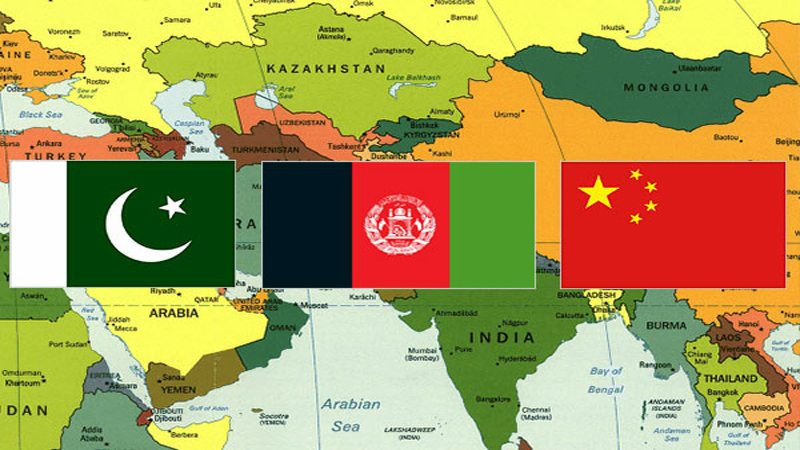
Foreign ministers of China, Pakistan and Afghanistan will meet in Beijing on December 26th for discussions on development and security in the region. It is the first of a kind dialogue that is going to take place between these countries as agreed upon in June when Chinese Foreign Minister Wang Yi visited Kabul and Islamabad to create political trust between them. The three countries will have an in-depth exchange of views on matters pertaining to reconciliation, development, connectivity, security and counter-terrorism.
China will act as a primary mediator to create trust between Pakistan and Afghanistan. The dialogue would also be a step towards finding measures in the resolution of the stalemate continuing affecting Afghanistan. Foreign Minister Wang Yi Foreign, Minister Khawaja Muhammad Asif, and Acting Afghan Foreign Minister Salahuddin Rabbani will attend the meeting.
All three countries share border and they are common neighbours of each other. The border between Pakistan and Afghanistan is around 2500 km, known as the Durand Line, which is often disputed by Afghanistan. The ‘Pashtunistan’ stunt has not gone away completely and often dilutes bilateral ties. The Pakistan-China border is around 510 km and Afghanistan shares a border of 76 km with China. The Xinjiang separatists take refuge in Afghanistan and often launch offensives inside China. The three countries also have the potential to counter the rising trend of Daesh, which is sweeping across the region. If these militant proxies are overcome, the region will seek a new peaceful and development view.
This new trilateral dialogue has the potential to address cross-border issues at the lofty Pamir Mountains and Hindu Kush, sharing a common security and activating regional connectivity for trade and business under the Belt and Road Initiative (BRI).
The trilateral cooperation looks positive and it could address many fundamental issues including the cross-border terrorism.
In August, President Donald Trump came up with his new Afghan policy, which was viewed as a new factor of destabilisation in the region to counter terrorism. Bringing new American troops up to 4000 in addition to NATO’s troops and assigning a greater role to India appears to be continuity of the past 16-years war in Afghanistan. A new strategy is needed. The Afghanistan-Pakistan-China trilateral move, on the contrary, looks a stabilising factor to bring peace in the war-toned Afghanistan.
China is a global economy and both Pakistan and Afghanistan having close geographical proximity with China, they could be immensely benefited if they build trust and confidence with each other. The regional trilateral trade between China-Pakistan-Afghanistan is around US$ 22 billion. Pakistan-China trade has been hovering around US$ 20 billion. The China-Afghan trade has reached US$ 1 billion. The Pakistan-Afghanistan trade is around US$ 1.4 billion and the trade has been rather decreasing between them since 2010.
The trilateral dialogue should result in a series of comprehensive talks. It should not be restricted to the Pakistan-Afghanistan confidence-building measures (CBMs). It should include military and defence exchanges among the three countries to ensure security in the Pamir Mountains and Hindu Kush region — the neglected terrain that is vulnerable to violence and terrorism. The forces of disruption should be countered by the combined military efforts of the three countries.
 The three countries should set up a joint security task force to monitor terrorism and terrorists’ activities and to enhance security coordination. This will also help improve bilateral security cooperation between the forces of Pakistan and Afghanistan. The Chinese BRI and investments in the China-Pakistan Economic Corridor (CPEC) could be risky if such concerns were not removed that are in the high interests of these three neighbours. Their strong ties will promote a good neighbourhood environment necessary for security and development.
There should be regional economic integration in the trans-Himalayan region connecting China, Pakistan and Afghanistan. Physical barriers that have served as the sources of poverty and hindrance to development for ages need to be removed. Connectivity is the solution.
The trilateral dialogue should result in a series of comprehensive talks. It should not be restricted only to Pakistan-Afghanistan confidence-building measures. Military and defence exchanges between the three countries should be included to ensure security in the Pamir Mountains and the Hindu Kush
Wakhan, Badakshan, Xinjiang and Gilgit-Baltistan should be integrated by road connectivity under the BRI and CPEC. This region is relatively backward in all three countries and the BRI must address the poverty of the region — the first region from China entering the Silk Road. The region would become the intersection and hub of the BRI and CPEC. This is the significance of this highly important region, which desperately needs common security.
There should be greater people-to-people exchanges, educational, artists, think tanks and non-governmental organisations (NGOs) etc including parliamentarian and political exchanges to foster strong social and cultural ties between the people of the three countries. In short, looking from these geo-strategic and geo-economic perspectives, the Beijing-initiated first trilateral dialogue is expected to bring about great respite to this turbulent region of underdevelopment and dis-connectivity.
The writer is Director of the China-Pakistan Study Centre at the Institute of Strategic Studies Islamabad. He writes on East Asian affairs
Published in Daily Times, December 26th 2017.