
We have completely failed to give effect to his ideals and perception of the state. Quaid-i-Azam Muhammad Ali Jinnah was a great leader, brilliant statesman and a master strategist, who fought the case for Pakistan so well that he frustrated the designs of the British that wished to see the sub-continent united in one form or another till the last moment.
He also made the Indian National Congress and Hindu majority believe that division of the sub-continent could save them from some bigger catastrophe. Of course, he had united the Muslims of the subcontinent and waged a struggle for a separate homeland for the Muslims to save them from a dictatorship of the majority. However, Quaid-e-Azam had declared in unequivocal terms that the beneficiaries of jagirs, feudal lords and exploiters would have no place of privilege in an independent Pakistan.
Where did we go wrong? Unfortunately, a conglomerate of a privileged few which includes feudals, the British-trained bureaucracy and industrial robber barons devoid of political acumen and vision took over the state
In his presidential address at the All India Muslim League session at Delhi on 24 April 1943 he had outlined his vision about Pakistan, saying “I have visited villages; there are millions and millions of our people who hardly get one meal a day. Is this civilisation? If that is the idea of Pakistan I would not have it.” It was unfortunate that Pakistan lost its great leaders soon after independence, before they had time to lay a solid constitutional foundation to establish and strengthen institutions. Quaid-i-Azam had envisioned Pakistan to be a modern progressive state, rooted in the eternal values of our religion and at the same time responsive to the imperatives of constant change. In his address before the Constituent Assembly on 11 August 1947, he had assured the people of Pakistan including minorities that their fundamental rights, liberties and freedom would be well-protected.
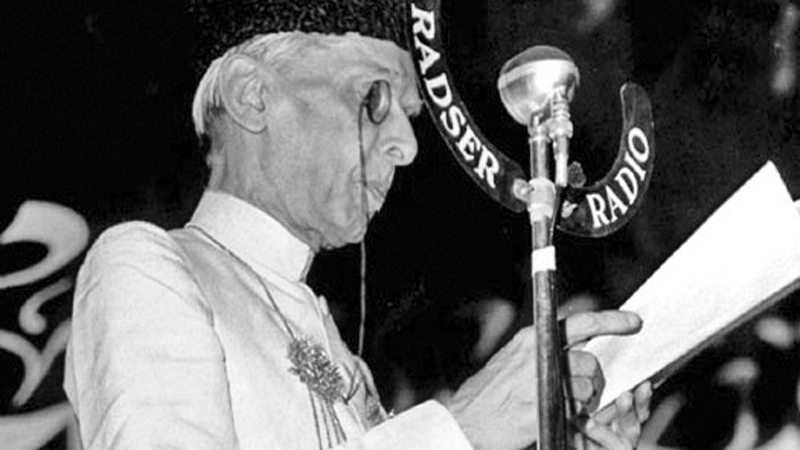 He declared: “You are free; you are free to go to your temples; you are free to go to your mosques or to any other place of worship in this State of Pakistan. You may belong to any religion or caste or creed as that has nothing to do with the business of the State”. He had also vowed to fight corruption, bribery, black marketing, nepotism and exploitation of public offices.
In fact, it was a well thought-out first policy statement in which he had given guidelines and the parameters within which the constitution of Pakistan was to be framed by the elected representatives of the people. Unfortunately, efforts were made to distort his speeches even during his lifetime, and certain persons with vested interest had tried to remove his 11 August 1947 speech delivered before the constituent assembly from the record. Some religious parties insist the Pakistan should be a theocratic state based on sharia.
But he had made it absolutely clear that it was not going to be a theocratic state because he was aware of the fact that every sect would come out with its own interpretation of the Quran and Sunnah. And the resultant conflicts and clashes between the sects could lead to bloodshed, as is happening today. He had stated that the people’s representatives would frame the constitution adding that “we will seek guidance from the Holy Quran to establish a just society”, but he had not even remotely hinted that sharia would be enforced in Pakistan. Unfortunately, we lost Quaid-i-Azam too soon and bureaucracy, feudalist politicians and those who had opposed Pakistan and Quaid-i-Azam assumed the role of Islam’s champions. Anyhow, Pakistan has all the ingredients needed to make a modern welfare state, provided that there is visionary leadership.
The question is where did we go wrong? Unfortunately, a conglomerate of a privileged few which includes feudals, the British-trained bureaucracy and industrial robber barons devoid of political acumen and vision took over the state. Barring a few honourable exceptions, most of our leaders have lacked political acumen, leadership qualities and a sense of direction; thus they brought the country to its present situation. They continued with internecine conflicts and politics of power and pelf. On 14 August 1947, we rid ourselves of colonialism but fell prey to neo-colonialism due to the flawed policies of various governments in the past. Instead of adopting a rational policy, Pakistan entered into defence pacts with the West. British-trained bureaucracy was instrumental in binding Pakistan in CENTO, SEATO and the bilateral agreement with the United States. The meaninglessness of the military pacts with the West was understood by the nation during the 1965 and 1971 Indo-Pak wars.
Our so-called allies had stopped military as well as economic aid to Pakistan. Anyhow, Pakistan had to depend on the West for its developmental and defence needs, because our inept leadership failed to adopt economic policies that could have made Pakistan a self-reliant country.
It was because of this dependency syndrome that Pakistan was forced into becoming a camp-follower of the West, earning enmity of the other super power. It was also evident after 9/11, when Pakistan was coerced into joining Bush’s war of terror. To conclude, I quote the words of Professor Akbar S Ahmed, a Cambridge scholar who wrote “Islam gave the Muslims of India a sense of identity; dynasties such as the Mughals had given them territory; poets like Iqbal created in them a sense of destiny; Jinnah’s heroic stature can be understood from the fact that by leading the Pakistan movement and creating the state of Pakistan, he gave them all three”.
He can be reached at [email protected]
Published in Daily Times, December 25th 2017.