
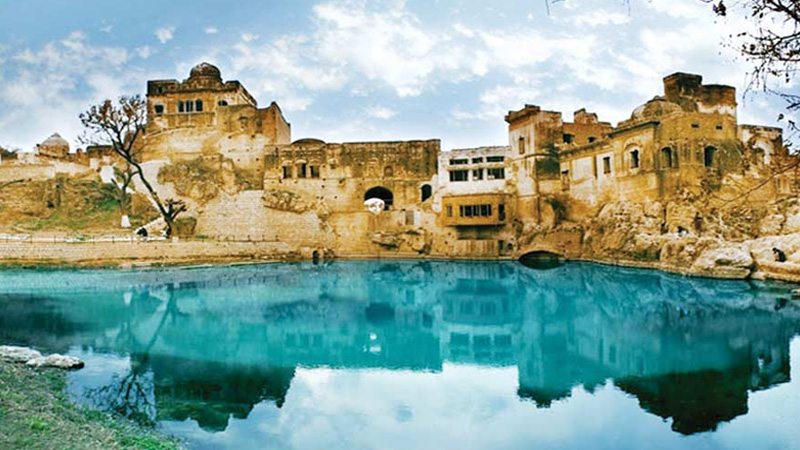
 On November 23, 2017, a three-judge Supreme Court bench, headed by Chief Justice Mian Saqib Nisar, proceeded to a suo moto case hearing of the Katas Raj pond situated in the district of Chakwal, Punjab. The matter at hand concerned with the drying up of the pond due to cement factories nearby drawing a large amount of groundwater through a number of bore wells, severely reducing the sub-soil water level and the failure of the government to safeguard it. The bench describing the Katas Raj Temples, one of the most revered places of worship of the Hindu community, as a national heritage site, directed the federal and Punjab governments to form a special committee of experts to probe the issue.
The usage of huge quantity of water by cement factories operating in the area is said to be greater than that of the entire population of Chakwal city. Eucalyptus trees that consume a lot of water have been planted senselessly in close proximity with the temple. These are the significant reasons that an aquifer feeding the Katas Raj pond has come under severe pressure and this has drastically plummeted the water level in the pond.
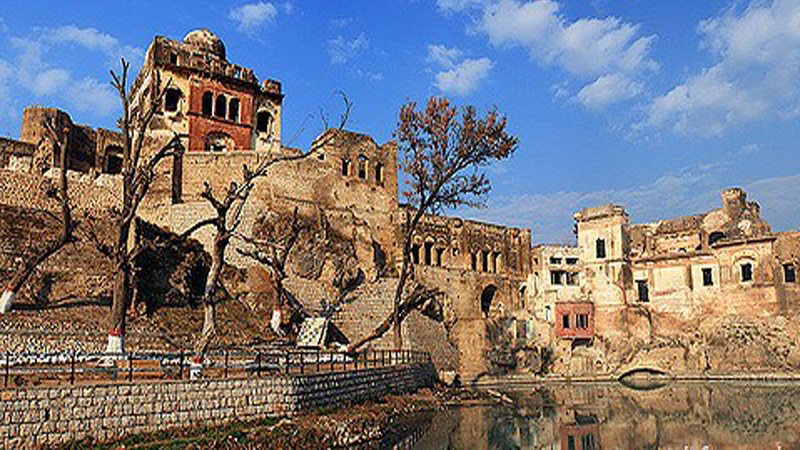
Pakistan is the land of heritage, history, culture, architecture and inherits one of the oldest civilisations in the world: the Indus Valley civilisation. It has a number of archaeological sites, archaic ruins, and antediluvian cities which include Mohenjo-Daro and Taxila. Located at the Kallar Kahar town near the M2 Motorway in the district of Chakwal, Punjab, the Katas Raj Temple complex is one of the most exquisite and wonderful national architectural heritage sites. The complex houses seven ancient temples connected to one another with walkways called satgraha, some temples from the middle ages and some recently erected temples. The oldest temple dating back to the 6th century was laid by Lord Shiva. The complex is considered to be the second most sacred shrine of the Hindus and is revered by Hindus across the globe.
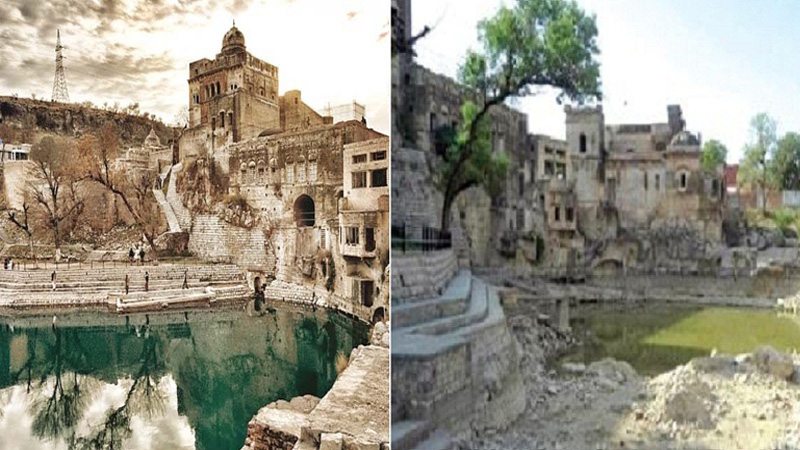
Prior to the 1947 Indian partition, the temple complex was believed to be a popular pilgrimage site for the Hindus. After the Indo-Pak war of 1965 – 1984, Indian Hindus were allowed to visit the temples. But even after 1984, Pakistani Hindus continued to make their visits to them. Unfortunately, neither the Pakistani Hindus nor the government of Pakistan has made any effort for the maintenance and renovation of the complex. As a result, of the seven temples, four are in deplorable and pitiable condition and the remaining three have been damaged completely. In 2005, the veteran Indian political leader Lal Krishna Advani visited the temples and expressed discontentment after he saw the sacred site’s decaying condition.
Of the seven temples, four are in deplorable and pitiable condition and the remaining three have been damaged completely. In 2005, the veteran Indian political leader Lal Krishna Advani visited the temples and expressed discontentment after he saw the sacred site’s decaying condition
It is believed strappingly by Hindus that after the death of his wife, Sati, Lord Shiva was immensely shocked, he sniveled uncontrollably and his tear drops formed a pool of water at the foot of the Katas Raj temples. This is why the pond is considered sacred by the Hindus, here they they take a bath, wash their sins and seek salvation. The pond has a maximum depth of around 20 feet, covers an area of two kanals and 15 marlas. It is a natural spring similar to all other springs that increase and decrease in their water flows according to seasonal variations.
It is reported that before 2012, the pond used to supply water for drinking and irrigation purposes to two adjacent villages: Katas and Waulah and to the Choa Saidan Shah town. But after the pond dried up in 2012, people of these areas were compelled to install tube wells in order to get drinking water and irrigate their crops and gardens.
In January 2017, the former Prime Minister, Muhammad Nawaz Sharif, visited the temple complex and ensured the protection of rights of religious minorities in Pakistan. He directed the Evacuee Trust Property Board chairman to take care of the properties of the minorities including the Katas Raj temple complex and make efforts for the maintenance and restoration to its original condition. To provide visitors with potable water, Nawaz Sharif inaugurated a water filtration plant at the Amrit Jal area in the complex, but ironically, the plant has not yet been functionalised due to the non-availability of electricity.
 The fact is that in Pakistan, places of worship for minorities are either disappearing or subject to negligence by the state. As religious fanaticism keeps growing with a fast pace in Pakistan, and religious extremist groups get stronger by the day, places of worship of minorities are targeted, especially that of the Hindu minority. Though attacks on the holy places of religious minority communities have been taking place ever since the Indo-Pak partition in 1947, the attacks gained momentum after the Babri Mosque was destructed by Hindu fanatics in the Indian city of Ayodhya in 1992. According to Amarnath Motumal, Vice Chairperson of Pakistan Human Rights Commission’s Sindh Chapter, also member of the minority Hindu community, the main cause of attacks on Hindus and their holy places is religious extremism.
To gauge this, the government of Pakistan should engage expert architects, archeologists, paleontologists and environmentalists for the repair of the damaged temples and the preservation of the Hindu’s sacred pond in order to restore the exquisiteness and originality of the Katas Raj complex.
The writer is an academic at C&S Govt Degree College Shikarpur and tweets at @ARShykh
Published in Daily Times, December 9th 2017.