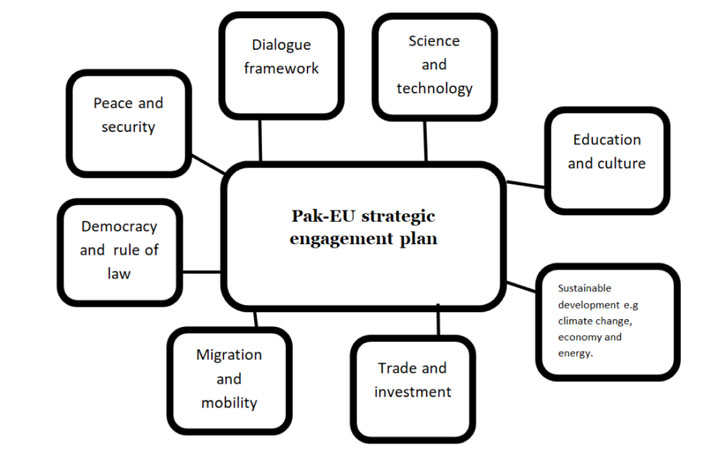
 Relationship between Pakistan and the European Union (EU) is deeply anchored in economic cooperation and mutual strategic dependency. At the heart of this partnership lies the Generalized Scheme of Preferences Plus (GSP+), a special incentive arrangement for sustainable development and good governance. Since its inception in 2014, the GSP+ framework has served as the single most critical bridge connecting Pakistani manufacturers to the vast European consumer market. By granting duty-free access to over 66% of EU tariff lines, the scheme has consistently acted as an economic lifeline for Pakistan.
For Pakistan, GSP+ is not just a standard trade agreement; it is a vital pillar of macroeconomic stability. The country remains the largest beneficiary of the GSP+ scheme globally.
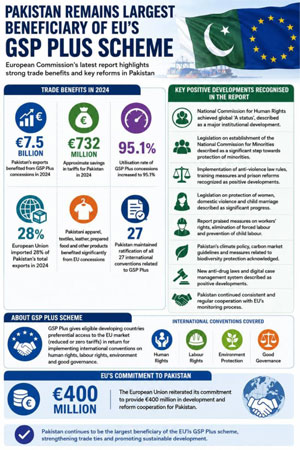
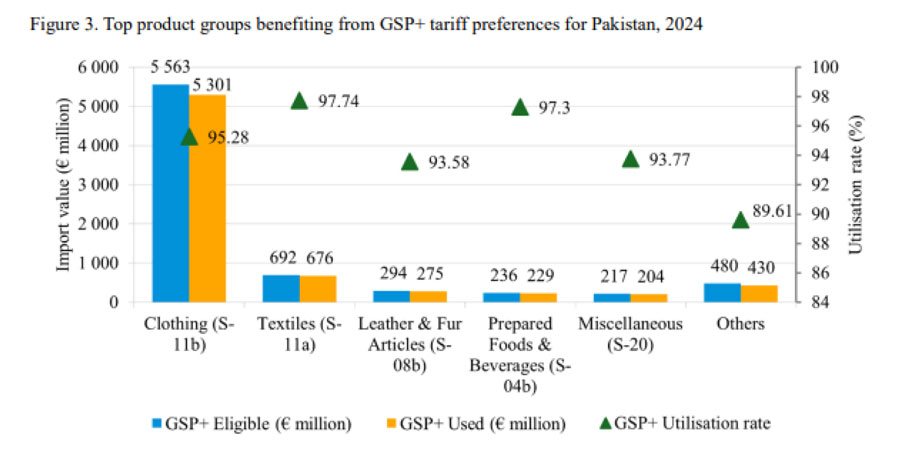
In 2024 alone, Pakistan’s eligible exports to the EU reached an impressive EUR 7.5 billion, with the trade mechanism saving domestic exporters an estimated EUR 732 million in tariff exemptions. These preferences heavily favor labor-intensive manufacturing sectors, specifically textiles and clothing, which account for roughly 70% to 76% of total shipments to the EU. The resulting industrial volume sustains millions of livelihoods across the country, brings in indispensable foreign exchange reserves, and drives economic development in otherwise vulnerable regions.
EU Assessment Framework (2023–2025)
European Commission’s Joint Staff Working Document for the 2023–2025 monitoring period provides a comprehensive audit of Pakistan’s compliance with the 27 international conventions underpinning the GSP+ criteria. The assessment covers four broad domains: human rights, labor rights, environmental protection, and good governance. The report presents a mixed evaluation, noting legislative milestones while expressing strong institutional concern over practical enforcement and structural regressions.
On the constructive side, the report acknowledges legislative milestones such as the expansion of institutional human rights frameworks, the continued de facto moratorium on the death penalty, the passage of a Domestic Violence Bill for the Islamabad Capital Territory, and regional laws raising the legal marriage age. However, these points are counterbalanced by significant concerns regarding civil spaces, labor welfare gaps, and corruption. Most notably, the European Commission repeats a sustained emphasis on the status of minority rights and religious freedoms, asserting that deep-seated vulnerabilities persist for non-majority faith communities.
Addressing the Minority Rights Narrative
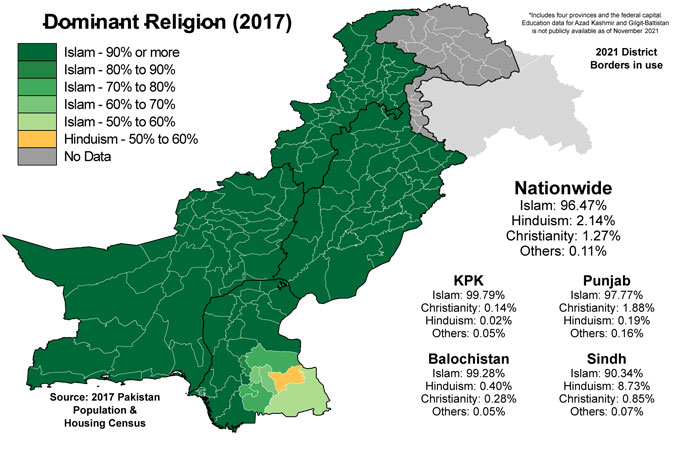
While Pakistan remains firmly committed to institutional reforms and values its dialogue with European monitoring bodies, the persistent focus on minority rights in these assessments requires a critical, data-driven response. The recurring narrative in Western reports often overlooks the broader structural reality of Pakistan’s religious demography and the state-backed infrastructure dedicated to protecting non-Muslim citizens.
In a country where 97% of the population identifies as Muslim, Pakistan has established an extensive infrastructural network to ensure that religious minorities can freely practice their faith, build community centers, and maintain places of worship. The structural ratio of worship spaces per capita for minority populations in Pakistan presents a striking contrast to the narratives popularized by international bodies:
8 Christian Community: Pakistan features 2189 active churches, translating to approximately 1 church for every 1206 Christian citizens.
8 Hindu Community: The country maintains 732 temples, providing 1 place of worship per 5669 Hindu citizens.
8 Sikh Community: There are 58 historic, fully operational gurdwaras, representing an exceptionally high ratio of 1 gurdwara per 159 Sikh citizens.
When placed alongside global figures, Pakistan’s domestic protection of religious infrastructure stands out favorably. For instance, while Pakistan maintains an architectural footprint of one church for every 1206 Christian citizens, major European states struggle with baseline institutional representation growing Muslim minorities. In the United Kingdom, for example, there is only one mosque for every 2249 Muslim residents. This comparison highlights a significant disparity in how religious infrastructure is supported and maintained between these regions.
Double Standards & Shrinking Religious Freedoms in the West
A core issue regarding the EU’s lecturing approach is the visible deterioration of religious freedoms within several EU member states. Countries currently struggling with their own systemic discrimination and minority rights records continue to criticize Pakistan.
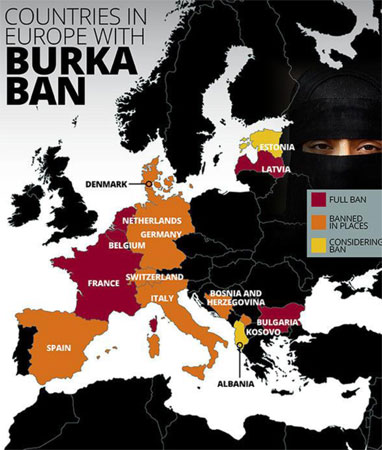
Over the past two decades, multiple European nations have implemented aggressive state regulations that directly target religious expressions, undercutting the very principles of pluralism they champion abroad.
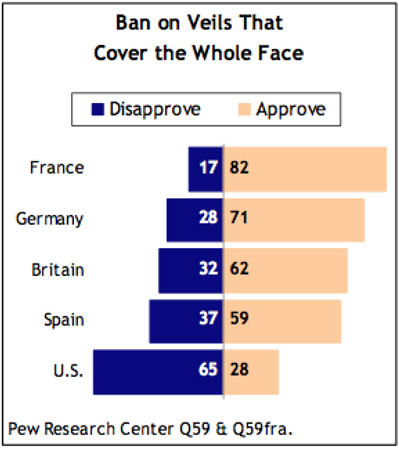
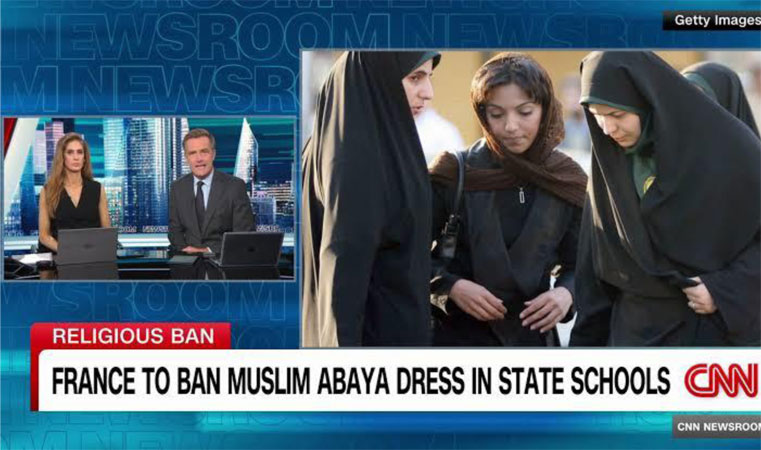
8 France: Introduced a series of restrictive laws, beginning with the 2004 ban on visible hijabs in public schools, followed by the 2011 nationwide ban on full-face veils in public spaces, and culminating in the 2023 prohibition of the abaya in schools
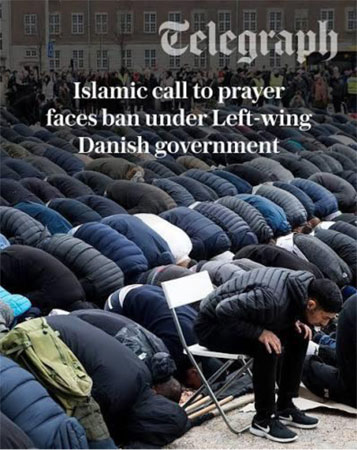
8 Belgium, Denmark & Austria: These nations have implemented sweeping public bans on face coverings, directly penalizing traditional Islamic garments and restricting personal clothing choices.
8 Switzerland & Netherlands: Both countries have codified legal frameworks that restrict religious attire and face coverings in public offices, transport systems, and academic facilities.
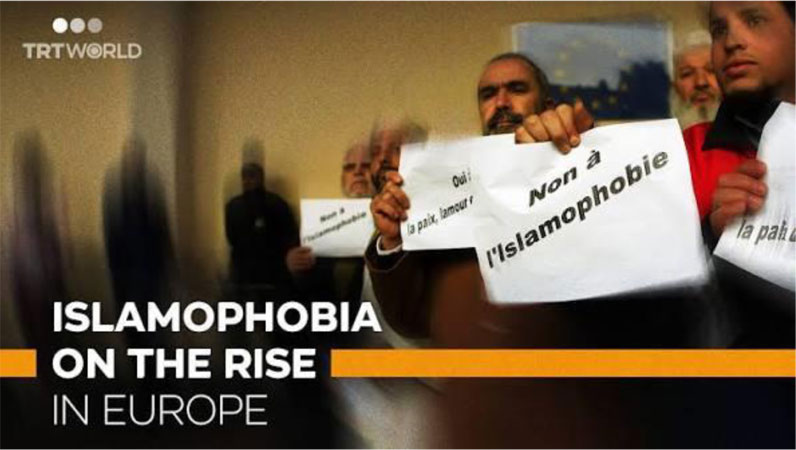
These legislative models illustrate a troubling trend of shrinking religious freedom and rising Islamophobia across Europe. Before questioning the constitutional architecture of developing partners like Pakistan, these self-described liberal states should focus on addressing the institutional intolerance within their own societies.
Role of Selective NGO Narratives
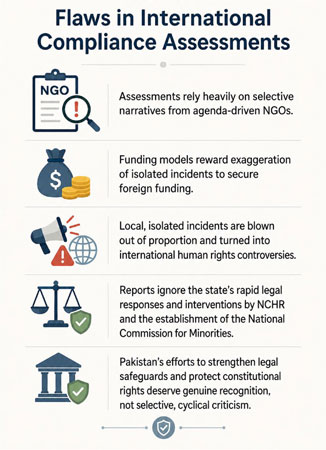
A major flaw in international compliance assessments is their heavy reliance on selective narratives provided by agenda-driven non-governmental organizations (NGOs). Many of these groups operate within a funding model that rewards the exaggeration of isolated incidents. By blowing local disputes or singular criminal cases out of proportion, these entities secure foreign funding at the expense of Pakistan’s international reputation.
These monitoring reports frequently turn local, isolated incidents into international human rights controversies. In doing so, they completely ignore the state’s rapid legal responses, the active interventions of the National Commission for Human Rights (NCHR), and the formal establishing of the National Commission for Minorities. Pakistan’s sustained efforts to strengthen legal safeguards and protect constitutional rights deserve genuine institutional recognition rather than selective, cyclical criticism.
Way Forward for Trade & Diplomacy
GSP+ framework remains a mutually beneficial arrangement. While it supports Pakistan’s industrial development, it also provides European consumers with competitive, high-quality manufacturing imports and helps the EU advance its global sustainability goals.
However, for this partnership to remain viable, it must be built on mutual respect and objective evaluationrather than unilateral lecturing. Future interactions should move away from selective NGO narratives and instead focus on measurable, institutional progress. Pakistan’s commitment to protecting its minority populations remains clear, and a fair-trade dialogue must recognize these domestic realities.