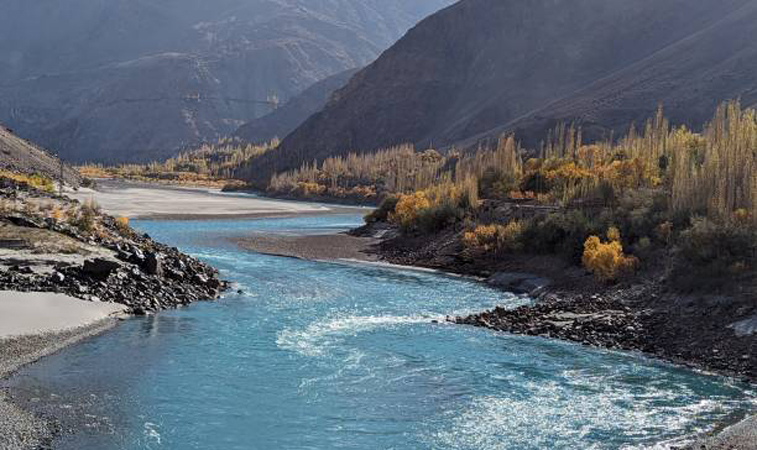
 As dawn breaks over the rugged mountains of Dasu in Upper Kohistan, a lone Kashmiri markhor carefully navigates a rocky cliff overlooking a valley carved by centuries of flowing water of River Indus.
The endangered wild goat, famed for its majestic spiral horns and remarkable agility, has long depended on the freshwater streams and alpine meadows sustained by the Indus river system.
Today, wildlife experts feared that this iconic species faces a growing threat of extinction not from poachers or predators alone, but from shrinking water resources linked to India’s violations of the Indus Waters Treaty (IWT).
For generations, the rivers of Indus, Jhelum, and Chenab have nourished not only millions of people but also the forests, grasslands, wetlands, aquatic resources and mountain habitats that support a rich diversity of wildlife.
Conservationists warned that any disruption in the natural flow of these western rivers could have far-reaching negative consequences for fragile ecosystems stretching from the Himalayas region of Kashmir to the plains of Punjab and northern hills Khyber Pakhtunkhwa.
“Without smoth flow of water, there is hardly any survival of wildlife and Markhor ,” said Dr. Muhammad Mumtaz Malik, former Chief Conservator of Wildlife, Khyber Pakhtunkhwa.
Standing among maps and wildlife surveys accumulated over decades of conservation work, he described water as the lifeline of Himalayan biodiversity, fisheries and wildlife.
“Water is essential for wildlife and biodiversity survival. Conservation efforts in KP, Azad Kashmir and Punjab will suffer immensely if western river flows decline amid IWT violations. The entire food chain depends on these freshwater systems,” he said.
High in the alpine meadows, the Kohistani markhor relies on vegetation sustained by seasonal streams and mountain springs.
According to Dr Mumtaz Malik, changes in water availability can alter plant growth, reduce grazing opportunities, and fragment habitats already under pressure from climate change.
As river systems become increasingly stressed, Dr. Malik warned that the markhor may face greater difficulty accessing food and water, particularly during prolonged dry periods.
Habitat degradation could accelerate Markhor population decline among species already struggling for survival in Kashmir region after IWT violations.
The concern extends far beyond a single species but entire biodiversity including migratory birds and trout fish.
KP and Azad Kashmir’s diverse landscape, ranging from subtropical forests to snow-covered peaks, provides refuge to some of South Asia’s most remarkable wildlife, including the snow leopard, Himalayan brown bear, musk deer, Himalayan goral, Eurasian lynx, pangolin, barking deer, and grey wolf.
Environmentalists feared that reduced river flows could trigger a chain reaction across these interconnected ecosystems.
Shrinking freshwater sources may affect breeding cycles, force wildlife migration, reduce vegetation cover, and weaken natural resilience against drought.
Along the banks of the Indus at Dasu and Dubair Valleys in Upper and Lower Kohistan districts, local fishermen and farmers spoke of their deep connection with the river. For many communities, water is not merely a resource rather it is a way of life. It irrigates crops, sustain livestock, supports fisheries, and nourishes forests that shelter wildlife.
“When there is no water, there are no habitats. And when habitats collapse, conservation programs collapse,” Dr. Malik emphasized.
He said the issue extends beyond wildlife conservation and poses wider ecological and human challenges.
“Wildlife and biodiversity keep ecosystems healthy and support sustainable agriculture and food security,” he said.
“Reduced water flow increases the risk of drought and desertification. That translates into hunger, poverty, and food insecurity for millions of people.”
Experts said Pakistan is already among the countries most vulnerable to climate change, facing erratic rainfall patterns, glacial melt fluctuations, and increasing environmental stress. They cautioned that additional pressure on river systems could worsen existing challenges, affecting agriculture, forests, pollinators, and wildlife alike.
Bird species such as the Himalayan monal, Himalayan snowcock, chukar partridge, and Eurasian eagle-owl may also face habitat degradation if freshwater ecosystems shrink.
“Water sustains the entire food chain,” Dr. Malik said. “Starvation at one level spreads throughout the ecosystem.”
Environmental and wildlife experts are urging international institutions, including the World Bank, which brokered the Indus Waters Treaty in 1960, to ensure compliance and safeguard ecological stability across the region. They have also called on global conservation organizations to pay greater attention to the potential environmental consequences of reduced river flows in the Himalayan ecosystem.
For villagers living along the riverbanks of Kohistan and Kolai Palas, the debate over water is deeply personal. Every stream, canal, and river channel represents livelihoods, food security, and the survival of future generations.
Conservationists stressed that environmental protection should rise above political disputes. As rivers descend from the Himalayas into the mountains of Kohistan and Azad Kashmir to fertile plains of Punjab, they carry more than water. They carry the hopes of communities, the survival of endangered wild species, and the ecological balance of an entire region.
If those waters diminish, experts warned, the silence that follows may be heard not only in the mountains of Kohistan and Kashmir where the Markhor roams, but across landscapes and communities that depend upon these rivers for life itself.