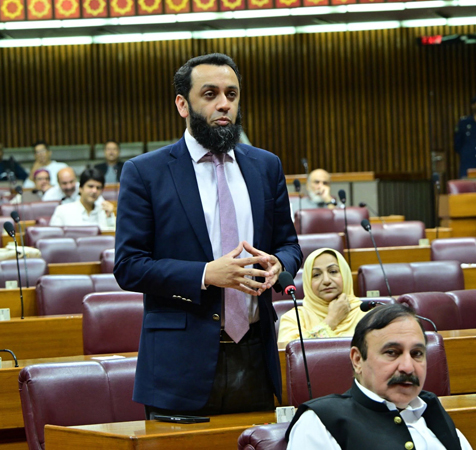
 As the PPP’s Azad Jammu and Kashmir (AJK) chapter on Sunday urged the region’s election commission to withdraw the election schedule for 12 refugee seats in the Legislative Assembly, Information Minister Ataullah Tarar called for a resolution to differences through democratic and constitutional means.
Ahead of the July 27 elections in AJK, the Joint Awami Action Committee (JAAC) had called for widespread protests demanding the abolition of 12 seats in the region’s Legislative Assembly reserved for refugees from Indian-occupied Jammu and Kashmir who settled in mainland Pakistan after 1947.
Elections for these seats are held separately from the 33 general seats in AJK, with refugees registered in 12 constituencies across Pakistan voting for their representatives. The seats have long been politically sensitive due to disputes over voter lists, delimitation, and constitutional amendments.
Information Minister Tarar while addressing the media outside Parliament House stressed that elections are the best way to achieve the public mandate in a democracy. “Azad Jammu and Kashmir is at the top of Pakistan’s priorities. Public welfare measures will continue in AJK,” he said. “The federation is committed to solving public problems and to the development of AJK,” he said, adding that the government had allocated significant financial resources in the upcoming budget for public facilities in AJK, including electricity.
“Decisions on matters of national interest and public welfare should be prioritised above politics,” he stated. “Everyone has the right to protest but taking the law into one’s own hands cannot be allowed,” he stressed. “No opinion can be imposed by force, peaceful protest is the right of every citizen. Differences should be resolved through dialogue.” The recent unrest and deadly clashes erupted in areas, including Rawalakot, where the newly proscribed Joint Awami Action Committee (JAAC) had been holding a sit-in outside the Combined Military Hospital Rawalakot.
The clash on Sunday came as the AJK government and the JAAC witnessed a face-off, as the election date for AJK was announced for July 27.
AJK’s 53-member legislative assembly includes 12 seats reserved for Kashmiri refugees – people who fled Indian-controlled Kashmir in 1947 and 1965 and are now scattered across Pakistan. Six seats represent refugees from the Jammu division (~434,000 people) and six from the Kashmir Valley (~30,000 people) – an already lopsided arrangement that many see as unfair.