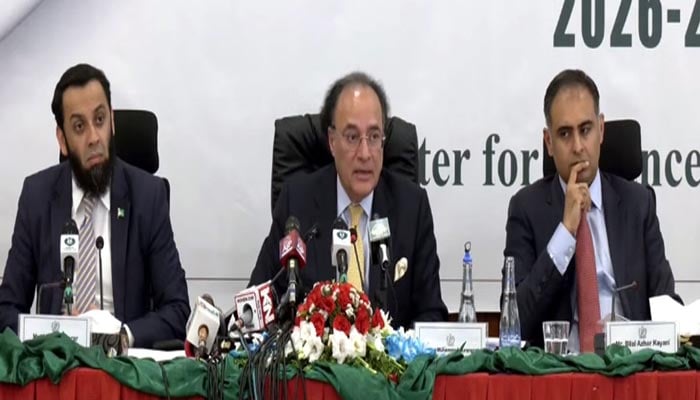
Finance Minister Muhammad Aurangzeb has said Pakistan’s economy is transitioning from a phase of stabilisation to growth, highlighting a series of fiscal, export and tax measures announced in the federal budget for 2026-27.
Speaking at a post-budget press conference in Islamabad, Aurangzeb said the government had utilized available fiscal space to support economic expansion while maintaining financial discipline. He stated that the country’s economic indicators had improved during the outgoing fiscal year and expressed confidence that the growth momentum would continue.
The finance minister said the government had introduced several initiatives to support export-led growth. These include an additional Rs70 billion subsidy package that will enable exporters to obtain financing at a reduced rate of 4.5 percent. He added that the super tax had been abolished for exporters and removed for businesses earning up to Rs500 million, while the advance tax had also been eliminated to improve the business environment.
Addressing the agriculture sector, Aurangzeb announced that customs duty, additional customs duty and regulatory duty on imported agricultural machinery had been reduced to zero. He noted that agricultural credit had surpassed Rs2 trillion after recording a 15 percent increase and assured that small farmers would not be required to mortgage their homes to access financing.
The minister also highlighted tax relief for salaried individuals. The lowest tax slab was reduced from 5 percent to 1 percent, while the 15 percent slab was lowered to 13 percent. He said the measures were designed to ease the burden on middle-income households.
Minister of State for Finance Bilal Azhar Kayani described the budget as people-centric, saying it provides support to salaried workers, industrialists, exporters and the construction sector.
Aurangzeb further announced plans to expand the tax base through a modern automated tax system, while emphasizing continued cooperation between the federal government and provinces to sustain economic reforms and long-term growth.