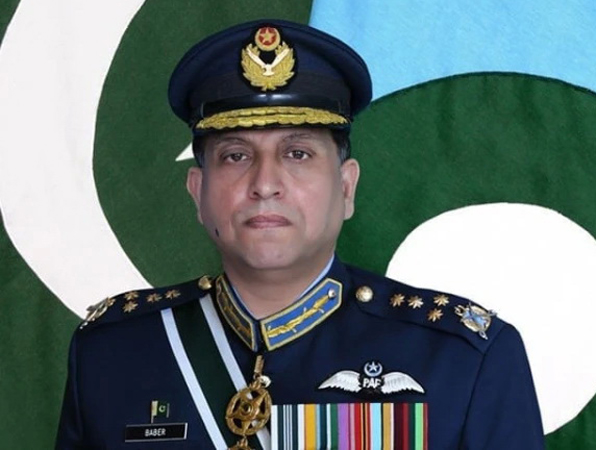
 Pakistan’s air chief said on Thursday the military launched cyberattacks targeting Indian communication hubs, power grids and transport infrastructure during the May 2025 conflict between the nuclear-armed neighbors, as he described a new model of cyber-enabled, multi-domain warfare.
The four-day conflict erupted after India blamed Pakistan-based militants for an April 22, 2025 attack in Pahalgam in Indian-Occupied Kashmir that killed 26 civilians, most of them tourists. Pakistan denied involvement and called for an independent investigation.
Tensions escalated rapidly after India launched cross-border strikes under “Operation Sindoor” on May 7, saying it had targeted militant infrastructure inside Pakistan and Pakistan-administered Kashmir. Pakistan said civilian areas were hit and responded days later with “Operation Bunyan-un-Marsoos,” targeting Indian military installations.
The fighting, involving missiles, drones, artillery exchanges and air operations, was the most serious confrontation between the two countries in decades before a US-backed ceasefire was announced on May 10, 2025.
“We have cyber force launches offensive targeting Indian communication hubs, power grids and transport infrastructure … causing massive power disruption in different Indian states and key military installation,” Air Chief Marshal Zaheer Ahmed Babar Sidhu said during a ceremony marking the first anniversary of what Pakistan calls “Marka-e-Haqq” (“Battle of Truth”). The air chief said the confrontation demonstrated the effectiveness of Pakistan’s military modernization and integration of cyber, electronic warfare and drone capabilities.
“What the world witnessed in May 2025 was not achieved overnight but acquired through our transformative modernization undertaken within the past four to five years,” he said. Sidhu said Pakistan had conducted what he described as a new form of integrated warfare. “For the first time in the history of air warfare, PF conducted full-spectrum, multi-domain operation,” he said. He also described the aerial confrontation as unprecedented in scale.
“What follows was the largest and longest B-Wear versus B-Wear engagement in the history of air combat,” he said, referring to beyond-visual-range aerial warfare.
According to the air chief, Pakistan Air Force aircraft including J-10 and F-16 fighters intercepted Indian strike formations while cyber and electronic warfare operations disrupted Indian military coordination.
“Pakistan Air Force valiant pilots started targeting enemy top-line fighter aircraft,” he said. “Within minutes, multiple Rafale jets, Su-30MKI, Mirage 2000, MiG-29 and multi-million-dollar unmanned systems were shut down.”
The Pakistani air chief also claimed Pakistan had targeted Indian military infrastructure using long-range strike systems and drones. “Our killer drones, hypersonic missiles and long-range weapons struck 16 enemy air bases within a span of about 8 to 10 hours,” he said. “Key military installation, BrahMos site, critical command and control center and two of its prized S-400 batteries was neutralized,” he said, referring to Indian missile infrastructure and Russian-made air defense systems.
Sidhu said Pakistan’s modernization drive had focused on rapid operationalization of advanced and locally developed technologies despite financial constraints. “We inducted and operationalized numerous advanced combat and combat support capabilities along with niche technology in a record time,” he said. “The smartly executed homegrown kill chain was developed under the ambit of newly established National Aerospace Science and Technology Park.”