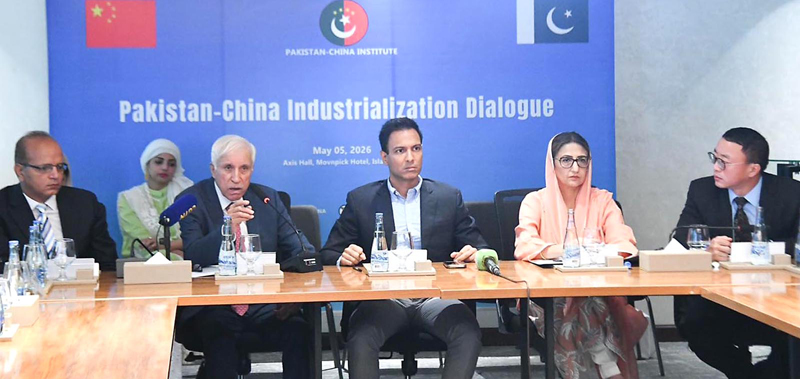
 Pakistan’s quest to attract over $8 billion in foreign direct investment (FDI) in Special Economic Zones (SEZs), and to generate 500,000 jobs between 2018 and 2024, remained well below the target, according to the investment minister.
As of 2025, only four SEZs have advanced beyond the planning stage with partial implementation, Investment Minister Qaiser Ahmed Sheikh said on Tuesday.
Speaking at the ‘Pakistan-China Industrialisation Dialogue’ in Islamabad, the minister explained that the four SEZs are located in Rashakai in Khyber Pakhtunkhwa, Allama Iqbal Industrial City in Punjab, Dhabeji in Sindh, and Bostan in Balochistan.”
“Under the China-Pakistan Economic Corridor (CPEC), nine SEZs were designated in the first phase, targeting sectors including food processing, ceramics, textiles, pharmaceuticals, and auto assembly, he added.
Sheikh emphasised that Pakistan is now entering a decisive phase of CPEC, shifting focus towards industrialisation, export-led growth, and enhanced business-to-business partnerships.
“Pakistan has immense potential, but we must transition from an import-driven economy to one that produces and exports value-added goods,” he remarked.
The minister added that the Joint Cooperation Committee (JCC), at its meeting in Beijing last September, had proposed government-to-government SEZs in Karachi and Islamabad, specifically targeting Chinese industrial relocation in electronics, textiles, pharmaceuticals and electric vehicles, addressing the industrial transfer gaps.
He stated that Pakistan has proposed government-to-government industrial parks targeting the relocation of Chinese manufacturing capacity in electronics, electric vehicles, pharmaceuticals, and textiles as China’s own industrial cost structure shifts upward.
The minister added that China has been Pakistan’s largest trading partner for twelve consecutive years.
However, China’s exports to Pakistan rose from $16.67bn in 2023 to $20bn in 2024, a 17.7 per cent year-on-year increase, while Pakistan’s exports to China remained about $3bn annually against China’s total annual imports of $2 trillion. The resulting bilateral trade deficit reflects a structural asymmetry, the investment minister elaborated.
Pakistan exports predominantly primary commodities like cotton, seafood and gum resins, while importing capital goods, machinery, organic chemicals, and electronics from China.
The first phase of the China-Pakistan Free Trade Agreement (CPFTA), which has been in force since 2007, increased bilateral trade by 242pc between 2007 and 2018, but Pakistan’s trade deficit with China simultaneously rose from 25pc to 35pc of bilateral trade, reaching $13bn.
The second phase of CPEC, focusing on the industrialisation agenda, aims to close this export gap through value-added manufacturing for re-export to the Chinese market, Sheikh said.
The investment minister also said that CPEC, originally valued at $46bn at inception in 2015, expanded to $62bn by 2020 and $65bn by 2022, making it China’s single largest overseas investment and Pakistan’s largest inbound investment since independence.
As per the latest factsheet, CPEC has cumulatively attracted $30bn in realised investment across energy, transport, and industrial sectors, and directly created over 261,000 jobs, he added.
CPEC has directly produced over 261,000 jobs since 2015, with the 1,320MW Port Qasim coal power project alone creating over 5,000 direct local jobs and the Sahiwal coal power plant generating over 3,770 direct positions.
Additionally, the CPEC Consortium of Universities now comprises 130 member institutions across both countries, supporting higher education linkages and joint research capacity. Beijing and Islamabad have also established vocational training infrastructure, directly targeting skills gaps in the industrial workforce.
Sheikh said the focus is on labour-intensive manufacturing in textiles, electronics assembly and light engineering, which are estimated to have the potential to generate 500,000 formal jobs within the CPEC framework by 2030.
He added that Pakistan’s internet penetration grew from 11pc in 2015 to 54pc by 2024, creating a foundation for digital-industrial integration.
“CPEC’s commerce value grew from $4.8bn in 2015 to $16bn in 2023, and with the second phase fully operationalised, projections suggest Pakistan’s industrial export capability could increase by 20pc, provided that SEZ governance, security infrastructure, and regulatory frameworks are brought to investment-grade standards,” he outlined.
Referring to the Mainline-1 (ML-1) project, Sheikh stated it would benefit the industrial sector by reducing freight transit time between Karachi port and inland manufacturing centres by an estimated 40pc, lowering logistics costs that currently consume a disproportionate share of Pakistani manufacturers’ operating expenses.
“The project has faced financing realignments, with Pakistan exploring ADB (Asian Development Bank) co-financing for some segments previously designated for Chinese concessional loans, reflecting the broader need to diversify CPEC’s financing architecture as the second phase advances,” he said.
Participating in the dialogue, Counsellor Yang Guangyuan from the Chinese embassy underscored the vast potential for bilateral cooperation across multiple sectors, including agriculture, information technology, pharmaceuticals, and manufacturing.