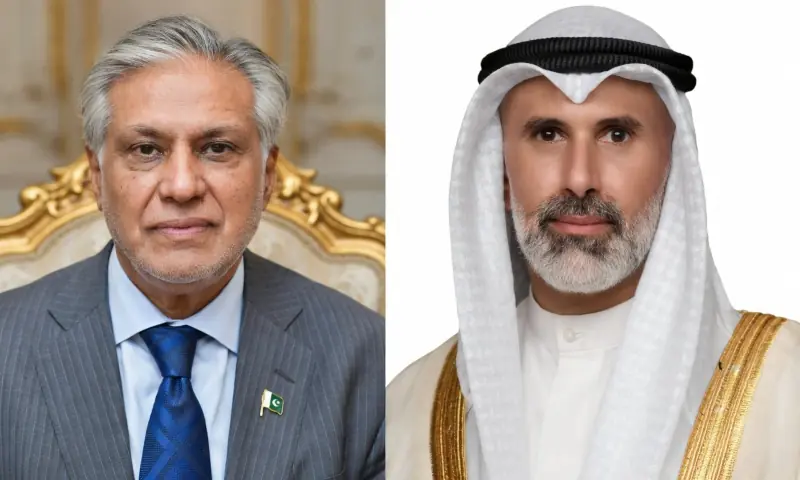
Deputy Prime Minister and Foreign Minister Ishaq Dar held discussions with Kuwait’s Foreign Minister Sheikh Jarrah Jaber Al-Ahmad Al-Sabah on the evolving situation in the Middle East and its potential economic consequences, according to Pakistan’s Foreign Office.
Read More: Muslim countries condemn Iran’s attacks, urge de-escalation
In an official statement, the Foreign Office said both leaders exchanged views on regional developments and reviewed the broader economic implications arising from ongoing instability in the Middle East. The conversation focused on the importance of diplomacy, regional peace, and continued engagement to address growing tensions.
DPM/ FM Senator Mohammad Ishaq Dar @MIshaqDar50 spoke today with the Foreign Minister of Kuwait, Sheikh Jarrah Jaber Al-Ahmad Al-Sabah.
The two leaders discussed the evolving regional situation and exchanged views on its wider economic implications.
DPM/FM underscored… pic.twitter.com/U9xYLhvG5U
— Ministry of Foreign Affairs – Pakistan (@ForeignOfficePk) May 2, 2026
During the call, Ishaq Dar highlighted Pakistan’s ongoing efforts to promote constructive dialogue and diplomatic engagement in support of peace and stability across the region and beyond. He reiterated Islamabad’s position that peaceful negotiations remain essential for addressing complex regional disputes.
According to the statement, Kuwait’s foreign minister appreciated Pakistan’s diplomatic initiatives and acknowledged its efforts to encourage lasting peace and security for the Muslim world as well as the wider international community.
Both sides also reaffirmed the strong bilateral relationship between Pakistan and Kuwait, describing ties as rooted in mutual respect, cooperation, and shared regional interests. Officials agreed to remain in close coordination on developments affecting the region.
The discussion comes amid heightened tensions linked to the ongoing crisis in the Strait of Hormuz, a strategically important global shipping route affected by recent conflict and security challenges. Continued disruptions in the area have raised concerns over energy supplies, shipping activity, and broader economic stability.
Global institutions have warned that prolonged instability in the region could have serious international consequences, including pressure on oil prices, trade flows, and inflation.
Pakistan has recently played an active diplomatic role in regional dialogue efforts and has repeatedly emphasized negotiations as the preferred path for resolving conflicts. Officials say Islamabad remains committed to facilitating constructive engagement where possible.
Read More: Middle East tensions disrupt Pakistan’s sea trade
Analysts note that Pakistan’s consultations with regional partners reflect growing concern over the economic impact of instability in the Middle East, particularly for energy-importing countries and trade-dependent economies.