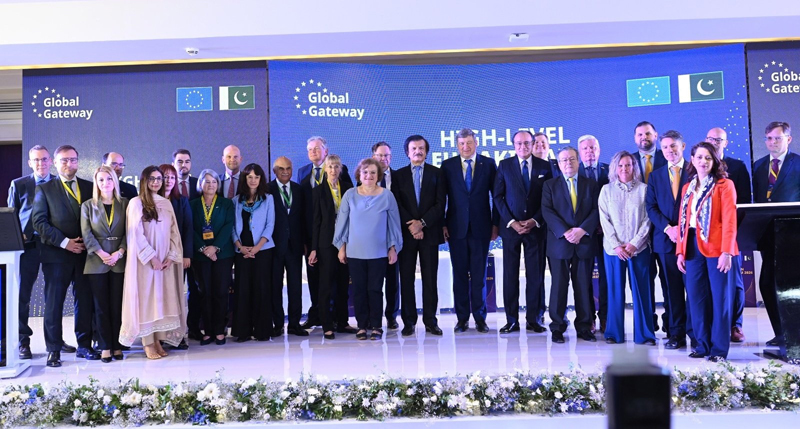
 The European Union, in collaboration with the Government of Pakistan, today inaugurated the first-ever “High-Level EU-Pakistan Business Forum” in Islamabad, marking an important milestone in strengthening bilateral economic relations.
The Forum brings together around 1000 senior policymakers, European and Pakistani business leaders, investors and financial institutions. With the EU being the largest single market in the world, a leading exporter of outward Foreign Direct Investment globally and Pakistan’s number one export destination, the Forum represents a significant opportunity to further the EU-Pakistan economic partnership. It aims to turn strong trade ties into increased investment flows, technology partnerships, greater innovation, and sustainable industrial growth.
The European Union Ambassador to Pakistan, H.E. Raimundas Karobolis, opened the Forum, stating: “The European Union enjoys strong economic relations with Pakistan. It is a source of pride for me to say, that the European Union is the top export destination for Pakistan.
The purpose of the forum is not just to celebrate our trade relations, but to deepen, diversify, “green,” and transform them into long-lasting investments. Through this, our mutual prosperity will thrive.”
Speaking at the EU-Pakistan Business Forum in Islamabad, Aurangzeb outlined what he described as a broad economic turnaround driven by fiscal consolidation, current account surpluses, export growth and structural reforms aimed at attracting foreign investment.
Pakistan has been attempting to stabilize its economy under a $7 billion International Monetary Fund (IMF) program after years of high inflation, dwindling reserves and balance-of-payments pressures. The government is now seeking to shift the narrative from crisis management to investment and long-term growth, particularly as it courts international investors at a time of global economic uncertainty.
“We are quite clear that our reserves are going to be at $18 billion at the end of June,” Aurangzeb said.
He said Pakistan’s economy was expected to grow by around 4 percent in the current fiscal year, up from 3.1 percent a year earlier, while the country had also recorded a current account surplus during the first nine months of the fiscal year.
Aurangzeb said remittances remained strong and information technology exports were continuing to support external accounts, alongside gains in higher value-added exports.
The minister also pointed to lower debt servicing costs despite the State Bank of Pakistan’s decision this week to raise interest rates by 100 basis points to 11.5 percent in response to inflation risks linked partly to higher global energy prices.
Much of Aurangzeb’s address focused on structural reforms aimed at improving competitiveness and reassuring foreign investors about Pakistan’s business environment.
He said the government had reduced tariffs and duties on intermediate goods and raw materials to help make local industries more export competitive.
“We said we are going to bring down our tariff regime… so that our industry actually gets competitive,” he said.
Aurangzeb also reiterated the government’s commitment to privatization, saying Pakistan was moving ahead with plans involving airports, electricity distribution companies and state-owned enterprises following renewed momentum in the privatization of the national airline, Pakistan International Airlines.
“The private sector has to lead the country,” he said.
The minister said Pakistan had also returned to international debt markets after a four-year gap and was in the final stages of launching its inaugural Panda bond, a yuan-denominated bond issued in China’s domestic market, and expected the issuance to be completed by mid-May if all went according to plan.
Toward the end of his remarks, Aurangzeb highlighted Pakistan’s growing crypto economy, saying authorities had moved to regulate the sector after discovering the scale of digital asset usage in the country.
“We had 40 million crypto users in Pakistan,” he said, adding that the government was now in advanced stages of issuing licenses under a new regulatory framework.
Aurangzeb framed the reforms as part of a broader economic transformation, saying international institutions had compared Pakistan’s current trajectory to the early stages of Southeast Asia’s export-led growth.
“This can very well be our South Asia moment,” he said.
Haroon Akhtar, Special Assistant to the Prime Minister for Industries and Production Division delivered a keynote address at the inaugural session.
The opening session also marked the launch of the EU-Pakistan Business Network, which brings together more than 300 EU companies active in Pakistan. The Network aims to serve as a collective voice of EU businesses in the country, facilitating dialogue with policymakers and supporting new European companies exploring opportunities in Pakistan.
The opportunities emanating from the EU’s Global Gateway initiative, the EU’s largest investment program outside of the EU which aims to mobilise and de-risk 400 billion EUR of investments in the period 2021-2027 – were presented in a dedicated plenary session with Mr Peteris Ustubs, Director for Asia and the Pacific at the Directorate-General for International Partnerships,European Commission ; Ms Thouraya Triki, Director at the *European Investment Bank ; and Mr Hans Bogaard, Director of Agribusiness, Food and Forestry at FMO, (the Entrepreneurial Development Bank from the Netherlands).
Discussions throughout the day focused on opportunities and challenges in priority sectors such as agribusiness, digital innovation and fintech, green logistics, sustainable textiles, and responsible mining.
Throughout the two-day Forum more than 600 B2B meetings are scheduled reflecting strong interest from both European and Pakistani companies in forming joint ventures and partnerships.
New financial programmes and partnerships are also expected to be signed during the Forum.
The event provides a structured platform for high-level dialogue and deal-making between a combined economy of over 700 million people.