
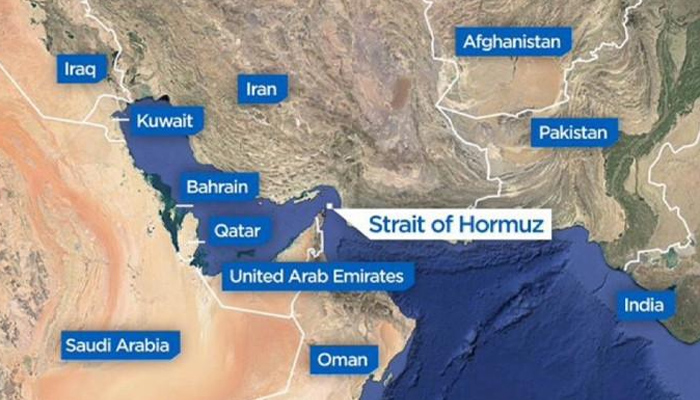
 The blockade over an artery responsible for one-fifth of the global oil traffic began with a warning crackling over the radio: “Do not attempt to breach the blockade. Vessels will be boarded for interdiction and seizure…Turn around or prepare to be boarded. If you do not comply…we will use force.” The message, posted by US Central Command on X, was directed at ships approaching Iranian ports and underscored the dramatic escalation that has turned the Strait of Hormuz into the world’s most fraught waterway.
In the first 48 hours, the US Navy said it turned back more than a dozen oil tankers, and none managed to get through.
The war’s loudest images may still come from the Gulf, from warships, blocked lanes and threats carried over the airwaves, yet the real centre of gravity has shifted east. After the first direct senior-level US-Iran talks since 1979 were held in Islamabad last week, Washington and Tehran left without a final deal, all the while leaving the door open to further contact, and keeping Pakistan in the middle of the process.
President Donald Trump insists that the war with Iran is “very close to over,” albeit warning that Washington is “locked and loaded” if Tehran refuses a deal. The White House has said another round could again happen in Pakistan, even as Islamabad says no date has yet been fixed. Referring to Hotel Serena, which hosted the first round of talks on April 11, Trump hinted at a return to the same location while speaking to the New York Post on Tuesday, “You should stay there… something could be happening over the next two days, and we’re more inclined to go there,” he said.
His press statements considerably explain how Pakistan’s role has expanded.
Senior Fellow for South Asia at the Atlantic Council, Michael Kugelman, captured the distance travelled when he wrote: “We’ve come a loooong way from Trump’s ‘all they’ve given us are lies and deceit’ New Year’s Day tweet in 2018.” A relationship once defined by public hostility has now circled back to negotiation, and that negotiation has found a venue in Islamabad.
The numbers hint at the scale of the crisis. Iran’s forensics chief said more than 3,300 people have been killed in Iran since US-Israeli strikes began on 28 February. Thirteen US servicemembers have been killed so far, and 395 have been injured in the wake of Operation Epic Fury. Relentless strikes continue in Southern Lebanon, where air raids and shelling hit Kafr Sir and Nabatieh, and a triple?tap attack on Mayfadoun killed four paramedics, prompting Lebanon’s minister for administrative reform to call it “a new war crime.”
Across the water, the conflict reverberates through global markets. Oil prices climbed more than 1% as traders weighed whether peace talks could open the strait again. Shortages are pushing refined fuels into the spot market and driving up costs. The World Bank’s chief economist warns that the war’s economic ripple could push 300 million more people toward acute food insecurity. Markets may stabilise under $100 a barrel, yet hunger statistics do not wait for closing bells.
Leading authority on Iran and the Middle East, Vali Nasr, put it more bluntly. “Saudi Arabia is voicing a broader international concern that the US blockade is a dangerous escalation. It further closes all trade in the Persian Gulf, could lead to more violent conflict there, but also lead to disruption of trade in the Red Sea. It could bring the global economy to its knees before it does Iran, especially since Trump is still asking for surrender rather than a deal.”
Diplomacy is now a race against an expiring ceasefire. The truce brokered in Islamabad on 8 April ends next week, and the parties remain far apart on core issues. Army Chief Asim Munir flew to Tehran on Wednesday carrying plans to coordinate a second round of US-Iran talks, accompanied by Interior Minister Mohsin Naqvi, while Prime Minister Shehbaz Sharif has embarked on a high-level whirlwind diplomatic tour. Pakistani officials say the urgency stems from the looming ceasefire expiry and hope to secure an extension.
According to Osama Bin Javed of Al Jazeera, the outreach reflects a “double-pronged strategy,” one that involves taking regional allies into confidence while sustaining direct engagement with Tehran. That effort was visible in Islamabad itself, where key diplomatic alignments were being quietly shaped ahead of high-level engagements, including coordination with Gulf leadership.
US President Trump publicly credited CDF Munir for doing “a great job,” as he thanked the people and leadership of Pakistan for helping facilitate negotiations. White House Press Secretary Karoline Leavitt has gone further, describing Pakistan as “the only mediator in this negotiation.” “While there have been many countries around the world who want to offer their help, the President [Donald Trump] feels it’s important to continue to streamline this communication through the Pakistanis,” she added. Similarly, Iran’s Ambassador to Pakistan Reza Amiri Moghadam claimed on Thursday that Islamabad remains the only venue for talks with the United States, adding that “we only trust Pakistan,” while speaking at an event in the capital.
The country that has long been treated as a pawn in great?power games is suddenly at the centre of global diplomacy.
Yet the blockade remains–a naval cordon around Iranian ports that the US says has “completely halted economic trade going into and out of Iran by sea.” Iran warns it will block shipping in the Persian Gulf, the Sea of Oman and the Red Sea if the blockade continues. China’s foreign minister has, however, told his Iranian counterpart that freedom of navigation through the strait must resume and that the moment marks a “critical juncture between war and peace.”
Pakistani officials privately acknowledge that detractors exist on all sides–in Tehran, in Washington, and especially in Israel–and that resistance to compromise remains strong. That is expected. Peace processes rarely fail because they lack opportunity. They fail because they run out of space.
Reuters reports that negotiators, recognising the gulf between them, are seeking a temporary memorandum rather than a comprehensive deal. The biggest rift concerns Tehran’s stockpile of highly enriched uranium and how long Iran must halt enrichment. Proposals include sending part of the material to a third country for medical use. This, some say, is hard bargaining with a ticking clock.
Inside the United States, the politics are shifting. A majority of Senate Democrats recently backed resolutions to block arms sales to Israel, signalling growing unease about providing offensive weapons without guardrails. However, even as they blocked the fourth Senate attempt to limit Trump’s war authority in Iran, Republicans worry that the war is approaching the 60?day mark after which the War Powers Resolution requires congressional approval.
Meanwhile, former US Secretary of State John Kerry even argues that Trump’s decision to blockade the strait could bring Tehran back to the negotiating table. That claim drew immediate pushback, with critics warning that blockades invite escalation and chief among the lessons of modern history is that economic strangulation breeds nationalism.